


For more than two decades, Microsoft's software and Intel's processors were so wedded that the pairing came to be known as Wintel. But as that computing era wanes, Microsoft is turning to a new source of chip design: its own labs.
The design effort will initially be split between research labs at the company's headquarters in Redmond, Washington, and its Silicon Valley campus here. Tentatively named the Computer Architecture Group, the project underscores sweeping changes in the industry.
One reason for the effort is that Microsoft needs to begin thinking about the next-generation design of its Xbox game console, said Charles Thacker, a veteran engineer and Microsoft engineer who will head the Silicon Valley group. Voice recognition may also be an area where the research could play a significant role.
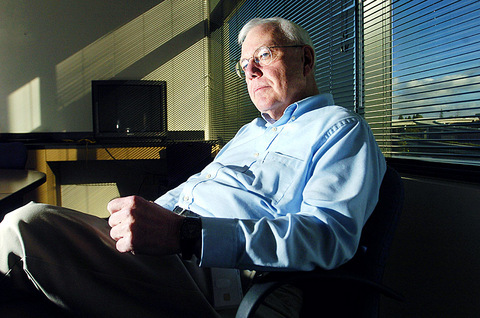
PHOTO: THE NEW YORK TIMES
"Voice is big," Thacker said. "You can throw as much technology at it as you want to."
Microsoft is exploring hardware design now in part because of a new set of tools that will make it possible to test ideas quickly, he said. The researchers will employ a system designed by researchers at the University of California, Berkeley, that makes it possible to reconfigure computer designs without the cost of making finished chips.
"We are at an inflection point in the industry," he said. "Our friends say computers are not going to get faster, we're just going to get more of them."
As shrinking transistor sizes make it possible for designers to put multiple processors on a single chip, and computing functions are increasingly hidden in consumer devices, Microsoft faces new challenges and opportunities.
In recent years, the computing model centered on the desktop PC has increasingly given way to new, more specialized markets like video games and cellphones. As Microsoft has moved to enter these markets, it has increasingly designed hardware, software and packaging that are made by independent contractors but marketed under the Microsoft or Windows brand.
At the same time, new coalitions have emerged, like Apple's decision to use Intel microprocessors, or Microsoft's switch two years ago from Intel chips to PowerPC microprocessors designed and manufactured by IBM in its Xbox system.
The explosion of chips with an increasing number of "cores," or multiple processors, is bringing parallel computing -- the ability to divide tasks for faster processing -- into the consumer electronics market. That could give companies like Microsoft a competitive advantage by controlling both hardware and software and the way they interact.
"This is a historic time in the computer industry," said David Patterson, a computer scientist at the University of California, Berkeley. "We're in the middle of a revolutionary change toward parallel computing that will absolutely involve both hardware and software."


RESILIENCE: Taiwan plays a key role in semiconductors, energy, information infrastructure and advanced manufacturing, AIT Director Raymond Greene said Taiwan’s continued investment in deterrence and resilience remains vital, especially in uncrewed systems and other emerging technologies, American Institute in Taiwan (AIT) Director Raymond Greene said yesterday. Greene made the remarks at the annual National Strategic Summit on Supply Chain Resilience held by the Research Institute for Democracy, Society and Emerging Technology (DSET), a government-backed think tank. As Taiwan last year became the US’ fourth-largest trading partner and supply chain security is becoming more important, cooperation in emerging technologies continues to deepen between the two countries, he said. The US is committed to accelerating innovation, building key infrastructure, strengthening cooperation

The National Chungshan Institute of Science and Technology yesterday showcased its locally developed variants of the Vision 60 robotic patrol dog, which it plans to deploy on the nation’s outlying territories in the South China Sea. The variants were produced under the Joint Lab project — created by the institute and domestic companies — and assembled with domestically produced motors, lenses and artificial intelligence (AI) systems alongside licensed tech from the US, Missile and Rocket Systems Research Division deputy director Jen Kuo-kang (任國光) told the media event at a military base in Taipei’s Dazhi (大直) area. Taiwan has built up its strengths

RIGHT DIRECTION: Taiwan’s efforts to prevent forced labor include a proposal to ‘fully prohibit’ employers from withholding workers’ documents, an official said Taiwan is to establish a mechanism to restrict imports of goods linked to forced labor, the Executive Yuan said yesterday, after the US proposed imposing additional tariffs on Taiwanese goods over labor concerns. “The Ministry of Labor and the Ministry of Economic Affairs are to establish an interministerial review procedure,” Executive Yuan spokesperson Michelle Lee (李慧芝) said at a news briefing in Taipei. “The government is to use the Foreign Trade Act [貿易法] as the legal basis to restrict imports of goods produced with forced labor” and bring its supply chain governance more in line with international standards on human rights, resilience

NOT IMMEDIATE: Taiwan has a chance to appeal the proposed 10 percent tariff before it starts, while other countries face a 12.5 percent tariff from the trade office Taiwan is among 60 economies determined by the US to have failed to impose or enforce a ban on the importation of goods produced with forced labor, according to a notice released on Tuesday by the Office of the US Trade Representative (USTR), which proposed imposing an additional 10 percent or more tariff on them. The USTR in a statement said that following an investigation, it had determined under Section 301 of the Trade Act of 1974 that the failure of the 60 economies to impose and effectively enforce a prohibition on the importation of goods produced with forced labor is


 RSS
RSS