


Australian telecoms giant Telstra yesterday launched a new 3G mobile broadband network as the firm moves to bolster investor confidence ahead of a troubled share sale.
The company's chief executive, Sol Trujillo, claimed the world's geographically largest national 3G network would offer wireless mobile and Internet access to 98 percent of the people of sparsely-populated Australia.
The "turbo-charged" service, which boasts a beefed up third generation (3G) mobile technology, was five times faster than any other network in the country and would offer its users 12 channels of television, sport and movie downloads.
"You see this is the day ... that life in Australia will be changed forever," said Trujillo of the network, put in place with an investment of A$1 billion (US$746 million) in little more than 10 months.
"This is an exciting day for all Australians, no matter where they live and work," he boasted.
"It is a versatile, high capacity network with headroom for higher speeds in the months and years ahead," said Trujillo, who is at the center of an increasingly bitter war of words over his management style with the Australian government, which holds a 51.8 percent stake in the telecoms firm.
Telstra customers will be able to download material at an average speed of 550 kilobytes to 1.5 megabytes per second (Mbps), with peak network speeds reaching up to 3.6Mbps, increasing to 14.4Mbps early next year.
Telstra's 3G customers, which currently number approximately 420,000 compared to rival Hutchinson's 1 million, will have to buy new handsets which it has been developing in conjunction with Samsung, Motorola, LG and Sony Ericsson.
"From today, almost every Australian is going to have access to nationwide, very high speed mobiles and Internet," Telstra group managing director consumer and small business David Moffatt said.
But the glitzy investor briefing strategy at which the plans for the network were unveiled was rudely interrupted when a fire sprinkler activated in the room, sending hundreds of analysts scrambling for cover.
As Telstra touted its new broadband mobile network, analysts also poured more cold water on the significance of the announcement, especially as Australia lags far behind in its fixed broadband infrastructure.
"I'm very sorry but this is a load of rubbish, it's just another network -- nobody's going to use it for watching television services," media analyst Paul Budde of the Web site Budd.com said.
While the technology is good, it is not what Australia really needs and it remains unclear whether the user rates would be affordable for a significant proportion of the population, according to Budde.
Also at the investors' conference on its five-year transformation program, which began nearly a year ago, Telstra forecast 1.5 to 2 percent revenue growth next year, with earnings before interest and tax to rise 2 percent to 4 percent.
The network launch came ahead of the government's unveiling on Monday of the prospectus for the sale of A$8 billion worth of stock, or one-third of its holding, in Telstra.
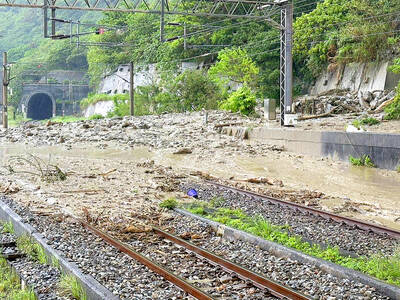
ROLLER-COASTER RIDE: More than five earthquakes ranging from magnitude 4.4 to 5.5 on the Richter scale shook eastern Taiwan in rapid succession yesterday afternoon Back-to-back weather fronts are forecast to hit Taiwan this week, resulting in rain across the nation in the coming days, the Central Weather Administration said yesterday, as it also warned residents in mountainous regions to be wary of landslides and rockfalls. As the first front approached, sporadic rainfall began in central and northern parts of Taiwan yesterday, the agency said, adding that rain is forecast to intensify in those regions today, while brief showers would also affect other parts of the nation. A second weather system is forecast to arrive on Thursday, bringing additional rain to the whole nation until Sunday, it

LANDSLIDES POSSIBLE: The agency advised the public to avoid visiting mountainous regions due to more expected aftershocks and rainfall from a series of weather fronts A series of earthquakes over the past few days were likely aftershocks of the April 3 earthquake in Hualien County, with further aftershocks to be expected for up to a year, the Central Weather Administration (CWA) said yesterday. Based on the nation’s experience after the quake on Sept. 21, 1999, more aftershocks are possible over the next six months to a year, the agency said. A total of 103 earthquakes of magnitude 4 on the local magnitude scale or higher hit Hualien County from 5:08pm on Monday to 10:27am yesterday, with 27 of them exceeding magnitude 5. They included two, of magnitude
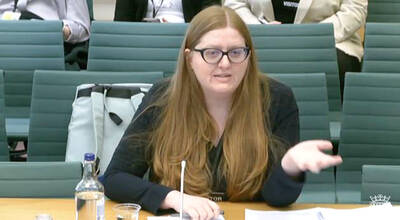
CONDITIONAL: The PRC imposes secret requirements that the funding it provides cannot be spent in states with diplomatic relations with Taiwan, Emma Reilly said China has been bribing UN officials to obtain “special benefits” and to block funding from countries that have diplomatic ties with Taiwan, a former UN employee told the British House of Commons on Tuesday. At a House of Commons Foreign Affairs Committee hearing into “international relations within the multilateral system,” former Office of the UN High Commissioner for Human Rights (OHCHR) employee Emma Reilly said in a written statement that “Beijing paid bribes to the two successive Presidents of the [UN] General Assembly” during the two-year negotiation of the Sustainable Development Goals. Another way China exercises influence within the UN Secretariat is

Taiwan’s first drag queen to compete on the internationally acclaimed RuPaul’s Drag Race, Nymphia Wind (妮妃雅), was on Friday crowned the “Next Drag Superstar.” Dressed in a sparkling banana dress, Nymphia Wind swept onto the stage for the final, and stole the show. “Taiwan this is for you,” she said right after show host RuPaul announced her as the winner. “To those who feel like they don’t belong, just remember to live fearlessly and to live their truth,” she said on stage. One of the frontrunners for the past 15 episodes, the 28-year-old breezed through to the final after weeks of showcasing her unique


 RSS
RSS