


Japan's Sony Corp, scrambling to contain the fallout from widening defective battery problems, launched a global replacement program after China's Lenovo Group Ltd (
Sony will offer to replace certain battery packs for notebook computers in response to concerns over recent overheating incidents, the Japanese electronics giant announced in the US late on Thursday.
"This is a program to ease the worries of computer makers and consumers," said Sony spokesman Takashi Uehara in Tokyo.
"This is not a compulsory recall," he said, adding it was not yet clear how many laptop computer batteries might be returned.
Fujitsu spokesman Masao Sakamoto said yesterday that the company will decide soon on a recall on laptops using Sony-made batteries. The program could develop into the largest-ever recall of computer batteries by any company, according to Japanese media.
Analysts said it was hard to quantify the potential magnitude and cost of the problem but believed it so far looked manageable for Sony, which has recently rebounded under a major restructuring plan.
"The number of recalls is difficult to estimate now and there is the question of how many customers will replace batteries without any problems," said Tatsuya Mizuho, a director at the credit rating agency Fitch Ratings.
In the latest recall Lenovo, which took over IBM Corp's ThinkPad personal computer unit last year, said on Thursday that about 526,000 lithium-ion batteries made by Sony were susceptible to overheating and would be replaced free of charge.
The recall was announced with the US Consumer Product Safety Commission two weeks after a laptop overheated and caught fire as its owner was about to take a flight from Los Angeles International airport.
It was the fourth recall in recent months involving Sony batteries believed to be defective. Last month Dell Inc asked customers to return 4.1 million faulty laptop batteries and Apple Computer Inc recalled 1.8 million batteries worldwide, warning they could catch fire.
Last week, Toshiba Corp said it was recalling 340,000 laptop batteries due to a problem that caused the laptops to sometimes run out of power.
Sony last month announced it would incur costs of up to US$257 million for recalls of millions of its batteries by Apple and Dell.
"This level of cost would not be a serious concern to Sony, although it is a significant amount," said Mizuho at Fitch Ratings.
"But if the extent of the problems expands further, it would invite worries over Sony's technology and brand image," he added.
The massive battery recall has hit Sony just as a restructuring drive had appeared to be paying off after a weak patch at the iconic Japanese company that created the Walkman.
There is also concern about prospects for two of the group's pivotal new products -- the PlayStation 3 (PS3) game console and the Blu-ray high-definition DVD player.
Sony was forced to delay the global launch of the PS3 by six months until this November.
Earlier this month it pushed back the rollout in Europe, Russia, the Middle East, Africa and Australasia again, until March, because of technical problems with the Blu-ray player, which has been built into the PS3.

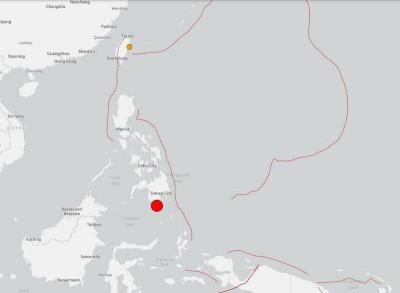
A magnitude 7.8 earthquake struck off the southern coast of Mindanao in the Philippines at 7:38am today, prompting the US Tsunami Warning System to issue an alert for neighboring countries, including Taiwan. The system issued a purple alert indicating a "tsunami threat." The potential threat zone includes Taiwan, the Philippines, Papua New Guinea, Yap and Palau. Philippine authorities were assessing the damage from the quake, with the office of civil defense seeking to verifying initial reports that 15 people had been killed and 129 injured in the region, mostly from falling debris. Arlene Hollero, disaster chief of Maasim town in the Philippines' Sarangani Province,

RESILIENCE: Taiwan plays a key role in semiconductors, energy, information infrastructure and advanced manufacturing, AIT Director Raymond Greene said Taiwan’s continued investment in deterrence and resilience remains vital, especially in uncrewed systems and other emerging technologies, American Institute in Taiwan (AIT) Director Raymond Greene said yesterday. Greene made the remarks at the annual National Strategic Summit on Supply Chain Resilience held by the Research Institute for Democracy, Society and Emerging Technology (DSET), a government-backed think tank. As Taiwan last year became the US’ fourth-largest trading partner and supply chain security is becoming more important, cooperation in emerging technologies continues to deepen between the two countries, he said. The US is committed to accelerating innovation, building key infrastructure, strengthening cooperation

The National Chungshan Institute of Science and Technology yesterday showcased its locally developed variants of the Vision 60 robotic patrol dog, which it plans to deploy on the nation’s outlying territories in the South China Sea. The variants were produced under the Joint Lab project — created by the institute and domestic companies — and assembled with domestically produced motors, lenses and artificial intelligence (AI) systems alongside licensed tech from the US, Missile and Rocket Systems Research Division deputy director Jen Kuo-kang (任國光) told the media event at a military base in Taipei’s Dazhi (大直) area. Taiwan has built up its strengths

RIGHT DIRECTION: Taiwan’s efforts to prevent forced labor include a proposal to ‘fully prohibit’ employers from withholding workers’ documents, an official said Taiwan is to establish a mechanism to restrict imports of goods linked to forced labor, the Executive Yuan said yesterday, after the US proposed imposing additional tariffs on Taiwanese goods over labor concerns. “The Ministry of Labor and the Ministry of Economic Affairs are to establish an interministerial review procedure,” Executive Yuan spokesperson Michelle Lee (李慧芝) said at a news briefing in Taipei. “The government is to use the Foreign Trade Act [貿易法] as the legal basis to restrict imports of goods produced with forced labor” and bring its supply chain governance more in line with international standards on human rights, resilience


 RSS
RSS