


It may be late, pricey and facing a crowded market, but the PlayStation 3 (PS3) still created a buzz at a Tokyo game show as Japanese gamers got their first chance to play the new console.
Sony, Microsoft and Nintendo are intensifying their battle for control of the US$25-billion global gaming market with fast-action, high-definition new machines, drawing a record 193,000 crowd to this year's Tokyo Game Show.
"It's the first time that I will be able to test the PS3. The graphics are really great. The cars look so real," said 11-year-old Do Itakuya, waiting in line to try out the latest version of Gran Turismo for the PS3.
Gamers eager to get their hands on the latest in the wildly popular PlayStation series waited for up to 70 minutes for their turn at the Tokyo Game Show in a convention center east of the capital over the weekend.
young and old
"I saw all types of people come through, from age five up to 60, and quite a few girls," said a Sony official at the stand.
"Great! Fun! And there are lots of games," exclaimed 20-year-old brothers Masaki and Takafumi Endo.
"It's just like cinema," Masaki said.
"We're going to buy one," added Takafumi, who decided against purchasing Microsoft's rival XBox 360 console after its launch last November "as there weren't enough games."
Japan's legion of PlayStation fans, who have been playing the original version since the mid-1990s and the PS2 since 2000, are getting used to waiting for the PS3, whose launch was delayed for six months for technical reasons.
Originally scheduled to be rolled out in March, the PS3 is now finally set to hit the shelves in Japan on Nov. 11 and in the US on Nov. 17.
Gamers in Europe, Russia, the Middle East, Africa and Australasia will have to wait until March next year due to a shortage of laser parts for the DVD player, meaning the PS3 will miss the crucial year-end holiday period there.
price slash
Facing complaints that the PS3 was too expensive, Sony on Friday slashed its price tag by one-fifth in Japan.
The electronics icon is also using its next generation Blu-ray Disc technology in the PS3, banking on its cutting-edge games and home-entertainment abilities to justify its premium price tag.
The Japanese market leader badly needs its flagship console to succeed to aid its recovery from a profit slump.
The standard PS3 with a 20-gigabyte hard disc will now retail for ?49,980 (US$430), still the most expensive of the three main next-generation video games consoles on the market.
Nintendo Co will launch its new Wii game machine in December at ?25,000 while Microsoft plans to cut the price of its already launched Xbox 360 to ?29,800 on Nov. 2.
While the lower price may make it harder for Sony to recover the huge development and production costs of the PS3, it has made it more affordable, particularly to the non-hardcore gamers whom Sony is wooing.

LEVERAGE: China did not ‘need to fire a shot’ to deny Taiwan airspace over Africa when it owns ‘half the continent’s debt,’ a US official said, calling it economic warfare The EU has raised concerns about overflight rights following the delay of President William Lai’s (賴清德) planned state visit to the Kingdom of Eswatini after three African nations denied overflight clearance for his charter at the last minute. Taiwanese allies Paraguay and Saint Kitts and Nevis, as well as several US lawmakers and the Inter-Parliamentary Alliance on China (IPAC) condemned China for allegedly pressuring the countries. Lai was scheduled to fly directly to Taiwan’s only African ally from yesterday to Sunday to celebrate the 40th anniversary of King Mswati III’s accession and his 58th birthday, but Seychelles, Mauritius and Madagascar suddenly revoked
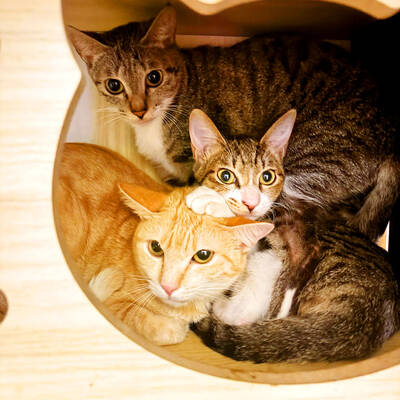
The number of pet cats in Taiwan surpassed that of pet dogs for the first time last year, reaching 1,742,033, a 32.8 percent increase from 2023, the Ministry of Agriculture said yesterday, citing a survey. By contrast, the number of pet dogs declined slightly by 1.2 percent over the same period to 1,462,528, the ministry said. Despite the shift, households with dogs still slightly outnumber those with cats by 1.2 percent. However, while the number of households with multiple dogs has remained relatively stable, households keeping more than two cats have increased, contributing to the overall rise in the feline population. The trend
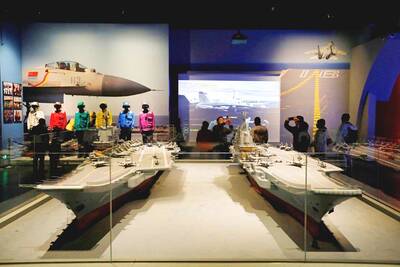
China on Wednesday teased in a video an aircraft carrier that could be its fourth, and the first using nuclear power, while making an allusion to Taiwan and vowing to further build up its islands, as it looks to boost maritime power, secure resources and bolster territorial claims. The video, issued on the eve of the 77th founding anniversary of the Chinese People’s Liberation Army Navy, featured fictional officers with names that are homophones of three commissioned aircraft carriers, the Liaoning (遼寧), Shandong (山東) and Fujian (福建). Titled Into the Deep, it showed a 19-year-old named “Hejian” (何劍) joining the group, sparking
BIG YEAR: The company said it would also release its A12 chip the same year to keep a ‘reliable stream of new silicon technologies’ flowing to its customers Taiwan Semiconductor Manufacturing Co (TSMC, 台積電) yesterday said its newest A13 chip is to enter volume production in 2029 as the chipmaker seeks to hold onto its tech leadership and demand for next-generation chips used in artificial intelligence (AI), high-performance-computing (HPC) and mobile applications. TSMC, the world’s biggest contract chipmaker, also unveiled its A12 chip at its annual technology symposium in Santa Clara, California. The A12 chip, which features TSMC’s super-power-rail technology to provide backside power delivery for AI and HPC applications, is also to enter volume production in 2029, a year after the scheduled release of the A14 chip. The technology moves


 RSS
RSS