


Following the latest in a series of major setbacks in the US the oil giant BP said last week it planned to embark on a major review of its global operations.
The group's US woes continued last week with the announcement of a fourth delay to its new Thunder Horse platform in the Gulf of Mexico, which is not now likely to begin operating until mid-2008.
The group said all underwater welding on the platform's structure needed to be checked.
Industry analyst Simon Wardell of Global Insight called the news "quite a big setback, a bit of a blow" that risked damaging even further BP's image in the US.
This week also saw proceedings open in a lawsuit against the oil giant for an explosion at the Texas City oil refinery last year, which left 15 people dead and 170 injured.
The group has already recognized that internal errors were behind the blast and boss John Browne has publicly apologized for the explosion.
On top of that, the company was obliged to admit last week that it was responsible for a leak that saw the equivalent of 1,000 barrels of oil cause a major slick in the port of Long Beach, California.
That slick however, was minor compared to the massive spill the company caused in Alaska earlier this year. Rusty oil pipes were to blame for that disaster, which forced the partial shut down of the Prudhoe Bay Oil field, the largest in North America.
The company is also facing three separate investigations for allegedly manipulating the prices of butane, propane and petrol between 2002 and 2004.
Last week BP announced its first piece of good news in a long time when it unveiled a planned US$3 billion investment in its Whiting refinery in Indiana, which will allow it to supply a million more US drivers with gasoline.
But above all it began a major review of its activities, which is set to last for five to 10 years and will, BP hopes, lead to a better integration of its global activities.
Analysts say the plan is similar to an overhaul announced by BP's competitor Exxon after the 1989 Exxon Valdez oil spill.
That review saw Exxon go on to forge a reputation as the world's safest oil firm.
BP's problems in the US are in large part linked to its extremely rapid growth.
In less than six years, the firm has grown from a large British company to a global giant, following the acquisitions in 2000 and 2001 of US oil firms Arco, Castrol and Amoco.
Wardell argued this means BP has found itself with "a lot of units in isolation" within the company as a whole.
BP has publicly admitted on a number of occasions that it has made errors, notably with Browne's apologies for both the Texas City explosion and the Alaska spill.
But Wardell said it is good that BP is now showing that it intends to put its house in order.
"They are trying to take action now very swiftly to try to assure everyone that they're taking things seriously," he said.
"It's not just a problem with investors, or share price, it can have some impact on reputation," he added.
After the Alaska spill BP even managed to win the support of prominent US ecologist Sybil Ackerman, who represents an association of environmentally-minded voters in the state of Oregon.
As BP has become a world leader in the field of renewable energy, Ackerman recently told Britain's Financial Times that the company was "deserving of censure, but not a vendetta."
Ackerman warned that whipping up bad feeling against the firm could in the long term do more harm than good for environmental campaigners.
"There is danger that some senators and representatives may use the Alaska problem as a club to retaliate against an oil company that has pushed hard for strong and responsible environmental measures," she said.
Ackerman argued it was important to recognize that BP had accepted it had made mistakes and tried to improve its environmental record.
"If environmentalists do not step up in support during BP's time of need, it will be a lesson to other companies that is does not pay to be green," she said.
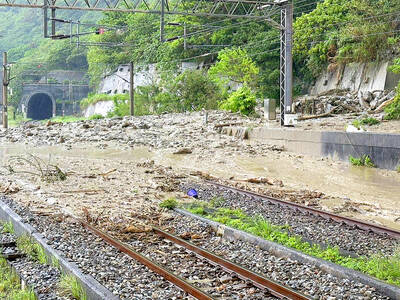
ROLLER-COASTER RIDE: More than five earthquakes ranging from magnitude 4.4 to 5.5 on the Richter scale shook eastern Taiwan in rapid succession yesterday afternoon Back-to-back weather fronts are forecast to hit Taiwan this week, resulting in rain across the nation in the coming days, the Central Weather Administration said yesterday, as it also warned residents in mountainous regions to be wary of landslides and rockfalls. As the first front approached, sporadic rainfall began in central and northern parts of Taiwan yesterday, the agency said, adding that rain is forecast to intensify in those regions today, while brief showers would also affect other parts of the nation. A second weather system is forecast to arrive on Thursday, bringing additional rain to the whole nation until Sunday, it

LANDSLIDES POSSIBLE: The agency advised the public to avoid visiting mountainous regions due to more expected aftershocks and rainfall from a series of weather fronts A series of earthquakes over the past few days were likely aftershocks of the April 3 earthquake in Hualien County, with further aftershocks to be expected for up to a year, the Central Weather Administration (CWA) said yesterday. Based on the nation’s experience after the quake on Sept. 21, 1999, more aftershocks are possible over the next six months to a year, the agency said. A total of 103 earthquakes of magnitude 4 on the local magnitude scale or higher hit Hualien County from 5:08pm on Monday to 10:27am yesterday, with 27 of them exceeding magnitude 5. They included two, of magnitude

CONDITIONAL: The PRC imposes secret requirements that the funding it provides cannot be spent in states with diplomatic relations with Taiwan, Emma Reilly said China has been bribing UN officials to obtain “special benefits” and to block funding from countries that have diplomatic ties with Taiwan, a former UN employee told the British House of Commons on Tuesday. At a House of Commons Foreign Affairs Committee hearing into “international relations within the multilateral system,” former Office of the UN High Commissioner for Human Rights (OHCHR) employee Emma Reilly said in a written statement that “Beijing paid bribes to the two successive Presidents of the [UN] General Assembly” during the two-year negotiation of the Sustainable Development Goals. Another way China exercises influence within the UN Secretariat is

Taiwan’s first drag queen to compete on the internationally acclaimed RuPaul’s Drag Race, Nymphia Wind (妮妃雅), was on Friday crowned the “Next Drag Superstar.” Dressed in a sparkling banana dress, Nymphia Wind swept onto the stage for the final, and stole the show. “Taiwan this is for you,” she said right after show host RuPaul announced her as the winner. “To those who feel like they don’t belong, just remember to live fearlessly and to live their truth,” she said on stage. One of the frontrunners for the past 15 episodes, the 28-year-old breezed through to the final after weeks of showcasing her unique


 RSS
RSS