


Asian financial markets were jolted yesterday by the military coup in Thailand but the early losses were limited and will likely stay that way unless the takeover sparks a violent response.
The news prompted Fitch Ratings to say that it was considering lowering the credit rating of the country's sovereign debt and seven major Thai banks. Standard & Poor's Ratings Services said it was putting six major Thai companies, including Thai Oil Public Co, on negative watch.
But some analysts predicted that the coup's impact may be limited -- and possibly even help end Thailand's political crisis, which has dragged on for months.
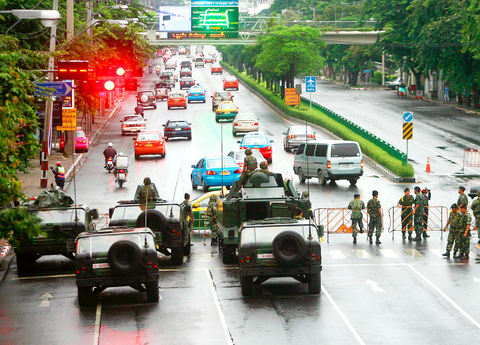
PHOTO: EPA
"We think overnight developments in Thailand probably set up a net reduction in political uncertainty and could enable a speedier resumption of decisive governance," Michael Kurtz, a regional economist for Bear Stearns, said in a report issued yesterday.
Meanwhile, dealers said stocks and the Thai baht took an early blow in a knee-jerk reaction after Thai Prime Minister Thaskin Shinawatra was ousted.
However, the downturn was limited on the view the coup could actually end months of political uncertainty which began earlier this year when Thaksin's family sold Thai telecoms giant Shin Corp for a tax free US$1.9 billion.
While the Thai stock market was closed as a result, the baht was lower, quoted at 37.735 to the US dollar, down from the 37.305 level shortly before the tanks were ordered onto Bangkok's streets.
Charlotte Donavanik, executive vice president for the Bank of Ayudhya in Bangkok, said business leaders were worried about the short-term impact but added a change in government could end months of political uncertainty.
"It is probably to early to talk about impacts but it is good to see that no violence has occurred so far," she said.
In the region, Tokyo closed down 0.98, with the coup denting sentiment although dealers there said other factors, such as concerns over the outlook for US interest rates, were also at work and probably more important.
Manila, which has seen its share of military coup attempts over the years, fell a sharp 1.99 percent while in late trade Singapore was down 0.68 percent and Kuala Lumpur had lost 0.45 percent.
"It is a combination of factors -- the Thai coup and an easing of bargain hunting by investors," Pong Teng Siew, head of research with EON Capital Securities said in Kuala Lumpur.
Dealers said one cause for concern was that foreign investors tended to view Southeast Asia as one entity despite the vastly different political and social makeup of the various markets.
This was compounded by memories of the devastating 1997 Asian financial crisis, whose epicenter was in Bangkok after the Thai government allowed the baht to float freely in the face of a sharp deterioration in the country's balance of payments.
The coup had a mixed impact on share markets elsewhere in the region but they were nearly all lower. Seoul was down 0.70 percent, Sydney fell 1.15 percent, Jakarta eased 0.68 percent and Hong Kong was flat.
There has been no financial impact yet from the coup in Thailand, IMF Managing Director Rodrigo Rato said yesterday as regional officials expressed hope for a quick resolution of the crisis.
"We are following the developments very closely and we certainly have not seen up to now any financial consequences," Rato told reporters at the close of the annual general assembly of the fund and the World Bank.
"We look forward for an evolution in the benefits of democracy and stability in the country," he said.
The political uncertainty "will definitely shake the economic and political confidence in the region," Pattama Teanravisitsagool, macroeconomic policy director at Thailand's Office of the National Economic and Social Development Board said in Singapore.
The board recently revised down its economic growth forecast for this year for Thailand to 4.2 to 4.7 percent from an earlier estimate of 4.2 to 4.9 percent, citing oil prices and growing political uncertainties.
DBS Bank said that despite heightened uncertainty after the coup, it maintained its forecast for the Thai economy to slow this year before a slight uptick next year.
Thailand's financial markets were expected to reopen today.

ROLLER-COASTER RIDE: More than five earthquakes ranging from magnitude 4.4 to 5.5 on the Richter scale shook eastern Taiwan in rapid succession yesterday afternoon Back-to-back weather fronts are forecast to hit Taiwan this week, resulting in rain across the nation in the coming days, the Central Weather Administration said yesterday, as it also warned residents in mountainous regions to be wary of landslides and rockfalls. As the first front approached, sporadic rainfall began in central and northern parts of Taiwan yesterday, the agency said, adding that rain is forecast to intensify in those regions today, while brief showers would also affect other parts of the nation. A second weather system is forecast to arrive on Thursday, bringing additional rain to the whole nation until Sunday, it
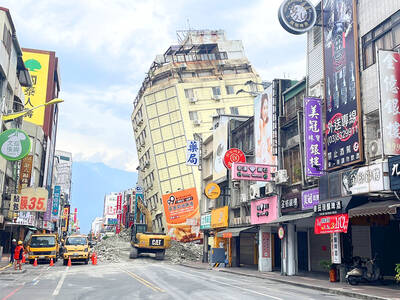
LANDSLIDES POSSIBLE: The agency advised the public to avoid visiting mountainous regions due to more expected aftershocks and rainfall from a series of weather fronts A series of earthquakes over the past few days were likely aftershocks of the April 3 earthquake in Hualien County, with further aftershocks to be expected for up to a year, the Central Weather Administration (CWA) said yesterday. Based on the nation’s experience after the quake on Sept. 21, 1999, more aftershocks are possible over the next six months to a year, the agency said. A total of 103 earthquakes of magnitude 4 on the local magnitude scale or higher hit Hualien County from 5:08pm on Monday to 10:27am yesterday, with 27 of them exceeding magnitude 5. They included two, of magnitude

CONDITIONAL: The PRC imposes secret requirements that the funding it provides cannot be spent in states with diplomatic relations with Taiwan, Emma Reilly said China has been bribing UN officials to obtain “special benefits” and to block funding from countries that have diplomatic ties with Taiwan, a former UN employee told the British House of Commons on Tuesday. At a House of Commons Foreign Affairs Committee hearing into “international relations within the multilateral system,” former Office of the UN High Commissioner for Human Rights (OHCHR) employee Emma Reilly said in a written statement that “Beijing paid bribes to the two successive Presidents of the [UN] General Assembly” during the two-year negotiation of the Sustainable Development Goals. Another way China exercises influence within the UN Secretariat is

Taiwan’s first drag queen to compete on the internationally acclaimed RuPaul’s Drag Race, Nymphia Wind (妮妃雅), was on Friday crowned the “Next Drag Superstar.” Dressed in a sparkling banana dress, Nymphia Wind swept onto the stage for the final, and stole the show. “Taiwan this is for you,” she said right after show host RuPaul announced her as the winner. “To those who feel like they don’t belong, just remember to live fearlessly and to live their truth,” she said on stage. One of the frontrunners for the past 15 episodes, the 28-year-old breezed through to the final after weeks of showcasing her unique


 RSS
RSS