


In a conference room at a Holiday Inn last week in Connecticut, 167 young women from 22 countries received a tutorial in catering to the needs of the affluent American child. (Lesson 1: Turn off the television set.)
Many of the women were German. But two drew particular attention, Li Kunyi, 23, and Zhang Man, 24, among the first au pairs from China.
Their services are in great demand, in part because so many Americans have adopted baby girls from China. Driving the need more aggressively is the desire among ambitious parents to ensure their children's worldliness, as such parents assume that China's expanding influence will make Mandarin the sophisticates' language decades hence.
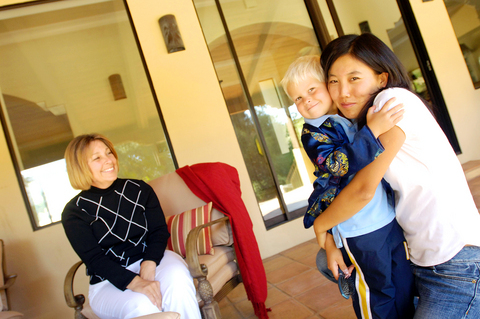
PHOTO: NY TIMES NEWS SERVICE
"Our clientele is middle and upper middle class," said William Gertz, chairman of the American Institute for Foreign Study, which oversees Au Pair in America. "They see something really happening, and they don't want to be left behind."
The last two years have seen an astonishing increase in the number of US parents wishing to employ Mandarin-speaking nannies, difficult to find here and even harder to obtain from China.
Au Pair in America, the 20-year-old agency that sponsored the two young women in Connecticut, had received no requests for Chinese au pairs until 2004, said Ruth Ferry, the program director.
Since then, it has had 1,400.
The agency said it expected to bring 200 more au pairs to this country before the end of next year, and other companies in the business are beginning to recruit in China, all taking advantage of relaxed standards for cultural-exchange visas for Chinese.
Yu Hongbin, 23, of Harbin, who like many other Chinese college students studying English gave herself an Anglophone name, Cecilia, was the first Chinese au pair to land in the US.
She arrived in March through Go Au Pair, one of the 11 such agencies sanctioned by the Office of Exchange Coordination and Designation at the State Department.
Her employer is Joan Friend, a former president of a technology company in northern California who had been having her two children, Jim, 5, and Paris, 6, tutored in Mandarin for several years.
"The tutors just played with them," Friend said from her house in Carmel Valley, California. "They thought I was crazy because the children were so young."
After her son and daughter began to learn the sounds of Mandarin, Friend sought more intensive training and repeatedly asked Go Au Pair for a Mandarin speaker to live with the family. But visa problems and a lack of contacts in China left the agency unable to place anyone with her.
Ultimately, Friend found Yu on her own, through an acquaintance in China, and Go Au Pair handled the paperwork.
"I've never been to China," said Friend, a reited, single mother.
She added that she considered China central to the future of global economics, saying, "I think China will rule the banking world in my children's lifetime, and I want them to be able to participate in that if they want to."
Since she has been with the Friends, Yu, who studied English and tourism in college in China, has been reading to the children in Mandarin and teaching them to count. In turn, Friend, in addition to paying her expenses and a monthly stipend, has taken her on trips to Arizona, San Francisco and farther down the coast to Newport Beach.
Begun in 1986, the State Department Au Pair program requires that young nannies work no more than 45 hours a week and return to their home countries after one year. Host families have to provide their charges with a window into the American experience. It is only in the last few years that au pairs have been actively recruited outside Western Europe.
In China's new culturally progressive climate, biases against such domestic work prevail. Zhang, one of the au pairs who arrived last week and moved in with a family in New Hampshire, said her parents had initially disapproved of her decision.
"There are prejudices about being a baby sitter," she remarked. "They said: `You have a great job coming out of college. Why would you want to go to America to take care of children?'"
It is Zhang's hope to open a nursery school in China. And she would like to immerse herself more deeply in American culture, she said.

ROLLER-COASTER RIDE: More than five earthquakes ranging from magnitude 4.4 to 5.5 on the Richter scale shook eastern Taiwan in rapid succession yesterday afternoon Back-to-back weather fronts are forecast to hit Taiwan this week, resulting in rain across the nation in the coming days, the Central Weather Administration said yesterday, as it also warned residents in mountainous regions to be wary of landslides and rockfalls. As the first front approached, sporadic rainfall began in central and northern parts of Taiwan yesterday, the agency said, adding that rain is forecast to intensify in those regions today, while brief showers would also affect other parts of the nation. A second weather system is forecast to arrive on Thursday, bringing additional rain to the whole nation until Sunday, it

LANDSLIDES POSSIBLE: The agency advised the public to avoid visiting mountainous regions due to more expected aftershocks and rainfall from a series of weather fronts A series of earthquakes over the past few days were likely aftershocks of the April 3 earthquake in Hualien County, with further aftershocks to be expected for up to a year, the Central Weather Administration (CWA) said yesterday. Based on the nation’s experience after the quake on Sept. 21, 1999, more aftershocks are possible over the next six months to a year, the agency said. A total of 103 earthquakes of magnitude 4 on the local magnitude scale or higher hit Hualien County from 5:08pm on Monday to 10:27am yesterday, with 27 of them exceeding magnitude 5. They included two, of magnitude
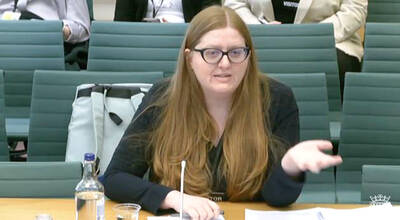
CONDITIONAL: The PRC imposes secret requirements that the funding it provides cannot be spent in states with diplomatic relations with Taiwan, Emma Reilly said China has been bribing UN officials to obtain “special benefits” and to block funding from countries that have diplomatic ties with Taiwan, a former UN employee told the British House of Commons on Tuesday. At a House of Commons Foreign Affairs Committee hearing into “international relations within the multilateral system,” former Office of the UN High Commissioner for Human Rights (OHCHR) employee Emma Reilly said in a written statement that “Beijing paid bribes to the two successive Presidents of the [UN] General Assembly” during the two-year negotiation of the Sustainable Development Goals. Another way China exercises influence within the UN Secretariat is

Taiwan’s first drag queen to compete on the internationally acclaimed RuPaul’s Drag Race, Nymphia Wind (妮妃雅), was on Friday crowned the “Next Drag Superstar.” Dressed in a sparkling banana dress, Nymphia Wind swept onto the stage for the final, and stole the show. “Taiwan this is for you,” she said right after show host RuPaul announced her as the winner. “To those who feel like they don’t belong, just remember to live fearlessly and to live their truth,” she said on stage. One of the frontrunners for the past 15 episodes, the 28-year-old breezed through to the final after weeks of showcasing her unique


 RSS
RSS