


In a deal that will reshape the semiconductor industry, Advanced Micro Devices Inc (AMD) agreed to buy ATI Technologies Inc on Sunday night for US$5.4 billion in cash and stock, people involved in the transaction said.
The deal, which was expected to be announced yesterday, comes as the semiconductor industry is becoming the focus of intense investor interest. Later this week, Philips Electronics plans to field final bids worth more than US$10 billion apiece for its semiconductor division from three consortiums of private equity investors, according to people involved in that auction. Philips had been considering an initial public offering for the unit.
AMD's deal for ATI, worth US$4.2 billion in cash and US$1.2 billion in stock, will expand AMD's business into graphic chipsets used in high-end PC's for playing video games and in workstations used in design work or to create video games and movie animation as well as chipsets for cellphones and handheld devices.
A chipset connects a computer system's processor to its memory and other parts, facilitating the flow of data among components.
"The deal puts AMD on more equal footing with Intel," said Samir Bhavnani, director of research at Current Analysis, a market research firm in San Diego, California. "It completes the puzzle for AMD."
He said the deal was important because it takes AMD beyond PCs and gives it greater strength for the cellphone and handheld markets.
The deal is not without challenges. While both companies have reported strong earnings growth over the past year, overall growth of PC sales is slowing, particularly in the high end of the market where the graphics chips are important components.
The slowdown also means the price competition with Intel for the core processors at the low end of the market has increased. Lower prices mean that AMD makes less money per processor.
The ability to sell graphics chipsets along with a processor could help improve AMD's overall gross profit margins, which fell in the latest quarter to 56.8 percent from 58.5 percent in the prior quarter.
ATI is a major player in a number of promising technologies that will grow as the electronics industry shifts away from the dominance of PCs to new forms of television, enhanced set-top boxes as well as handheld videoplayers. For instance, ATI makes chips for integrated digital televisions, which get digital broadcast over the airwaves. It also makes image processors that are used to display video on cellphones or mobile handheld game machines.
In its third quarter, ended May 31, ATI reported that revenue from the consumer side of its business grew 120 percent year-over-year due to strength in the handhelds market. Shipments of chips for the digital TV market more than doubled. By contrast, its revenue from chips used in PC's increased only 8.5 percent from the year earlier quarter.
Philips Semiconductors was ranked as the world's eighth-largest semiconductor maker last year by iSuppli, a market research firm. AMD was ranked slightly behind it. ATI was ranked as No. 25.

ROLLER-COASTER RIDE: More than five earthquakes ranging from magnitude 4.4 to 5.5 on the Richter scale shook eastern Taiwan in rapid succession yesterday afternoon Back-to-back weather fronts are forecast to hit Taiwan this week, resulting in rain across the nation in the coming days, the Central Weather Administration said yesterday, as it also warned residents in mountainous regions to be wary of landslides and rockfalls. As the first front approached, sporadic rainfall began in central and northern parts of Taiwan yesterday, the agency said, adding that rain is forecast to intensify in those regions today, while brief showers would also affect other parts of the nation. A second weather system is forecast to arrive on Thursday, bringing additional rain to the whole nation until Sunday, it
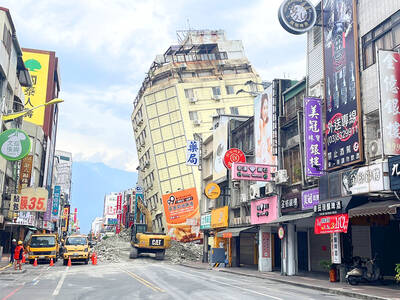
LANDSLIDES POSSIBLE: The agency advised the public to avoid visiting mountainous regions due to more expected aftershocks and rainfall from a series of weather fronts A series of earthquakes over the past few days were likely aftershocks of the April 3 earthquake in Hualien County, with further aftershocks to be expected for up to a year, the Central Weather Administration (CWA) said yesterday. Based on the nation’s experience after the quake on Sept. 21, 1999, more aftershocks are possible over the next six months to a year, the agency said. A total of 103 earthquakes of magnitude 4 on the local magnitude scale or higher hit Hualien County from 5:08pm on Monday to 10:27am yesterday, with 27 of them exceeding magnitude 5. They included two, of magnitude

CONDITIONAL: The PRC imposes secret requirements that the funding it provides cannot be spent in states with diplomatic relations with Taiwan, Emma Reilly said China has been bribing UN officials to obtain “special benefits” and to block funding from countries that have diplomatic ties with Taiwan, a former UN employee told the British House of Commons on Tuesday. At a House of Commons Foreign Affairs Committee hearing into “international relations within the multilateral system,” former Office of the UN High Commissioner for Human Rights (OHCHR) employee Emma Reilly said in a written statement that “Beijing paid bribes to the two successive Presidents of the [UN] General Assembly” during the two-year negotiation of the Sustainable Development Goals. Another way China exercises influence within the UN Secretariat is

Taiwan’s first drag queen to compete on the internationally acclaimed RuPaul’s Drag Race, Nymphia Wind (妮妃雅), was on Friday crowned the “Next Drag Superstar.” Dressed in a sparkling banana dress, Nymphia Wind swept onto the stage for the final, and stole the show. “Taiwan this is for you,” she said right after show host RuPaul announced her as the winner. “To those who feel like they don’t belong, just remember to live fearlessly and to live their truth,” she said on stage. One of the frontrunners for the past 15 episodes, the 28-year-old breezed through to the final after weeks of showcasing her unique


 RSS
RSS