


Microsoft planned to offer yesterday a strategy describing how it intends to transform the telecommunications world in much the same way it changed the computing world in the 1980s.
Its new approach centers on systems for the workplace that blend desktop computers with office and mobile phones, a combination known as "unified communications." But Microsoft, already late to the field, will not have its offerings commercially available before the second quarter of next year.
"This is pretty complicated stuff to get out," said Bernard Elliot, a research vice president at Gartner Inc, a market research firm in Stamford, Connecticut.
Microsoft's challenge is to convince corporate clients that they need to adopt a growing suite of the company's desktop and server-based software at a time when inexpensive and modular Web services are becoming increasingly popular.
"When we are looking to integrate with Microsoft, we have to consider how good their interfaces are," said Julie Farris, founder of Scalix, a Silicon Valley-based messaging company based on open-source software. "Those developed by competitors are almost always richer."
Microsoft's products will connect its Exchange Server e-mail system to advanced Internet-based PBX systems as well as traditional ones and make it possible to view voice mail in an Outlook inbox. The programs will also perform a series of sophisticated functions linking desktop and cellular phones to desktop and server computers.
In one Microsoft demonstration, a user late for a meeting that is scheduled in an Outlook calendar can phone the Exchange server and tell the system to notify other participants that he or she is running 10 to 15 minutes late. The system, using voice recognition to interpret the message, then automatically generates an e-mail notification.
Other features of the new extension to Exchange, to be called Communications Server, make it possible for users to have e-mail read to them by telephone.
"We think there's a lot of productivity to be gained by people having things in one place," said Jeff Ressler, Microsoft's director of Exchange marketing.
Although Microsoft has built alliances with powerful telecommunications firms like Cisco and Siemens, it is also potentially vulnerable because it has confined its development to the Windows operating system.
Elsewhere, IBM said that it would announce a new version of its collaboration software yesterday, called Lotus Sametime. The program, with many of the capabilities of the Microsoft software, is scheduled for delivery this summer. IBM, which has been the leader in collaboration software but has been losing market share to Microsoft, said it was pushing to adopt open standards.
"We've been far ahead of Microsoft in these technologies," said Ken Bisconti, IBM's vice president for workplace, portal and collaboration products, speaking from Cambridge, Massachusetts.
Microsoft is also facing a growing open-source communications software market. One project, an open-source, Internet-based PBX called Asterisk, has more than 500,000 systems now in use.

ROLLER-COASTER RIDE: More than five earthquakes ranging from magnitude 4.4 to 5.5 on the Richter scale shook eastern Taiwan in rapid succession yesterday afternoon Back-to-back weather fronts are forecast to hit Taiwan this week, resulting in rain across the nation in the coming days, the Central Weather Administration said yesterday, as it also warned residents in mountainous regions to be wary of landslides and rockfalls. As the first front approached, sporadic rainfall began in central and northern parts of Taiwan yesterday, the agency said, adding that rain is forecast to intensify in those regions today, while brief showers would also affect other parts of the nation. A second weather system is forecast to arrive on Thursday, bringing additional rain to the whole nation until Sunday, it

LANDSLIDES POSSIBLE: The agency advised the public to avoid visiting mountainous regions due to more expected aftershocks and rainfall from a series of weather fronts A series of earthquakes over the past few days were likely aftershocks of the April 3 earthquake in Hualien County, with further aftershocks to be expected for up to a year, the Central Weather Administration (CWA) said yesterday. Based on the nation’s experience after the quake on Sept. 21, 1999, more aftershocks are possible over the next six months to a year, the agency said. A total of 103 earthquakes of magnitude 4 on the local magnitude scale or higher hit Hualien County from 5:08pm on Monday to 10:27am yesterday, with 27 of them exceeding magnitude 5. They included two, of magnitude
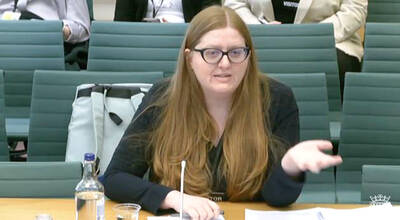
CONDITIONAL: The PRC imposes secret requirements that the funding it provides cannot be spent in states with diplomatic relations with Taiwan, Emma Reilly said China has been bribing UN officials to obtain “special benefits” and to block funding from countries that have diplomatic ties with Taiwan, a former UN employee told the British House of Commons on Tuesday. At a House of Commons Foreign Affairs Committee hearing into “international relations within the multilateral system,” former Office of the UN High Commissioner for Human Rights (OHCHR) employee Emma Reilly said in a written statement that “Beijing paid bribes to the two successive Presidents of the [UN] General Assembly” during the two-year negotiation of the Sustainable Development Goals. Another way China exercises influence within the UN Secretariat is

Taiwan’s first drag queen to compete on the internationally acclaimed RuPaul’s Drag Race, Nymphia Wind (妮妃雅), was on Friday crowned the “Next Drag Superstar.” Dressed in a sparkling banana dress, Nymphia Wind swept onto the stage for the final, and stole the show. “Taiwan this is for you,” she said right after show host RuPaul announced her as the winner. “To those who feel like they don’t belong, just remember to live fearlessly and to live their truth,” she said on stage. One of the frontrunners for the past 15 episodes, the 28-year-old breezed through to the final after weeks of showcasing her unique


 RSS
RSS