


The head of the world's largest chipmaker on Wednesday unveiled a new mobile personal computer designed to provide affordable, collaborative learning environments for teachers and young students.
Codenamed "Eduwise," Intel Corp CEO Paul Otellini said the US$400 machines will feature built-in wireless and will be able to run Microsoft Corp's Windows or Linux operating systems.
"What we want to do is accelerate to uncompromised technology for everyone in the world," Otellini said during a demonstration at the World Congress on Information Technology in Austin. "No one wants to cross the digital divide with yesterday's technology."
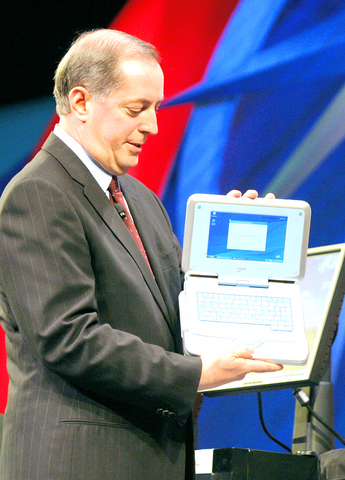
PHOTO: AP
The flip open Eduwise computer includes a handle, light blue accents and snaps shut like a purse. Special software allows students in a classroom to view presentations, take tests and interact individually with their teachers using a built-in wireless connection.
The cheaper PCs are part of a US$1 billion investment by Intel over the next five years to promote the use of computers in schools, cafes and other public spots in developing countries, Otellini said.
The Eduwise machine was designed by Intel, but will be built by its computer-making customers. Otellini said the devices should be available next year.
Many high-tech companies, including Intel rival Advanced Micro Devices Inc (AMD) and Microsoft, have announced similar initiatives to close the digital divide between developed and developing nations.
Massachusetts Institute of Technology professor Nicholas Negroponte's nonprofit One Laptop Per Child association hopes to begin providing US$100 laptops to millions of children in China, India, Egypt, Brazil, Thailand, Nigeria and Argentina by early next year.
Tentative designs call for a machine using one-tenth of the power of conventional laptops, a 17.7cm screen and a Linux operating system. The project's partners include Google Inc and AMD.
In an earlier speech at the conference, Microsoft CEO Steve Ballmer said the benefits of this global spread of technology are only starting to be felt.
"What we see going forward over the next five, 10, 15 years is a world of technology that has the potential itself to be even more important than the positive change it has enabled society in the past 10 years," he said.
"Computers will see, computers will listen, computers will understand. Computers will help the world grow smaller and help people to collaborate in new ways," he said.
Otellini also doubled former Intel CEO Andy Grove's prediction in 1996 that there would someday be more than a billion computers connected to the Internet.
He said the billion mark should be reached by next year, and that figure could double in five years because of cheaper, more powerful computers and the spread of the Internet to rural regions with the deployment of a long-range wireless technology called Wi-Max.
Otellini also said that Intel had reached a deal with the Mexican government to provide new low-cost PCs to 300,000 teachers by the end of this year.

National Taiwan University (NTU) yesterday said it disqualified a person from an entrance examination for using AI smart glasses to cheat, along with two others for making untruthful statements in their curriculum vitae. The three applicants were given null scores, Taiwan’s highest-ranked university said, calling on prospective students to be honest in the admissions process. NTU registrar Lee Hung-sen (李宏森) said that the cheating applicant wore a hat and thick-rimmed glasses to the second written exam for medical school, claiming that they felt cold. Suspicions were aroused when the applicant stared oddly at the test for long stretches while steadily bringing the paper
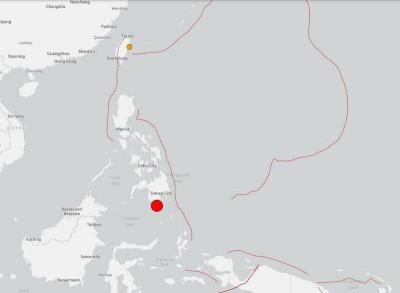
A magnitude 7.8 earthquake struck off the southern coast of Mindanao in the Philippines at 7:38am today, prompting the US Tsunami Warning System to issue an alert for neighboring countries, including Taiwan. The system issued a purple alert indicating a "tsunami threat." The potential threat zone includes Taiwan, the Philippines, Papua New Guinea, Yap and Palau. Philippine authorities were assessing the damage from the quake, with the office of civil defense seeking to verifying initial reports that 15 people had been killed and 129 injured in the region, mostly from falling debris. Arlene Hollero, disaster chief of Maasim town in the Philippines' Sarangani Province,

‘GRAY ZONE’ PRESSURE: Beijing’s activities are intended to create the deceitful impression that China has jurisdiction over the area around Taiwan, the CGA said Taiwan’s rights over its territorial waters and exclusive economic zone must not be violated by any country, the Mainland Affairs Council said yesterday, adding that it will not accept any unprovoked actions. The council issued the remarks in response to the China Coast Guard conducting maritime enforcement drills near eastern Taiwan and claiming to fully exercise China’s maritime administrative law enforcement authority. The Coast Guard Administration (CGA) has been closely monitoring the situation and is taking concrete steps to defend the nation’s sovereignty and secure its waters, the council said. China has no sovereign rights over the waters off eastern
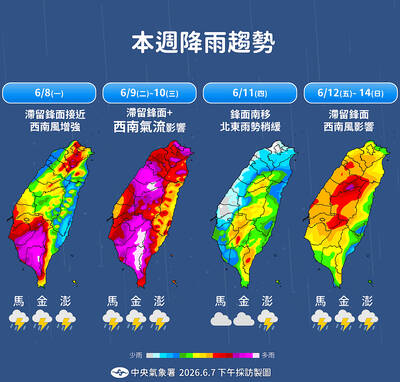
Heavy rain is expected to affect parts of Taiwan this week, the Central Weather Administration (CWA) said yesterday as a meteorologist said the active part of the annual plum rain season has started. A stationary plum rain front and southwesterly winds would bring unstable weather and abundant moisture to Taiwan from today for about a week, with the heaviest rainfall forecast for tomorrow and Wednesday, the CWA said. The agency said western and northeastern Taiwan, and mountainous areas in the east and southeast, could expect showers or thunderstorms on those two days, with localized heavy rain possible. Other parts of


 RSS
RSS