


Sony Corp, the world's biggest video-game console maker, will delay sales of the PlayStation 3 by about six months to early November, giving Microsoft Corp more time to increase its share of the US$20 billion global market.
The company had problems with a copy-protection format for its Blu-ray high-definition DVD player, preventing a planned release this spring, Ken Kutaragi, president of Sony Computer Entertainment Inc, said at a media conference in Tokyo yesterday.
Sony would be a year behind Microsoft, which released its latest Xbox 360 console in the US in November last year. The PlayStation 3 features Sony's Blu-ray technology and its fastest processor ever, forming a key part of chief executive officer Howard Stringer's strategy to use entertainment businesses to spur sales of consumer electronics.
Sony is targeting production of 1 million units a month for a global launch of the PlayStation 3 in November, Kutaragi said.
Shares of Sony fell 1.8 percent to ?5,470 at the 3pm close in Tokyo, compared with a 0.5 percent gain in the NIKKEI 225 Stock Average. The announcement came after markets shut.
Sony's first two PlayStation game consoles are bestsellers worldwide, with more than 100 million units sold each.
With the PlayStation 2, Sony missed out on the 1999 year-end shopping season to Sega Enterprises Ltd's Dreamcast game machine. Still, the PS2 was launched in March 2000, 18 months ahead of Nintendo Co's GameCube and almost two years ahead of Microsoft's first Xbox, and outsold all three consoles.
Merrill Lynch & Co's Tokyo-based analyst Hitoshi Kuriyama wrote in a report last month that the PlayStation 3 launch may be pushed back to autumn in Japan and next year in the US, because of reasons that included delays in video-chip production, heat emissions problems and a shortage of games.
The PlayStation 3 will cost about ?74,000 (US$630) to make, with the Cell chip and Blu-ray accounting for more than half of the costs, and Sony will probably sell it for ?44,800 in Japan and US$399 in the US, Kuriyama said.
That compares with the Xbox 360's US$399 price tag for a console with a hard-disk drive, and US$299 for a unit without a drive. Sony's PS3 won't come with a hard-disk drive, which can be used to store music, movies and other computer files.
The PlayStation 3 will be compatible with the Blu-ray disc, which can store at least five times more video, audio and computer files than standard DVDs. The console's Cell chip will also make the PS3 about 35 times faster than its predecessor.
"There clearly would be a huge risk with a delay," said Stephen Hall, who helps manage the equivalent of US$572 million at Britannic Asset Management in Glasgow, Scotland.
The Blu-ray will have to compete with Toshiba Corp's high-definition DVD format, which can store at least four times more data than standard DVDs. Microsoft backs Toshiba's HD DVD format and chairman Bill Gates last year said future versions of the Xbox 360 may support the HD DVD format.
"It remains to be seen whether the PS3 will be regarded as an entertainment hub, which Howard Stringer wants to do," said Amir Anvarzadeh, director of Japanese equity sales at KBC Financial Products in London.
A delay is "a hindrance. People want the PS3 to come out regardless of what the media is. They don't care if it's Blu-ray or HD DVD," Anvarzadeh said.

SILENCING CRITICS: In addition to blocking Taiwan, China aimed to prevent rights activists from speaking out against authoritarian states, a Cabinet department said The Ministry of Foreign Affairs (MOFA) yesterday condemned transnational repression by Beijing after RightsCon, a major digital human rights conference scheduled to be held in Zambia this week, was abruptly canceled due to Chinese pressure over Taiwanese participation. This year’s RightsCon, the world’s largest conference discussing issues “at the intersection of human rights and technology,” was scheduled to take place from tomorrow to Friday in Lusaka, and expected to draw 2,600 in-person attendees from 150 countries, along with 1,100 online participants. However, organizers were forced to cancel the event due to behind-the-scenes pressure from China, the ministry said, expressing its “strongest condemnation”
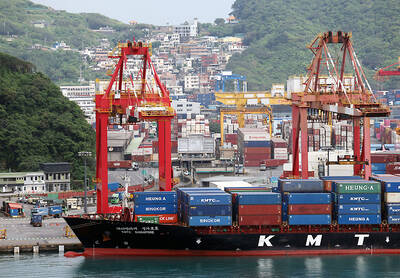
Taiwan’s economy grew far faster than expected in the first quarter, as booming demand for artificial intelligence (AI) applications drove a surge in exports, spilling over into investment and consumption, the Directorate-General of Budget, Accounting and Statistics (DGBAS) said yesterday. GDP growth was 13.69 percent year-on-year during the January-to-March period, beating the DGBAS’ February forecast by 2.23 percentage points and marking the most robust growth in nearly four decades, DGBAS senior official Chiang Hsin-yi (江心怡) told a news conference in Taipei. The result was powered by exports, which remain the backbone of Taiwan’s economy, Chiang said. Outbound shipments jumped 51.12 percent year-on-year to
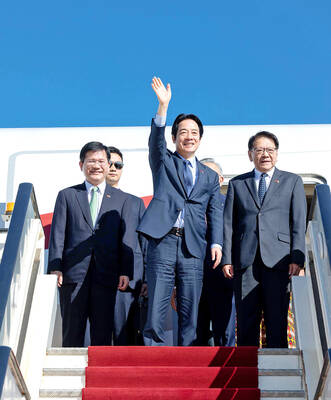
DELAYED BUT DETERMINED: The president’s visit highlights Taiwan’s right to international engagement amid regional pressure from China President Willaim Lai (賴清德) yesterday arrived in Eswatini, more than a week after his planned visit to Taiwan’s sole African ally was suspended because of revoked overflight permits. “The visit, originally scheduled for April 22, was postponed due to unforeseen external factors,” Lai wrote on social media. “After several days of careful arrangements by our diplomatic and national security teams, we successfully arrived today.” Lai said he looked forward to further deepening Taiwan-Eswatini relations through closer cooperation in the economy, agriculture, culture and education, as well as advancing the nation’s international partnerships. The president was initially scheduled to arrive in time to celebrate
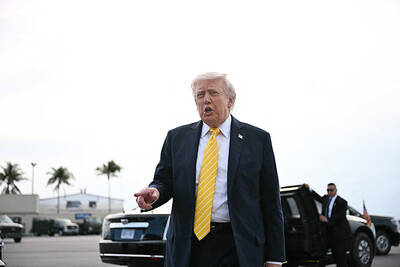
Iran’s Islamic Revolutionary Guard Corp (IRGC) yesterday said the US faced a choice between an “impossible” military operation or a “bad deal” with Tehran, after US President Donald Trump disparaged Iran’s latest peace proposal. Negotiations between the two countries have been deadlocked since a ceasefire came into effect on April 8, with only one round of direct peace talks held so far. Iran’s Tasnim and Fars news agencies reported that Tehran had submitted a 14-point proposal to mediator Pakistan, but Trump was quick to cast doubt on it. “I will soon be reviewing the plan that Iran has just sent to us, but


 RSS
RSS