


Microsoft Corp said sales of its Xbox 360 video-game console will gain from a possible delay in Sony Corp's PlayStation 3, helping it steal share in the US$28.5 billion industry.
"We want to win," Andres Vejarano, regional marketing manager for Asia, excluding Japan, said by telephone from Hong Kong yesterday.
"Any delay does give us a first mover advantage. It benefits us," he said.
Microsoft, the world's biggest software maker and No. 2 in game systems, is betting on the Xbox 360 to help trim its reliance on the Windows program, which powers 95 percent of all personal computers. The Redmond, Washington-based company has spent more than US$12 billion developing the Xbox 360, which it will sell in Hong Kong, Singapore and Taiwan from Thursday.
The Xbox 360 has met with "phenomenal" demand from pre-sales marketing in Hong Kong, Taiwan and Singapore, Vejarano said. "We want to make sure we've enough Xbox 360 for every consumer who wants to buy during the launch," he said.
The company's game player sold out within hours at outlets and online retailers -- including Amazon.com Inc and Wal-Mart Stores Inc -- when it was first released on Nov. 22 in the US.
Microsoft delayed sales of the Xbox 360 from an earlier scheduled March 2 in the three Asian countries because of "unprecedented global consumer demand out stripping inventory supply," Vejarano said.
The firm has added Toronto-based Celestica Inc as its third Xbox 360 maker, after Hsinchu, Taiwan-based Wistron Corp (
The Xbox 360 will be priced from US$300 to US$330 for a basic set, and US$380 to US$410 for a package including a hard-disk drive and wireless controller, in Hong Kong, Singapore and Taiwan, Vejarano said.
Microsoft started selling the basic system at US$299 and the package at US$399 in the US.
Tokyo-based Sony, the world's second-biggest consumer electronics maker, last month said a postponement of the PlayStation 3 can't be ruled out after Merrill Lynch & Co reported a delay of as much as a year because of issues such as adding the Blu-ray high-definition DVD player to the console.
"There are no changes in our plan to release PlayStation 3 in spring," said Satoshi Fukuoka, a spokesman for Sony Computer Entertainment Inc, the firm's games division, yesterday.
No date has been set, he said.
Microsoft is "on track" to meet its 4.5 million to 5.5 million unit sales target by June, Vejarano said, declining to give specific forecasts for geographic regions.
The company had sold 1.01 million Xbox 360 machines in the US as of Feb. 25, according to a JPMorgan Chase & Co report dated Monday. JPMorgan expects Asia to account for about 8 percent of Xbox 360 sales, similar to the contribution of the original Xbox consoles.
"We believe most of the uptake in Xbox 360 will be driven mainly by demand from US, Europe and the rest of Asia Pacific, excluding Japan, like Korea and Australia," analysts Adam Holt, Aaron Schwartz and Nitin Doke wrote.
The global video-games industry is expected to expand to about US$42 billion by 2010, according to San Diego-based DFC Intelligence. Microsoft may win as much as 40 percent market share with the Xbox 360, the researcher said.
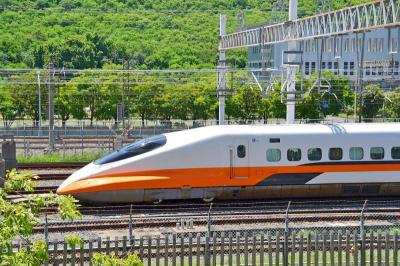
A signaling system malfunction disrupted high-speed rail (HSR) services beginning at 8am today, with trains temporarily reduced to three northbound and three southbound trains per hour as authorities conduct inspections. The malfunction occurred on a section of track in Miaoli County during pre-operation checks early this morning, forcing northbound and southbound trains to use a single track, the HSR operator said. The regular schedule has been replaced with three hourly trains offering only nonreserved seating in each direction, stopping at every station, it said, adding that business class cars would still have reserved seating. Departures from terminal stations are scheduled at the top

Taiwan is still in the process of assessing the possibility of recruiting workers from Eswatini, the Ministry of Foreign Affairs said yesterday, adding that its goal is to help Eswatini upgrade its vocational training centers. If there are plans to recruit workers from Eswatini, safeguarding national security, protecting public health and ensuring the employment rights of Taiwanese would be prerequisites, Department of West Asian and African Affairs Director-General Yen Chia-liang (顏嘉良) told a news conference. Key considerations would also include filling labor shortages in specific industries, and fostering bilateral professional and technical exchanges, he said. Yen was asked about the progress of labor

VERBOSE VESSELS: A CGA cutter and a China Coast Guard exchanged verbal barbs for more than a day in Taiwanese-controlled waters before the Chinese vessel left The Taiwanese and Chinese coast guards had a standoff near the strategically located Pratas Islands (Dongsha Islands, 東沙群島) in the north of the South China Sea, the Coast Guard Administration (CGA) said yesterday. The two sides engaged in intense radio exchanges over sovereignty claims during the 33-hour standoff. China Coast Guard vessel 3501 eventually left the restricted waters, 26.6 nautical miles (49.2km) west of the Pratas Islands, at 5pm yesterday, the CGA said. Lying approximately between southern Taiwan and Hong Kong, the Taiwan-controlled Pratas are seen by some security experts as vulnerable to Chinese attack due to their distance — more than

A US uncrewed surface vessel (USV) encountered multiple Chinese warships during an autonomous transit of the Taiwan Strait, US defense company Seasats said in a statement on Wednesday. Seasats announced that a Lightfish USV had completed the first autonomous transit of the Taiwan Strait. Over five days, the USV traversed the entire length of the Strait while constantly monitoring surface vessel traffic, the company said. The Lightfish encountered multiple Chinese warships, one of which was a Chinese People’s Liberation Army Navy (PLAN) Type 056 corvette, it said. The Chinese vessels were operating “well within Taiwan’s exclusive economic zone without transmitting their identity via the


 RSS
RSS