


French lawmakers on Thursday debated a proposal that would introduce a de facto download tax to legalize the copying of movie and music files from the Internet, after an embarrassed government was forced to resubmit the idea for a vote.
The proposal, an amendment to a bill before the assembly, has ignited a fierce debate over copyright between supporters of a monthly licence fee allowing them to download material, and critics who claim it would open the way to large-scale piracy.
At the same time, the government has been caught in a procedural mess that obliged Culture Minister Renaud Donnedieu de Vabres to reintroduce the article containing the "download tax" late on Wednesday just two days after ordering it withdrawn from the general bill.
"I want the debate to continue. I'm prepared to go right to the end of the debate," he told lawmakers, promising that the government would not railroad through the measure past fierce opposition.
The contentious article is part of a bill before parliament that is meant to define French digital copyright law and bring it into line with an EU-wide directive issued five years ago.
Drafted by the government, the main bill essentially outlaws downloading and the copying of commercial DVDs and CDs -- except for very limited private use -- and establishes fines and prison sentences as punishment for offenders.
An estimated eight to 10 million people in France -- nearly 17 percent of the population -- already download copyrighted files without making any sort of payment.
The government hastily suspended the initial examination of the bill in December last year, when a small group of ruling party and opposition MPs managed to attach the amendment that would legalize downloading for a fee.
The amendment calls for the general licence fee to be added to monthly subscription charges Internet users pay companies to access the Web. The sum, expected to be around US$9.50 to US$14, would go to a centralized fund to pay artists' royalties.
Villepin's government is, in fact, deeply hostile to the download tax, which it fears will open the way to rampant piracy. After withdrawing the bill, it lightened the fines in an attempt to mollify consumer advocates and then on Tuesday resubmitted the text to parliament -- minus the download fee provision.
But on Wednesday, the government apparently found that it had overstepped its constitutional powers by excising the article, and as a result the measure was reintroduced.
Villepin is now banking on the governing UMP's majority in the lower house and the Senate to ultimately quash the downloading amendment that it could not -- for procedural reasons -- remove on its own.
Despite the humiliation dealt to the government by the process, observers predict the bill will eventually become law without legalizing downloading.
The measure is due to go to a vote next Wednesday.

NO-LIMITS PARTNERSHIP: ‘The bottom line’ is that if the US were to have a conflict with China or Russia it would likely open up a second front with the other, a US senator said Beijing and Moscow could cooperate in a conflict over Taiwan, the top US intelligence chief told the US Senate this week. “We see China and Russia, for the first time, exercising together in relation to Taiwan and recognizing that this is a place where China definitely wants Russia to be working with them, and we see no reason why they wouldn’t,” US Director of National Intelligence Avril Haines told a US Senate Committee on Armed Services hearing on Thursday. US Senator Mike Rounds asked Haines about such a potential scenario. He also asked US Defense Intelligence Agency Director Lieutenant General Jeffrey Kruse

INSPIRING: Taiwan has been a model in the Asia-Pacific region with its democratic transition, free and fair elections and open society, the vice president-elect said Taiwan can play a leadership role in the Asia-Pacific region, vice president-elect Hsiao Bi-khim (蕭美琴) told a forum in Taipei yesterday, highlighting the nation’s resilience in the face of geopolitical challenges. “Not only can Taiwan help, but Taiwan can lead ... not only can Taiwan play a leadership role, but Taiwan’s leadership is important to the world,” Hsiao told the annual forum hosted by the Center for Asia-Pacific Resilience and Innovation think tank. Hsiao thanked Taiwan’s international friends for their long-term support, citing the example of US President Joe Biden last month signing into law a bill to provide aid to Taiwan,

China’s intrusive and territorial claims in the Indo-Pacific region are “illegal, coercive, aggressive and deceptive,” new US Indo-Pacific Commander Admiral Samuel Paparo said on Friday, adding that he would continue working with allies and partners to keep the area free and open. Paparo made the remarks at a change-of-command ceremony at Joint Base Pearl Harbor-Hickam in Hawaii, where he took over the command from Admiral John Aquilino. “Our world faces a complex problem set in the troubling actions of the People’s Republic of China [PRC] and its rapid buildup of forces. We must be ready to answer the PRC’s increasingly intrusive and
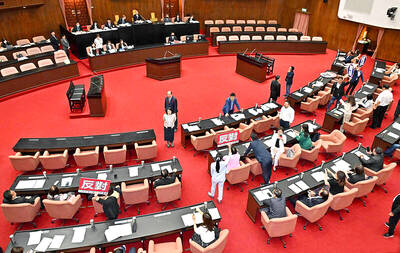
STATE OF THE NATION: The legislature should invite the president to deliver an address every year, the TPP said, adding that Lai should also have to answer legislators’ questions The Chinese Nationalist Party (KMT) yesterday proposed inviting president-elect William Lai (賴清德) to make a historic first state of the nation address at the legislature following his inauguration on May 20. Lai is expected to face many domestic and international challenges, and should clarify his intended policies with the public’s representatives, KMT caucus secretary-general Hung Meng-kai (洪孟楷) said when making the proposal at a meeting of the legislature’s Procedure Committee. The committee voted to add the item to the agenda for Friday, along with another similar proposal put forward by the Taiwan People’s Party (TPP). The invitation is in line with Article 15-2


 RSS
RSS