


Trade ministers from nearly 150 countries gathered in Hong Kong yesterday to work on a deal to open world markets and lift the global economy, with pressure growing for Europe to agree to a key cut in farm subsidies.
The WTO's 149 members have been working to agree a deal to cut tariffs and other barriers to trade that experts say prevent poorer nations from gaining access to world markets, and allow developed economies to grow.
Hopes for a deal at the six-day meeting -- opening formally tomorrow -- have been low since October, after preparatory talks failed to reach a breakthrough on the key area of agriculture subsidies and tariffs.

PHOTO: AP
US trade representative Rob Portman yesterday put responsibility for success or failure square-ly on the shoulders of the 25-member EU which pays out billions of dollars each year in farm subsidies.
Earlier this year, the US offered to cut farm aid by 60 percent by 2010 if the EU scraps 80 percent of its subsidies. So far the Europeans have refused to budge.
"The key to development is market access, agriculture access is the top challenge and we think that we need to make more progress here," Portman said in Hong Kong.
"The US made a bold agricultural proposal in October that is yet to be matched by others, including the EU," he said.
Adding its voice to the dispute, Brazil, one of the leading developing countries at the talks, warned yesterday that no deal would be made unless the EU made bigger concessions on agriculture subsidies.
"Unless the European Union improves its offer on agriculture, I do not believe we can complete the Doha cycle," Brazilian Foreign Minister Celsio Amorim said, referring to the round of talks launched in the Qatari capital in 2001.
And Commonwealth secretary general Don McKinnon said that the developed countries, led by the EU, had to offer more ground.
"More has to be given than received by the developed countries," McKinnon said.
"If you see what's on the table now you're not seeing a lot of satisfaction -- much more is expected," the leader of the 53-member grouping of mostly former British colonies said.
"[Nothing is moving] because of the intransigence on agriculture," McKinnon said.
"Agriculture has become the trigger of trust. With a really significant move on that by the Europeans and the US, a whole lot of other things can happen," he said.
Agriculture is not the only issue to be discussed at the talks, which will also cover industrial goods and the service industries such as banking and insurance.
And a rather embattled EU trade commissioner Peter Mandelson said yesterday that he would not be offering any new concessions on agriculture, saying the emphasis had to go to other areas.
"I come to Hong Kong to do business with my partners and I hope that others have come to do business with me," Mandelson said.
"This doesn't mean I will be tabling a new agricultural offer. I don't believe that this is what the round needs now from Europe, even if we had the latitude to do so," the commissioner said, effectively barred by some EU member countries led by France from giving much ground on subsidies.
"It is therefore for others to come up with first or better prop-osals on the key areas of negotiations," he said.
Mandelson's spokesman said six heavyweight WTO powers -- Australia, Brazil, the EU, India, Japan and the US -- would hold preliminary discussions yesterday before the main talks open.
WTO Director-General Pascal Lamy said yesterday that developing nations will succeed in gaining concessions on agriculture because they form a majority in the global trade organization.
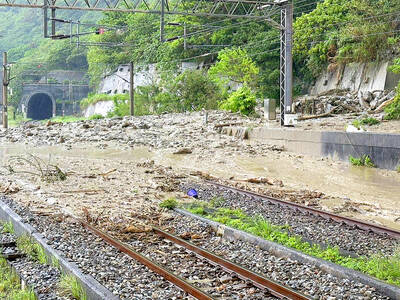
ROLLER-COASTER RIDE: More than five earthquakes ranging from magnitude 4.4 to 5.5 on the Richter scale shook eastern Taiwan in rapid succession yesterday afternoon Back-to-back weather fronts are forecast to hit Taiwan this week, resulting in rain across the nation in the coming days, the Central Weather Administration said yesterday, as it also warned residents in mountainous regions to be wary of landslides and rockfalls. As the first front approached, sporadic rainfall began in central and northern parts of Taiwan yesterday, the agency said, adding that rain is forecast to intensify in those regions today, while brief showers would also affect other parts of the nation. A second weather system is forecast to arrive on Thursday, bringing additional rain to the whole nation until Sunday, it

LANDSLIDES POSSIBLE: The agency advised the public to avoid visiting mountainous regions due to more expected aftershocks and rainfall from a series of weather fronts A series of earthquakes over the past few days were likely aftershocks of the April 3 earthquake in Hualien County, with further aftershocks to be expected for up to a year, the Central Weather Administration (CWA) said yesterday. Based on the nation’s experience after the quake on Sept. 21, 1999, more aftershocks are possible over the next six months to a year, the agency said. A total of 103 earthquakes of magnitude 4 on the local magnitude scale or higher hit Hualien County from 5:08pm on Monday to 10:27am yesterday, with 27 of them exceeding magnitude 5. They included two, of magnitude

CONDITIONAL: The PRC imposes secret requirements that the funding it provides cannot be spent in states with diplomatic relations with Taiwan, Emma Reilly said China has been bribing UN officials to obtain “special benefits” and to block funding from countries that have diplomatic ties with Taiwan, a former UN employee told the British House of Commons on Tuesday. At a House of Commons Foreign Affairs Committee hearing into “international relations within the multilateral system,” former Office of the UN High Commissioner for Human Rights (OHCHR) employee Emma Reilly said in a written statement that “Beijing paid bribes to the two successive Presidents of the [UN] General Assembly” during the two-year negotiation of the Sustainable Development Goals. Another way China exercises influence within the UN Secretariat is

Taiwan’s first drag queen to compete on the internationally acclaimed RuPaul’s Drag Race, Nymphia Wind (妮妃雅), was on Friday crowned the “Next Drag Superstar.” Dressed in a sparkling banana dress, Nymphia Wind swept onto the stage for the final, and stole the show. “Taiwan this is for you,” she said right after show host RuPaul announced her as the winner. “To those who feel like they don’t belong, just remember to live fearlessly and to live their truth,” she said on stage. One of the frontrunners for the past 15 episodes, the 28-year-old breezed through to the final after weeks of showcasing her unique


 RSS
RSS