


Research In Motion (RIM) moved closer on Wednesday to a showdown with NTP, a patent holding company, over BlackBerry service after a court dismissed its request to impose a failed settlement agreement on the two companies.
The ruling by Judge James Spencer of US District Court in Richmond, Virginia, means RIM will either have to renegotiate a settlement with NTP or face a shutdown of its BlackBerry wireless e-mail service in the US, perhaps within the next month.
The company does not break down its operations by country, but it is estimated that about 70 percent of its revenue from 3.65 million BlackBerry users worldwide comes from US customers.
Most analysts say a shutdown is unlikely because of the enormous financial damage it would do to the company.
If a shutdown does occur, RIM has said that it will substitute an alternate, user-tested technology that does not violate NTP's patents, although it has offered few details about it.
Spencer previously banned the sale and use of the BlackBerry system for everyone other than government account holders after finding that RIM had violated some wireless e-mail patents owned by NTP. That order was held up to permit RIM to mount an appeal, which was unsuccessful.
On Wednesday, Spencer issued a one-page order rejecting RIM's request to impose a proposed settlement reached out of court between the two companies last spring. It would have resolved the dispute in exchange for a US$450 million payment from RIM. But the deal fell apart after both sides accused each other of trying to add unacceptable conditions.
"The court finds that the two parties do not have a valid and enforceable settlement agreement," Spencer wrote.
The decision was reached without a hearing, and the reasons for Spencer's order were sealed.
The judge also dismissed a request by RIM to delay any order until the US Patent and Trademark Office completes a review of NTP's patents. To date, the patent office has rejected five of the seven NTP patents at the heart of the case. But NTP, which is based in Arlington, Virginia, has challenged those findings and the process is likely to continue for months, if not longer.
Kevin Anderson, a lawyer for NTP, said he hoped that Wednesday's ruling would persuade RIM to end its court challenges and try to negotiate a settlement.
"Our viewpoint has always been that RIM has the keys to its own jail cell," Anderson said. "They can get a deal that fully protects them and their customers at a price everyone agrees is fair."
Anderson declined to discuss exactly what that price might be, though he said it might not necessarily be higher than the US$450 million of the earlier agreement.
In a statement, RIM said it would continue to prepare an appeal to the US Supreme Court.
"While further review by the Supreme Court is generally uncommon, RIM continues to believe this case raises significant national and international issues warranting further appellate review," the company said.
Many analysts, however, are coming to the view that RIM is fast exhausting its legal options.
"RIM's legal alternatives are diminishing; therefore, the probability of a settlement is increasing," said Mike Abramsky, an analyst in Toronto with RBC Dominion Securities. (Its parent company, the Royal Bank of Canada, has a banking relationship with RIM.)

National Taiwan University (NTU) yesterday said it disqualified a person from an entrance examination for using AI smart glasses to cheat, along with two others for making untruthful statements in their curriculum vitae. The three applicants were given null scores, Taiwan’s highest-ranked university said, calling on prospective students to be honest in the admissions process. NTU registrar Lee Hung-sen (李宏森) said that the cheating applicant wore a hat and thick-rimmed glasses to the second written exam for medical school, claiming that they felt cold. Suspicions were aroused when the applicant stared oddly at the test for long stretches while steadily bringing the paper
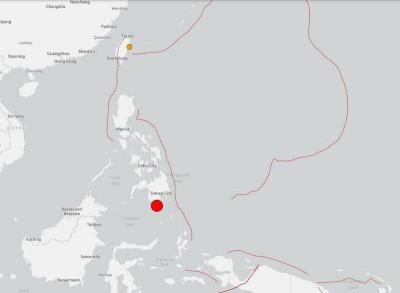
A magnitude 7.8 earthquake struck off the southern coast of Mindanao in the Philippines at 7:38am today, prompting the US Tsunami Warning System to issue an alert for neighboring countries, including Taiwan. The system issued a purple alert indicating a "tsunami threat." The potential threat zone includes Taiwan, the Philippines, Papua New Guinea, Yap and Palau. Philippine authorities were assessing the damage from the quake, with the office of civil defense seeking to verifying initial reports that 15 people had been killed and 129 injured in the region, mostly from falling debris. Arlene Hollero, disaster chief of Maasim town in the Philippines' Sarangani Province,

‘GRAY ZONE’ PRESSURE: Beijing’s activities are intended to create the deceitful impression that China has jurisdiction over the area around Taiwan, the CGA said Taiwan’s rights over its territorial waters and exclusive economic zone must not be violated by any country, the Mainland Affairs Council said yesterday, adding that it will not accept any unprovoked actions. The council issued the remarks in response to the China Coast Guard conducting maritime enforcement drills near eastern Taiwan and claiming to fully exercise China’s maritime administrative law enforcement authority. The Coast Guard Administration (CGA) has been closely monitoring the situation and is taking concrete steps to defend the nation’s sovereignty and secure its waters, the council said. China has no sovereign rights over the waters off eastern
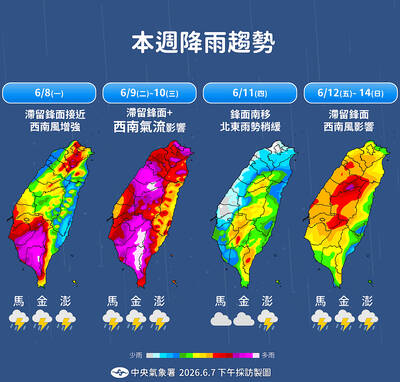
Heavy rain is expected to affect parts of Taiwan this week, the Central Weather Administration (CWA) said yesterday as a meteorologist said the active part of the annual plum rain season has started. A stationary plum rain front and southwesterly winds would bring unstable weather and abundant moisture to Taiwan from today for about a week, with the heaviest rainfall forecast for tomorrow and Wednesday, the CWA said. The agency said western and northeastern Taiwan, and mountainous areas in the east and southeast, could expect showers or thunderstorms on those two days, with localized heavy rain possible. Other parts of


 RSS
RSS