


The huge chemical spill in the Songhua River that threatens the water supply of Harbin, an old industrial city located in China's frigid, northeastern corridor, has focused attention on the environmental and economic challenges faced by the country's withering rust belt.
Long before Harbin's officials were forced to confront the contamination of the city's water, however, they had embarked on a radical step, one increasingly common among cities in China: Fearful of losing out during the country's economic boom, they had begun efforts to move the center of the city north, across the winding Songhua, to a large plot of farm land.
The city of Nanjing did something similar last year, carving out a 95km2 area to create its own "new town." And so have other cities, like Ningbo, Yangzhou and Nanchang, the capital of Jiangxi province, which is planning to relocate its city center to the western banks of the Gan River.
Across China, dozens of reborn cities are sprouting up like mushrooms after a spring rain, as the Chinese saying goes, relocating their town centers or creating entirely new ones.
Latecomers to the economic race, these big cities want to revitalize their blighted urban areas and cash in on the nation's real estate surge.
Harbin officials say they are creating a new commercial and government center for the city, which is now struggling to manage a water crisis after a chemical plant explosion 380km upriver contaminated the Songhua with toxic benzene on Nov. 13.
The Chinese government cut the city's water supply on Wednesday; 4 million people in Harbin are expected to be without running water until at least tomorrow.
Despite this setback, city officials are confident that the prospect of a multibillion dollar real estate boom will help attract investors.
"This is going to help development boom in the region," says Qu Weisong, a Harbin city official who helped create the new district. "It's about time real estate started to matter here."
Perhaps only in a country like China are such large-scale urban projects even possible. That's because local officials enjoy the same sweeping powers held by the government's top central planners.
While much of the world marvels at China's manufacturing prowess, what is more striking is the physical renaissance rolling across the urban landscape, led by city planners, architects, housing crews and construction companies.
Old urban centers -- most of them frozen in time since the Communist Party took over in 1949 -- are being demolished, millions of residents are being relocated, and construction crews are fanning out to build the cities of tomorrow.
In Shanghai, the government is clearing 525 hectares of riverfront land and relocating about 50,000 residents and more than 270 factories, including the country's largest shipyard, to build a site for the World Expo to be held in 2010.
Out west, in the city of Kunming, there are plans to create three new areas that will ring Dian Chi Lake, doubling the city's size to 5 million by 2020.
In Zhengzhou, the capital of Henan province, the city hired a Japanese designer to develop a master plan for a new 150km2 town.
And in Changchun, the capital of Jilin province in the north, the city government and the central business district are also being relocated to a new city center.
"Every government wants to do big things, and they want them done fast, while they're still in office," says Eva Wang, who runs EWS, a Shanghai-based architecture firm. "They all want to get credit for creating something really astounding."
Few urban projects, however, are as ambitious as the one being planned here in Harbin, a city of 9 million.
Early last year, Harbin officials won approval to build a new city center called Songbei -- a 740km2 area that will be packed with residential high rises, office towers, luxury villas, five-star hotels, shopping and entertainment complexes, trade zones and industrial parks.
Songbei is roughly the size of New York City.
"This is the most important thing that has happened to Harbin in a long time," says Wang Renping, who runs an online real estate company here. "Ten years ago, that was all empty land."
The Songbei project, however, is as much a sign of the city's desperation as a symbol of its hope.
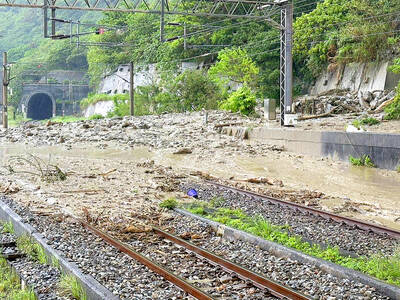
ROLLER-COASTER RIDE: More than five earthquakes ranging from magnitude 4.4 to 5.5 on the Richter scale shook eastern Taiwan in rapid succession yesterday afternoon Back-to-back weather fronts are forecast to hit Taiwan this week, resulting in rain across the nation in the coming days, the Central Weather Administration said yesterday, as it also warned residents in mountainous regions to be wary of landslides and rockfalls. As the first front approached, sporadic rainfall began in central and northern parts of Taiwan yesterday, the agency said, adding that rain is forecast to intensify in those regions today, while brief showers would also affect other parts of the nation. A second weather system is forecast to arrive on Thursday, bringing additional rain to the whole nation until Sunday, it
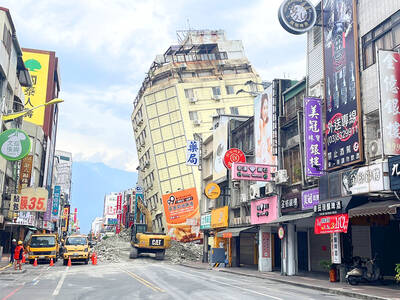
LANDSLIDES POSSIBLE: The agency advised the public to avoid visiting mountainous regions due to more expected aftershocks and rainfall from a series of weather fronts A series of earthquakes over the past few days were likely aftershocks of the April 3 earthquake in Hualien County, with further aftershocks to be expected for up to a year, the Central Weather Administration (CWA) said yesterday. Based on the nation’s experience after the quake on Sept. 21, 1999, more aftershocks are possible over the next six months to a year, the agency said. A total of 103 earthquakes of magnitude 4 on the local magnitude scale or higher hit Hualien County from 5:08pm on Monday to 10:27am yesterday, with 27 of them exceeding magnitude 5. They included two, of magnitude

CONDITIONAL: The PRC imposes secret requirements that the funding it provides cannot be spent in states with diplomatic relations with Taiwan, Emma Reilly said China has been bribing UN officials to obtain “special benefits” and to block funding from countries that have diplomatic ties with Taiwan, a former UN employee told the British House of Commons on Tuesday. At a House of Commons Foreign Affairs Committee hearing into “international relations within the multilateral system,” former Office of the UN High Commissioner for Human Rights (OHCHR) employee Emma Reilly said in a written statement that “Beijing paid bribes to the two successive Presidents of the [UN] General Assembly” during the two-year negotiation of the Sustainable Development Goals. Another way China exercises influence within the UN Secretariat is

Taiwan’s first drag queen to compete on the internationally acclaimed RuPaul’s Drag Race, Nymphia Wind (妮妃雅), was on Friday crowned the “Next Drag Superstar.” Dressed in a sparkling banana dress, Nymphia Wind swept onto the stage for the final, and stole the show. “Taiwan this is for you,” she said right after show host RuPaul announced her as the winner. “To those who feel like they don’t belong, just remember to live fearlessly and to live their truth,” she said on stage. One of the frontrunners for the past 15 episodes, the 28-year-old breezed through to the final after weeks of showcasing her unique


 RSS
RSS