


Gold may rise to US$500 an ounce for the first time since 1987 as investors purchase more bullion as a hedge against declining currencies, a survey shows.
Sixteen of 28 traders, investors and analysts surveyed from Sydney to Chicago on Nov. 17 and Nov. 18 advised buying gold, which rose US$16.80 last week to US$486.20 on the Comex division of the New York Mercantile Exchange. Prices are up 11 percent this year.
Gold sold in dollars gained against the major currencies last week, including a 3.5 percent increase in euros and 5 percent in the British pound. Gold rallied this year as mine output slowed, global jewelry demand rose and investors grew more concerned inflation would accelerate.
"Gold is trading like a currency," said Fulinda Malone-Rouse, business-development manager in New York for EBS Dealing Resources, a London-based spot market that handles US$120 billion in daily gold, silver andcurrency transactions. Trading is up 30 percent this year, and "we're seeing banks start to refocus on metals," Malone-Rouse said. "We're also seeing foreign-exchange traders trade gold."
Gold for December delivery rose 3.5 percent last week on the Comex, the biggest gain since August last year. The rally was anticipated by the majority of analysts surveyed Nov. 10 and Nov. 11.
"I can see gold going through US$500 an ounce in the very near future," Barrick Gold Corp chief executive Gregory Wilkins said in an interview. Since gold has traded above US$500 only "a handful of times," any return to that level may spur more demand, he said.
Investors also are being drawn to gold as a haven because of the threat to financial markets from avian flu in Asia, the war in Iraq and the riots in France's suburbs, traders and analysts said. Demand for gold coins, bars and bullion-backed shares rose 56 percent in the third quarter from a year earlier, led by a 38 percent gain in purchases in the Middle East, the producer-funded World Gold Council said Nov. 17.
"They see holding large amounts of currency as high-risk," said William O'Neill, a partner at Logic Advisors LLC, a commodity-consulting company in New Jersey.
O'Neill said gold will trade between US$520 and US$525 for the rest of the year, up from his previous forecast of US$485 to US$490. "This is the day of the hard asset."
Gold may also rise as central banks halt or slow a practice of selling precious-metal reserves and diversify out of dollar assets.
Russia's central bank may double its gold holdings to 10 percent of reserves from 5 percent, Maria Guegina, the bank's head of external reserves, said on Nov. 15. The central banks of South Africa and Argentina also said they may boost gold reserves.
"The markets work on fear and greed," Kevin McArthur, chief executive of mining company Glamis Gold Ltd, said. "The fear factor on central bankers is such that they are buying. That is a very positive thing that's happened in our industry."
Central banks, mainly in the US and Europe, hold almost a fifth of the world's gold as a reserve asset. In 1999, several European central banks agreed to limit their sales of bullion, to prevent price swings and make the market more transparent.
Investors may also buy gold to hedge against inflation, traders and analyst said.
European Central Bank president Jean-Claude Trichet said the bank is poised to raise interest rates for the first time in five years to stem inflation in the 12 euro nations. Bonds fell across the region. European inflation, which reached 2.5 percent in September from a year earlier, was 2.7 percent last year and 2.2 percent in 2003.
US consumer prices are rising at a 4.9 percent annual pace compared with a 3.7 percent increase at the same time last year, figures from the Labor Department showed.
"Inflation is real," McArthur said. "The flight to quality is to gold."
Some investors buy gold in times of inflation to preserve purchasing power. Gold surged to US$873 an ounce in 1980 when consumer prices jumped 12.5 percent. Gold reached a 16-year high of US$458.70 an ounce on Dec. 2 as US inflation jumped to 3.3 percent last year, from 1.9 percent in 2003.
"Gold will continue to climb higher over the coming months," said Stuart Flerlage, managing principal at Patronus Capital. "Investors recognize that everything they spend money on has become more expensive."

National Taiwan University (NTU) yesterday said it disqualified a person from an entrance examination for using AI smart glasses to cheat, along with two others for making untruthful statements in their curriculum vitae. The three applicants were given null scores, Taiwan’s highest-ranked university said, calling on prospective students to be honest in the admissions process. NTU registrar Lee Hung-sen (李宏森) said that the cheating applicant wore a hat and thick-rimmed glasses to the second written exam for medical school, claiming that they felt cold. Suspicions were aroused when the applicant stared oddly at the test for long stretches while steadily bringing the paper
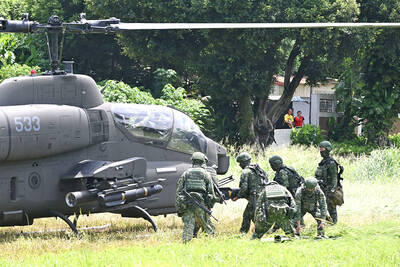
MILITARY ISSUES: A partisan divide between the Cabinet and the legislature ‘raised questions about Taiwan’s ability to adequately fund its defense,’ the report said Taiwan’s defense budget, military personnel numbers and resilience are challenges to its ability to meet national defense goals, the US Naval Institute said in a report published on Tuesday. In response to the perception of a growing military threat posed by China, Taiwan has embarked on an effort to enhance the capabilities needed to deter an attempt by Beijing to annex the nation by force, the institute said in the US Congressional Research Service report, titled Taiwan: Defense and Military Issues, which was filed on Thursday last week. Taiwan’s defense budget increased by about 7.5 percent from 2024 to last year, it

66 FIGHTER JETS: The aircraft is likely undergoing preparations for its transfer to Taiwan — a significant step forward in the nation’s modernization program, a lawmaker said The first of Taiwan’s order of F-16V Block 70 aircraft has been sighted in Texas ahead of delivery, Democratic Progressive Party (DPP) Legislator Wang Ting-yu (王定宇) said. Taiwan’s first F-16V Block 70 two-seat aircraft, tail number 6831, was seen flying from Lockheed Martin’s production facility in Greenville, South Carolina, to Naval Air Station Joint Reserve Base Fort Worth in Texas, Wang wrote on Facebook yesterday. The plane is likely undergoing preparations for its transfer to Taiwan, marking a significant step forward in the Republic of China Air Force’s modernization program, Wang said, citing military analysts. The F-16V Block 70 is a new-build version

NOT JUST NUMBERS: What matters to intelligence work is crucial, reliable information, so even a few credible leads can be highly valuable to national security, a legislator said The National Security Bureau (NSB) yesterday said it has finished the establishment of an information-reporting channel for Chinese nationals, the aim of which is to broaden intelligence gathering on China’s political, military, economic and social developments. Chinese nationals can submit information on the Web page, https://report.nsb.gov.tw, the NSB said in a statement. The move aims to expand the bureau’s diverse intelligence sources and is pursuant to the National Intelligence Services Act (國家情報工作法), it said, adding that it referenced practices adopted by intelligence agencies in the US, the UK and Israel. An increasing number of people are approaching Taiwanese agencies to provide information, as


 RSS
RSS