


South Korea's Samsung Electronics Co said yesterday it expects cut-throat competition in the flat-screen market to intensify in the coming years, with only top-flight producers surviving.
"The sector has enjoyed a 10-year boom thanks to high growth. However, it will face a different environment in the next phase [of development]," Souk Jun-Hyung, an executive vice president, told an analyst meeting.
The liquid crystal displays (LCD) industry requires technical innovation and huge capital to survive, he said.
"Only those with huge funds will be able to increase production," he said, adding Samsung Electronics would step up cost-cutting efforts to beat its competitors.
"The industry is under enormous pressure to reduce cost," Souk said.
On Wednesday Lee Sang-Wan, president of the company's LCD business, predicted that only five big players would survive in the LCD market.
The world's second largest LCD maker after local rival LG.Philips LCD said it would focus on large TV panels.
"Through technical innovation and effective investment, Samsung will build a high [industry entry] barrier that latecomers will not be able to get over," Souk said.
Analysts cautioned that global supply of LCDs would exceed demand next year as LCD makers in South Korea, Japan and Taiwan have ramped up investment in new plants to produce bigger flat panels at cheaper prices.
Separately, Samsung Electronics on Friday also said it has no intention to challenge Apple Computer Inc's hit iTunes music service with one of its own but can help other online song providers improve theirs, an executive said Friday.
"Everyone respects what they've done," David Steel, vice president of Samsung's digital media business, told reporters regarding Apple's iTunes. "They've got a great user interface."
Echoing comments made on Thursday by Choi Gee-sung, president of Samsung's digital media business, Steel said Samsung has no interest in becoming an online music provider itself like Apple.
"We are very interested in how we can improve the customer experience with our products," Steel said. "We don't aspire to be the end-to-end player."
Over the past week, there has been some confusion about Samsung's ambitions in the online business, with South Korean media reporting earlier this week that Choi said Samsung planned an online music service, remarks later confirmed by the company.
Choi on Thursday said there had been "some misunderstanding" of his comments to reporters.
He said Thursday that Samsung wants to work to help providers whose software is harder to use than iTunes to develop platforms that make services easier.
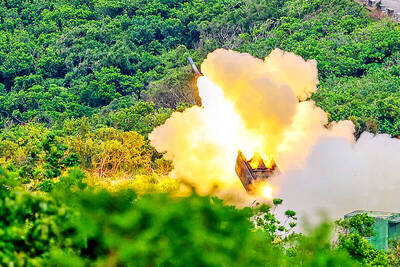
PRECISION STRIKES: The most significant reason to deploy HIMARS to outlying islands is to establish a ‘dead zone’ that the PLA would not dare enter, a source said A High Mobility Artillery Rocket System (HIMARS) would be deployed to Penghu County and Dongyin Island (東引) in Lienchiang County (Matsu) to force the Chinese military to retreat at least 100km from the coastline, a military source said yesterday. Taiwan has been procuring HIMARS and Army Tactical Missile Systems (ATACMS) from the US in batches. Once all batches have been delivered, Taiwan would possess 111 HIMARS units and 504 ATACMS, which have a range of 300km. Considering that “offense is the best defense,” the military plans to forward-deploy the systems to outlying islands such as Penghu and Dongyin so that
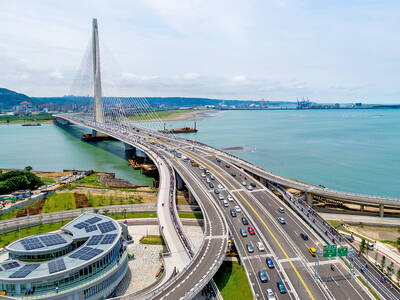
The Ministry of Transportation and Communications yesterday inaugurated the Danjiang Bridge across the Tamsui River in New Taipei City, saying that the structure would be an architectural icon and traffic artery for Taiwan. Feted as a major engineering achievement, the Danjiang Bridge is 920m long, 211m tall at the top of its pylon, and is the longest single-pylon asymmetric cable-stayed bridge in the world, the government’s Web site for the structure said. It was designed by late Iraqi-British architect Zaha Hadid. The structure, with a maximum deck of 70m, accommodates road and light rail traffic, and affords a 200m navigation channel for boats,
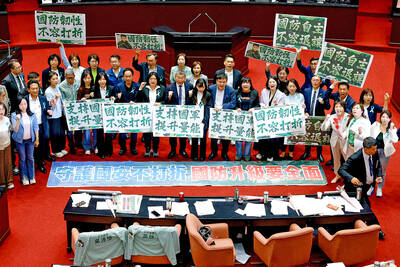
WHAT WAS ALL THAT FOR? Jaw Shaw-kong said that Cheng Li-wen had pushed for more drastic cuts and attacked him, just for the outcome to be nearly identical to his bill The legislature yesterday passed a supplementary budget bill to fund the purchase of separate packages of US military equipment, with the combined amount of spending capped at NT$780 billion (US$24.8 billion). The Chinese Nationalist Party (KMT) and Taiwan People’s Party (TPP) used their legislative majority to pass the bill, which runs until 2033 and has two main funding provisions. One was for NT$300 billion of arms sales already approved by the US for Taiwan on Dec. 17 last year, the other was for NT$480 billion for another arms package expected to be announced by Washington. The bill, which fell short of the NT$1.25

‘CLEAR MESSAGE’: The bill would set up an interagency ‘tiger team’ to review sanctions tools and other economic options to help deter any Chinese aggression toward Taiwan US Representative Young Kim has introduced a bill to deter Chinese aggression against Taiwan, calling for an interagency “tiger team” to preplan coordinated sanctions and economic measures in response to possible Chinese military or political action against Taiwan. “[Chinese President] Xi Jinping [習近平] has directed the People’s Liberation Army to be ready to invade Taiwan by 2027. China has a plan. America should have one too,” Kim said in a news release on Thursday last week. She introduced the “Deter PRC [People’s Republic of China] aggression against Taiwan act” to “ensure the US has a coordinated sanctions strategy ready should


 RSS
RSS