


The high-stakes question of whether to liberalize the EU lottery and betting industry is raising tensions between proponents of different gambling models in Europe as well as EU institutions.
National monopolies on the continent and UK bookmakers have long been divided over how much control the state should wield in the sector.
But with a key study underway about liberalization of the sector -- the first step towards legislation -- EU institutions are also at odds over the issue.
In Strasbourg this week, member of the European Parliament Jacques Toubon is to bring the EU's executive commission to task over the study, which it commissioned last year.
Toubon is to raise a question before the parliament about the impartiality of the study which was carried out by the Center for the Study of Gambling at the University of Salford in northern England and was partially sponsored by Stanley Leisure, a big British betting house.
The stakes are high in the liberalization game, with British bookmakers and online gambling operators enviously eyeing the continental lotteries, which are often national monopolies or strictly regulated regional operations.
"Is gambling an economic activity like others? If we answer yes, then we should liberalize it," said Christophe Blanchard-Dignac, chief executive of the French gaming monopoly Francaise des Jeux.
However, until now most EU states have considered gambling to be a special industry subject to special attention, because of the social problems such as "addictions and family dramas" that it can generate as well as "risk of criminal use" -- especially for online betting -- to launder money it bears.
Monopolies restrict and regulate gambling opportunities while "the free market tries to push growth to its limits," he said.
"One way or another gambling creates large dividends and it's got to be kept from being confiscated by private interests," Blanchard-Dignac said.
In most EU countries gambling possibilities are limited and winnings are usually capped at 50 percent to 60 percent of the stakes.
"If we give everything, the winnings are too big and it's too dangerous," said Winfried Wortmann, president of the European Lotteries and Toto Association.
What's not given back to lucky winners is used to finance public projects, running from amateur sports in France to social assistance programs in Portugal to the UK's National Trust.
The European Commission finds itself squashed between the two sides in the liberalization debate with the national lotteries suspecting it on the one hand of siding with the British bookies while at the same time it is swamped with complaints from the pro-liberalization camp.
"There is a risk that the [European] Commission can be sued for inaction," said spokesman Oliver Drewes.
Despite the doubts about the viability of the study under way, he insisted that there was no questioning its independence and the methods used to make it.
Results of the study are to be made public in early November.
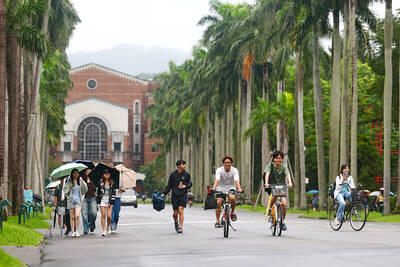
National Taiwan University (NTU) yesterday said it disqualified a person from an entrance examination for using AI smart glasses to cheat, along with two others for making untruthful statements in their curriculum vitae. The three applicants were given null scores, Taiwan’s highest-ranked university said, calling on prospective students to be honest in the admissions process. NTU registrar Lee Hung-sen (李宏森) said that the cheating applicant wore a hat and thick-rimmed glasses to the second written exam for medical school, claiming that they felt cold. Suspicions were aroused when the applicant stared oddly at the test for long stretches while steadily bringing the paper
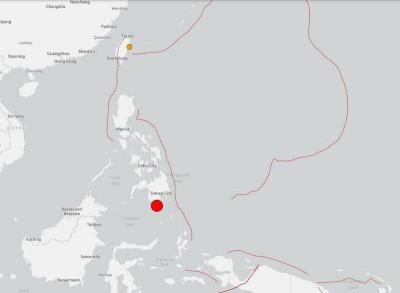
A magnitude 7.8 earthquake struck off the southern coast of Mindanao in the Philippines at 7:38am today, prompting the US Tsunami Warning System to issue an alert for neighboring countries, including Taiwan. The system issued a purple alert indicating a "tsunami threat." The potential threat zone includes Taiwan, the Philippines, Papua New Guinea, Yap and Palau. Philippine authorities were assessing the damage from the quake, with the office of civil defense seeking to verifying initial reports that 15 people had been killed and 129 injured in the region, mostly from falling debris. Arlene Hollero, disaster chief of Maasim town in the Philippines' Sarangani Province,
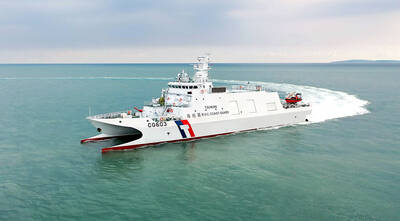
‘GRAY ZONE’ PRESSURE: Beijing’s activities are intended to create the deceitful impression that China has jurisdiction over the area around Taiwan, the CGA said Taiwan’s rights over its territorial waters and exclusive economic zone must not be violated by any country, the Mainland Affairs Council said yesterday, adding that it will not accept any unprovoked actions. The council issued the remarks in response to the China Coast Guard conducting maritime enforcement drills near eastern Taiwan and claiming to fully exercise China’s maritime administrative law enforcement authority. The Coast Guard Administration (CGA) has been closely monitoring the situation and is taking concrete steps to defend the nation’s sovereignty and secure its waters, the council said. China has no sovereign rights over the waters off eastern
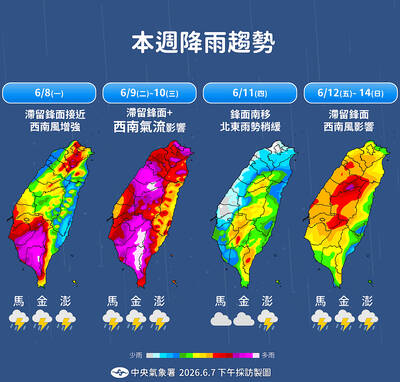
Heavy rain is expected to affect parts of Taiwan this week, the Central Weather Administration (CWA) said yesterday as a meteorologist said the active part of the annual plum rain season has started. A stationary plum rain front and southwesterly winds would bring unstable weather and abundant moisture to Taiwan from today for about a week, with the heaviest rainfall forecast for tomorrow and Wednesday, the CWA said. The agency said western and northeastern Taiwan, and mountainous areas in the east and southeast, could expect showers or thunderstorms on those two days, with localized heavy rain possible. Other parts of


 RSS
RSS