


The US Federal Reserve is being forced to rethink its plans for interest rate increases in the face of the calamity spawned by Hurricane Katrina in a strategic economic region, analysts say.
The bond and futures markets have shifted the odds of a further move by the US central bank, which has implemented 10 quarter-point increases as part of a gradual effort to normalize interest rates.
Yields on the bond market have fallen since the storm tore through the southeast as investors bet on a weaker economy.
The fed funds futures market is now priced for a 76 percent chance the Fed's target interest rate is lifted to 3.75 percent from 3.5 percent when the Fed meets on Sept. 20, down from a 90 percent chance earlier this week and 100 percent odds priced in last month.
Merrill Lynch chief economist David Rosenberg suggested that the Fed may stop its rate-boosting cycle immediately in the face of the disaster.
"We are clearly in a state of economic uncertainty and the prudent thing to do in such times is to do nothing at all," Rosenberg said. "The economy was already clearly losing momentum heading into Katrina."
SUBTLE SIGNALS
Rosenberg said the fact that Fed chairman Alan Greenspan met with US President George W. Bush after Katrina hit last week was significant.
"It is basically a subtle way to flash to the market that the negative economic consequences are resonating and that the Fed may not just look at this as a temporary soft patch this time," Rosenberg said.
Some analysts agree, arguing that Greenspan does not want to risk pushing the US economy into recession just before he retires in January.
"The interest-rate markets have moved to swiftly price in one last act of enlightened risk management from Fed chairman Greenspan in the form of a tightening pause," said Michael Wallace, economist with Action Economics.
Katrina has been so devastating because aside from leveling New Orleans and the surrounding area, it affected major oil refineries, ports, pipelines and highways connecting the region to the rest of the country.
HARMFUL DIVERSION?
The surge in energy costs threatens to divert tens of billions of dollars from consumers and dent spending on other items, thus crimping economic growth.
But a number of economists dispute the argument that the Fed should shift gears immediately.
Lehman Brothers economist Ethan Harris said "the markets have forgotten two lessons from prior natural disasters," referring to Fed action in the case of two major California earthquakes in recent years.
"The national economy usually weathers these storms with relatively minor damage," Harris said.
Harris said the devastating floods brought by Katrina represent a "supply shock" that may raise prices and not a "demand shock" that will harm long-term growth.
"In the past the Fed has approached supply shocks with a jaundiced eye," he said.
Other analysts say Greenspan and company will wait to see how quickly the disaster recovery proceeds and whether energy prices will settle to a less punishing level.
INSIDER'S VIEW
Among the few comments from the central bank, Philadelphia Fed president Anthony Santomero said Katrina's impact "may slow the rate at which the economy will grow for a time, but the expansion is strong enough to withstand them."
Nariman Behravesh, chief economist at research firm Global Insight, said the special circumstances of this event -- crimping the US energy industry and the major commodity port at New Orleans -- mean "a large national economic impact" that will shave between 0.5 percent and 1.0 percent from growth in the third and fourth quarters.
COMPLICATED TASK
"The uncertainty about the damage from Katrina will make the Fed's task far more complicated," Behravesh said.
He argued that "at most, the Fed will hike the federal funds rate another 25 basis points before the end of the year, probably at this month's meeting."
After that, the economist said, "Mr Greenspan and his colleagues are likely to take a `wait and see' attitude for a couple of meetings."
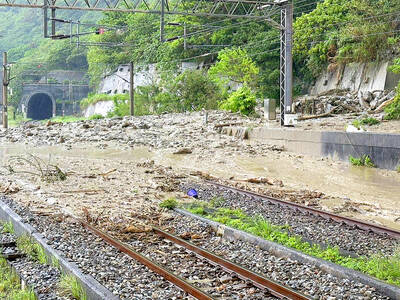
ROLLER-COASTER RIDE: More than five earthquakes ranging from magnitude 4.4 to 5.5 on the Richter scale shook eastern Taiwan in rapid succession yesterday afternoon Back-to-back weather fronts are forecast to hit Taiwan this week, resulting in rain across the nation in the coming days, the Central Weather Administration said yesterday, as it also warned residents in mountainous regions to be wary of landslides and rockfalls. As the first front approached, sporadic rainfall began in central and northern parts of Taiwan yesterday, the agency said, adding that rain is forecast to intensify in those regions today, while brief showers would also affect other parts of the nation. A second weather system is forecast to arrive on Thursday, bringing additional rain to the whole nation until Sunday, it
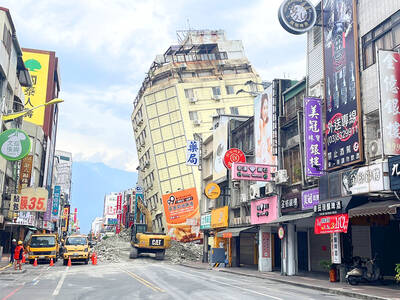
LANDSLIDES POSSIBLE: The agency advised the public to avoid visiting mountainous regions due to more expected aftershocks and rainfall from a series of weather fronts A series of earthquakes over the past few days were likely aftershocks of the April 3 earthquake in Hualien County, with further aftershocks to be expected for up to a year, the Central Weather Administration (CWA) said yesterday. Based on the nation’s experience after the quake on Sept. 21, 1999, more aftershocks are possible over the next six months to a year, the agency said. A total of 103 earthquakes of magnitude 4 on the local magnitude scale or higher hit Hualien County from 5:08pm on Monday to 10:27am yesterday, with 27 of them exceeding magnitude 5. They included two, of magnitude

CONDITIONAL: The PRC imposes secret requirements that the funding it provides cannot be spent in states with diplomatic relations with Taiwan, Emma Reilly said China has been bribing UN officials to obtain “special benefits” and to block funding from countries that have diplomatic ties with Taiwan, a former UN employee told the British House of Commons on Tuesday. At a House of Commons Foreign Affairs Committee hearing into “international relations within the multilateral system,” former Office of the UN High Commissioner for Human Rights (OHCHR) employee Emma Reilly said in a written statement that “Beijing paid bribes to the two successive Presidents of the [UN] General Assembly” during the two-year negotiation of the Sustainable Development Goals. Another way China exercises influence within the UN Secretariat is

Taiwan’s first drag queen to compete on the internationally acclaimed RuPaul’s Drag Race, Nymphia Wind (妮妃雅), was on Friday crowned the “Next Drag Superstar.” Dressed in a sparkling banana dress, Nymphia Wind swept onto the stage for the final, and stole the show. “Taiwan this is for you,” she said right after show host RuPaul announced her as the winner. “To those who feel like they don’t belong, just remember to live fearlessly and to live their truth,” she said on stage. One of the frontrunners for the past 15 episodes, the 28-year-old breezed through to the final after weeks of showcasing her unique


 RSS
RSS