


A US federal investigation of questionable tax shelters sold by KPMG, the large accounting firm, is about to take a long-anticipated step if, as expected, former partners at the firm and others involved are indicted on criminal charges, possibly as early as this week.
Last week, KPMG reached an agreement with the government that headed off an indictment of the firm itself, according to people briefed on the deal. As part of the agreement, which was expected to be announced yesterday, the firm would acknowledge wrongdoing, a move that will bolster prosecutors' case against the former KPMG partners and others.
Last week's settlement is a victory of sorts for KPMG and vindication of its legal team, led by Robert Bennett of Skadden Arps Slate Meagher & Flom, because it gives the firm a chance to avoid the kind of criminal case that proved fatal for another accounting firm, Arthur Andersen, Enron's auditor.
At the same time, the willingness of prosecutors to file criminal charges against former partners at the accounting firm may portend a new toughness in enforcing the rules governing complex and lucrative tax strategies.
"If they indict, it will be a shock wave through that part of the tax practice," said Daniel Simmons, a professor who teaches tax law at the University of California, Davis.
No court has ruled that the KPMG tax shelters were improper, which made the admission of wrongdoing from the firm important to prosecutors' efforts to build a case against any former partners. But prosecutors will probably broaden their case, which would make the propriety of the tax shelters less important. Prosecutors are also expected to focus on the conduct of the former partners -- for example, representations that might have been made in connection with selling the shelters.
An indictment, let alone a conviction, would send a message to those involved that they face more than civil liability if they were involved in overly aggressive tax transactions.
What has made the KPMG case so different from a typical action by the Internal Revenue Service is the outside pressure from lawmakers, according to lawyers involved. That has led to much more aggressive tactics by the government, the lawyers said.
"The entire flavor and complexion of the matter totally changed" after a Senate subcommittee held a hearing on the transactions in November 2003, said one lawyer who would speak only on the condition of anonymity because he is involved in the case.
"I saw it, and I knew it was going to change, and indeed it has changed," he said.
Normally, in an issue involving questionable shelters, the IRS might disallow a claimed loss, said Steven Dean, a law professor at Brooklyn Law School. Then, Dean said, a taxpayer has two options.
"Either the taxpayer can pay the tax," he said, and sue the IRS for a refund, "or can refuse to pay the tax and file a suit in a tax court."
Some firms involved in the tax shelter transactions sold by KPMG have sued the IRS; a ruling could come by the end of the year.
In the criminal case against former KPMG partners, prosecutors will probably try to show why the sophisticated transactions were illegal. They will also try to show that in marketing the shelters, former partners engaged in misconduct.

ROLLER-COASTER RIDE: More than five earthquakes ranging from magnitude 4.4 to 5.5 on the Richter scale shook eastern Taiwan in rapid succession yesterday afternoon Back-to-back weather fronts are forecast to hit Taiwan this week, resulting in rain across the nation in the coming days, the Central Weather Administration said yesterday, as it also warned residents in mountainous regions to be wary of landslides and rockfalls. As the first front approached, sporadic rainfall began in central and northern parts of Taiwan yesterday, the agency said, adding that rain is forecast to intensify in those regions today, while brief showers would also affect other parts of the nation. A second weather system is forecast to arrive on Thursday, bringing additional rain to the whole nation until Sunday, it

LANDSLIDES POSSIBLE: The agency advised the public to avoid visiting mountainous regions due to more expected aftershocks and rainfall from a series of weather fronts A series of earthquakes over the past few days were likely aftershocks of the April 3 earthquake in Hualien County, with further aftershocks to be expected for up to a year, the Central Weather Administration (CWA) said yesterday. Based on the nation’s experience after the quake on Sept. 21, 1999, more aftershocks are possible over the next six months to a year, the agency said. A total of 103 earthquakes of magnitude 4 on the local magnitude scale or higher hit Hualien County from 5:08pm on Monday to 10:27am yesterday, with 27 of them exceeding magnitude 5. They included two, of magnitude
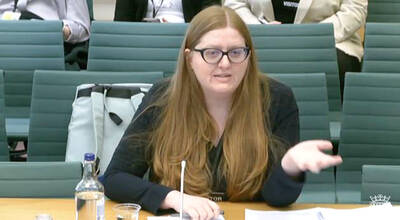
CONDITIONAL: The PRC imposes secret requirements that the funding it provides cannot be spent in states with diplomatic relations with Taiwan, Emma Reilly said China has been bribing UN officials to obtain “special benefits” and to block funding from countries that have diplomatic ties with Taiwan, a former UN employee told the British House of Commons on Tuesday. At a House of Commons Foreign Affairs Committee hearing into “international relations within the multilateral system,” former Office of the UN High Commissioner for Human Rights (OHCHR) employee Emma Reilly said in a written statement that “Beijing paid bribes to the two successive Presidents of the [UN] General Assembly” during the two-year negotiation of the Sustainable Development Goals. Another way China exercises influence within the UN Secretariat is

Taiwan’s first drag queen to compete on the internationally acclaimed RuPaul’s Drag Race, Nymphia Wind (妮妃雅), was on Friday crowned the “Next Drag Superstar.” Dressed in a sparkling banana dress, Nymphia Wind swept onto the stage for the final, and stole the show. “Taiwan this is for you,” she said right after show host RuPaul announced her as the winner. “To those who feel like they don’t belong, just remember to live fearlessly and to live their truth,” she said on stage. One of the frontrunners for the past 15 episodes, the 28-year-old breezed through to the final after weeks of showcasing her unique


 RSS
RSS