


China is not planning more abrupt changes to the yuan, a senior People's Bank of China official said, squelching speculation over further currency revaluations ahead of a meeting of top international finance officials later this week in China.
Following a 2 percent revaluation on July 21 that raised the yuan's level to 8.11 to the US dollar from the previous exchange rate of 8.27, further adjustments will be depend on the yuan's movement in the currency market, state media cited the official as saying yesterday.
The yuan's value surged to a 8.0965 closing against the US dollar on Friday, its highest level since July 21, amid speculation that a visit to the US by Chinese President Hu Jintao (
"Right now we often hear corporates or all sorts of people all asking when is the next time the foreign exchange rate will be adjusted again," Ma Delun (
"I'd like to tell everyone, the next change in the [yuan exchange rate level] is happening everyday, every hour it is going on," Ma said in a speech given over the weekend at a conference in Shenzhen.
"The next adjustment will come in the foreign-exchange market," Ma said.
The July 21 revaluation also cut the yuan's decade-old peg to the US dollar, linking it instead to a basket of currencies of China's main trading partners, including the US, Japan, the EU and South Korea.
But China still limits trading in the yuan and confines daily movements in the foreign-exchange market within a 0.3 percent range of its opening level. Since July 21, the yuan has appreciated by less than 0.2 percent against the dollar.
The central bank's goal is to maintain stability, Ma added.
Adjustments in China's foreign exchange policy will eventually give the market a much stronger sway over the yuan's value, though they may at first be perceived as slow, the Financial Times quoted central bank governor Zhou Xiaochuan (周小川) as saying.
Though the yuan's movement might seem small, "the important thing is that it has started to float and over time market forces will play a more and more important role," Zhou was quoted as saying.
Zhou said the central bank wants the yuan to move gradually to allow Chinese companies to adapt to the new trading system and to become familiar with financial instruments, such as forwards, used to hedge exchange-rate risks.
The comments came as top finance officials from the so-called Group of 20 developing and industrialized nations prepared to meet on Thursday in the northeastern city of Dalian. China this year assumed the presidency of the G20, a group created in 1999 with the aim of reforming the global financial system to make financial crises less likely.
Newly appointed US Treasury Secretary for International Affairs Timothy Adams, who will attend the Dalian meeting, was expected to reiterate Washington's position.
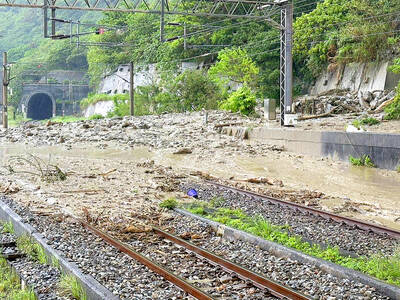
ROLLER-COASTER RIDE: More than five earthquakes ranging from magnitude 4.4 to 5.5 on the Richter scale shook eastern Taiwan in rapid succession yesterday afternoon Back-to-back weather fronts are forecast to hit Taiwan this week, resulting in rain across the nation in the coming days, the Central Weather Administration said yesterday, as it also warned residents in mountainous regions to be wary of landslides and rockfalls. As the first front approached, sporadic rainfall began in central and northern parts of Taiwan yesterday, the agency said, adding that rain is forecast to intensify in those regions today, while brief showers would also affect other parts of the nation. A second weather system is forecast to arrive on Thursday, bringing additional rain to the whole nation until Sunday, it
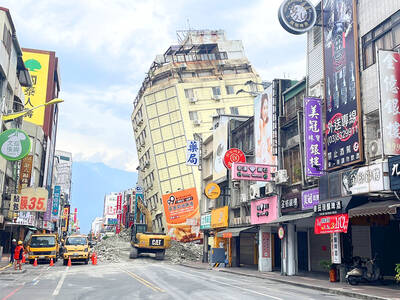
LANDSLIDES POSSIBLE: The agency advised the public to avoid visiting mountainous regions due to more expected aftershocks and rainfall from a series of weather fronts A series of earthquakes over the past few days were likely aftershocks of the April 3 earthquake in Hualien County, with further aftershocks to be expected for up to a year, the Central Weather Administration (CWA) said yesterday. Based on the nation’s experience after the quake on Sept. 21, 1999, more aftershocks are possible over the next six months to a year, the agency said. A total of 103 earthquakes of magnitude 4 on the local magnitude scale or higher hit Hualien County from 5:08pm on Monday to 10:27am yesterday, with 27 of them exceeding magnitude 5. They included two, of magnitude
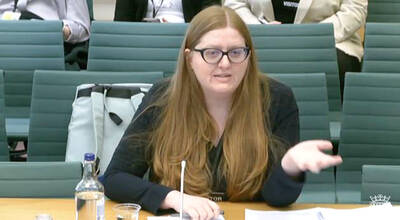
CONDITIONAL: The PRC imposes secret requirements that the funding it provides cannot be spent in states with diplomatic relations with Taiwan, Emma Reilly said China has been bribing UN officials to obtain “special benefits” and to block funding from countries that have diplomatic ties with Taiwan, a former UN employee told the British House of Commons on Tuesday. At a House of Commons Foreign Affairs Committee hearing into “international relations within the multilateral system,” former Office of the UN High Commissioner for Human Rights (OHCHR) employee Emma Reilly said in a written statement that “Beijing paid bribes to the two successive Presidents of the [UN] General Assembly” during the two-year negotiation of the Sustainable Development Goals. Another way China exercises influence within the UN Secretariat is

Taiwan’s first drag queen to compete on the internationally acclaimed RuPaul’s Drag Race, Nymphia Wind (妮妃雅), was on Friday crowned the “Next Drag Superstar.” Dressed in a sparkling banana dress, Nymphia Wind swept onto the stage for the final, and stole the show. “Taiwan this is for you,” she said right after show host RuPaul announced her as the winner. “To those who feel like they don’t belong, just remember to live fearlessly and to live their truth,” she said on stage. One of the frontrunners for the past 15 episodes, the 28-year-old breezed through to the final after weeks of showcasing her unique


 RSS
RSS