


Asian central banks will be more likely to allow their currencies to appreciate next year as economic growth strengthens, Lehman Brothers Holdings Inc said.
South Korea's won and the New Taiwan dollar may gain by 20 percent to 30 percent, as domestic-demand-driven expansion "increases the tolerance of policy makers to allow Asian currencies to rise," senior economist Robert Subbaraman wrote in a research note on Friday. "They remain significantly undervalued."
Faster growth raises demand for imported goods, reducing the need for central banks to sell their currencies and keep exports competitive.
"The stronger the recovery is, the more willing they will be," Subbaraman said in an interview on Monday. "The region is beginning to thrive from better economic fundamentals."
Asian economies excluding Japan will benefit in the second half of this year from an increase in electronics demand, and domestic consumer spending and business investment, he said.
China's economy, Asia's second-largest after Japan, grew a quicker-than-expected 9.5 percent in the second quarter as exports surged and investment in power plants, mines and factories gathered pace, the National Bureau of Statistics said on July 20.
Department store sales in South Korea rose 4.3 percent last month, the sixth straight month of gains, the government said on Aug. 17. Lehman forecasts South Korea's economy, Asia's third-largest, to expand 6 percent next year from 3.8 percent this year.
Aggregate growth in gross domestic product, excluding Japan, will reach 6.8 percent next year from 6.5 percent this year, the report said.
Lehman forecasts the Korean won will rise by about a fifth to 810 per dollar by the end of this year. The New Taiwan dollar will strengthen 28 percent to NT$23, the Singapore dollar will climb 22 percent to S$1.30 and Thailand's baht may rise 20 percent to 33 to the US currency, Subbaraman said.
The won traded at 1,025.80 per dollar as of 12:36pm yesterday in Seoul, having gained 0.9 percent this year, according to Seoul Money Brokerage Services Ltd. Taiwan's currency was at NT$32.12. It has declined 1.2 percent this year.
The yuan, which is a denomination of the Chinese currency, the renminbi, may gain 11 percent to 7.20 as the central bank steps up efforts to open up its currency market to overseas investors. The People's Bank of China allowed the yuan to strengthen 2.1 percent to 8.1 per dollar on July 21, the first time it has done so since 1995.
"China will allow the renminbi to appreciate steadily, but considerably" to rein in its large current-account surplus, Subbaraman said in the report. "China's transition to more flexible exchange rates has begun, which raises our conviction that Asia's currencies will rise sharply."
A stronger yuan makes it cheaper for China's consumers to buy Asian imports and harder for its exporters to compete abroad with companies such as Taiwan Semiconductor Manufacturing Co and Japan's NEC Electronics Corp.
Lehman's view on stronger Asian currencies is a reflection of its bearish forecast for the US dollar because of the current-account deficit, Subbaraman said. The difference in the value of incoming trade and outgoing widened to a record US$195.1 billion in the second quarter, the Commerce Department said on June 17. He expects the dollar to fall against the euro by 9.7 percent to US$1.35 next year.
The opening of China's economy will further support growth across Asian economies already aided by strong current-account surpluses and record foreign-exchange reserves in many Asian countries, he said. The current account measures investment as well as trade.
China's reserves, or currencies held at the central bank, surged 51 percent to US$711 billion in June from a year earlier, while South Korea's holdings rose 26 percent to US$206.4 billion as of April 30, according to Bloomberg's data.
A bigger pool of working-age people and a rising middle-class population will also underpin demand in Asia, Subbaraman said.
"There are structural forces that partly explain why the region is quite resilient to some large shocks, whether it's SARS, a tsunami or high oil prices," he said.
Rising crude-oil prices and slower-than-expected growth in China represent the biggest downside risks to the firm's forecasts, Subbaraman said. China is the world's largest oil consumer, while South Korea is the fourth-biggest importer.
Crude-oil futures fell as much as US$0.29, or 0.4 percent, to US$65.36 a barrel in after-hours electronic trading on the New York Mercantile Exchange. Prices reached a record US$67.10 a barrel on Aug. 12 and are 43 percent higher than a year ago.

ROLLER-COASTER RIDE: More than five earthquakes ranging from magnitude 4.4 to 5.5 on the Richter scale shook eastern Taiwan in rapid succession yesterday afternoon Back-to-back weather fronts are forecast to hit Taiwan this week, resulting in rain across the nation in the coming days, the Central Weather Administration said yesterday, as it also warned residents in mountainous regions to be wary of landslides and rockfalls. As the first front approached, sporadic rainfall began in central and northern parts of Taiwan yesterday, the agency said, adding that rain is forecast to intensify in those regions today, while brief showers would also affect other parts of the nation. A second weather system is forecast to arrive on Thursday, bringing additional rain to the whole nation until Sunday, it
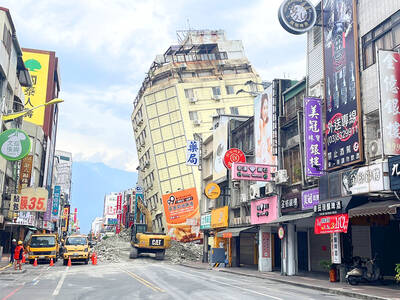
LANDSLIDES POSSIBLE: The agency advised the public to avoid visiting mountainous regions due to more expected aftershocks and rainfall from a series of weather fronts A series of earthquakes over the past few days were likely aftershocks of the April 3 earthquake in Hualien County, with further aftershocks to be expected for up to a year, the Central Weather Administration (CWA) said yesterday. Based on the nation’s experience after the quake on Sept. 21, 1999, more aftershocks are possible over the next six months to a year, the agency said. A total of 103 earthquakes of magnitude 4 on the local magnitude scale or higher hit Hualien County from 5:08pm on Monday to 10:27am yesterday, with 27 of them exceeding magnitude 5. They included two, of magnitude

CONDITIONAL: The PRC imposes secret requirements that the funding it provides cannot be spent in states with diplomatic relations with Taiwan, Emma Reilly said China has been bribing UN officials to obtain “special benefits” and to block funding from countries that have diplomatic ties with Taiwan, a former UN employee told the British House of Commons on Tuesday. At a House of Commons Foreign Affairs Committee hearing into “international relations within the multilateral system,” former Office of the UN High Commissioner for Human Rights (OHCHR) employee Emma Reilly said in a written statement that “Beijing paid bribes to the two successive Presidents of the [UN] General Assembly” during the two-year negotiation of the Sustainable Development Goals. Another way China exercises influence within the UN Secretariat is

Taiwan’s first drag queen to compete on the internationally acclaimed RuPaul’s Drag Race, Nymphia Wind (妮妃雅), was on Friday crowned the “Next Drag Superstar.” Dressed in a sparkling banana dress, Nymphia Wind swept onto the stage for the final, and stole the show. “Taiwan this is for you,” she said right after show host RuPaul announced her as the winner. “To those who feel like they don’t belong, just remember to live fearlessly and to live their truth,” she said on stage. One of the frontrunners for the past 15 episodes, the 28-year-old breezed through to the final after weeks of showcasing her unique


 RSS
RSS