


Ten days after China revalued its currency the central bank is again in a tight fix, battling market expectations for further adjustments.
China allowed the yuan to appreciate 2.1 percent to 8.11 yuan to the US dollar and has kept details about the basket's workings a secret, although it has promised to release more details in time.
The small shift, which by most estimates means the yuan is still undervalued by at least 10 percent, has prompted traders to speculate further changes are imminent, with some predicting a fresh adjustment before the end of the year.
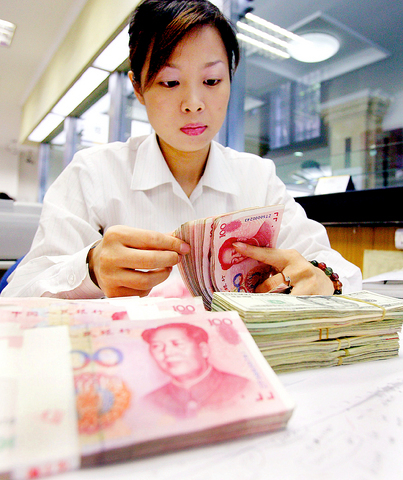
PHOTO: AFP
In an attempt to undermine speculators China's central bank last Tuesday took the unusual step of posting a notice in English, warning them not to interpret the revaluation last week as the first in a series.
"The 2.1 percent adjustment does not mean that the yuan exchange rate has been appreciated as a first step and that there will be further adjustments," the statement said.
Central bank chief Zhou Xiaochuan (
Analyst said the announcement reflected the bank's desire to deflect expectations amid worries about short-term funds flooding the banking system, a problem that has plagued the monetary system for the last two years.
"The central bank should manage expectations by controlling the pace of appreciation in the currency," said Ma Jun (馬駿), economist at Deutsche Bank.
It came as little surprise too that the central bank weighed into the forex market to prevent the yuan from rising sharply.
The yuan ended its first week of trade at 8.1056 to the US dollar, about a 0.04 percent change compared to the new level after its nearly decade-long peg to the US dollar at 8.28.
Although China's new managed float can in theory allow for a 0.3 percent shift in either direction to what the market deems fair value, analysts say the central bank is unlikely to allow that sort of play over the short term.
"Clearly it shows how in the earlier rhetoric China intends to do things gradually and in a step-by-step manner," Prakash Sakpal, an economist at ING Barings in Singapore, said of the yuan's minimal fluctuation.
It raises questions too about whether the revaluation is in effect just a new peg, much like the one against the dollar that locked the currency in a narrow band at around 8.28 yuan to the dollar.
China's central bank, which is fighting for greater monetary-policy independence from the ruling Communist Party, was in favor of a greater adjustment to the currency, analysts said.
"But there was a pretty strong view [among other decision makers] for a smaller adjustment," said Fred Hu (
Some say that Beijing's cautious strategy has only emboldened speculators to bet on further appreciation which would almost certainly trigger even more capital flows into China.
"The two percent revaluation has not relieved, and in fact has only intensified, yuan revaluation speculation," Zhang Shuguang (張曙光), a former senior fellow at the Chinese Academy of Social Sciences, told a forum in Beijing last week.
"What else is the central bank going to say in the face of mounting pressure?" Zhang said of the series of statements issued in the course of this week.
If China is to avoid the deluge of hot money that would cost billions of yuan in mop-up fees or spark an inflationary crisis, then it must give in to market demands by at minimum widening the yuan's trading band, Zhang said.
Beijing has long pledged to make its currency freely convertible as it presses ahead with 25 years of market-based reforms that launched its capitalist revolution, but is still hindered by the remnants of its command economy.
Holding it back are worries that its financial system is still too weak to cope with with fluctuations of full-floating currency, while its monetary hedging tools remain under-developed.
"It is a transition period now, and the central bank needs to map out policies to help Chinese enterprises gradually adapt to the fluctuation while giving time to its the banks to complete their reforms," said Sun Lijian (
"A comparatively stable rate of yuan is needed and so there will be more government intervention to maintain a stable rate within the floating scale," Sun said.
But unless China allows further appreciation, Democratic Senator Chuck Schumer and Republican Senator Lindsey Graham said on Friday that they would again push for a congressional vote on their co-sponsored bill that seeks punitive tariffs on all Chinese imports.
China, it seems, is back where it started.
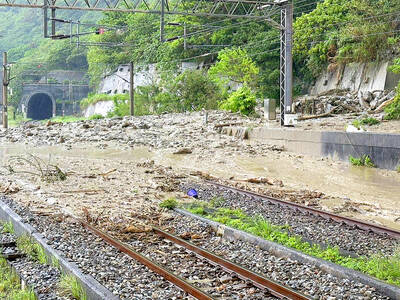
ROLLER-COASTER RIDE: More than five earthquakes ranging from magnitude 4.4 to 5.5 on the Richter scale shook eastern Taiwan in rapid succession yesterday afternoon Back-to-back weather fronts are forecast to hit Taiwan this week, resulting in rain across the nation in the coming days, the Central Weather Administration said yesterday, as it also warned residents in mountainous regions to be wary of landslides and rockfalls. As the first front approached, sporadic rainfall began in central and northern parts of Taiwan yesterday, the agency said, adding that rain is forecast to intensify in those regions today, while brief showers would also affect other parts of the nation. A second weather system is forecast to arrive on Thursday, bringing additional rain to the whole nation until Sunday, it
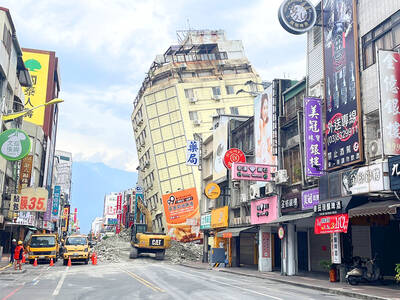
LANDSLIDES POSSIBLE: The agency advised the public to avoid visiting mountainous regions due to more expected aftershocks and rainfall from a series of weather fronts A series of earthquakes over the past few days were likely aftershocks of the April 3 earthquake in Hualien County, with further aftershocks to be expected for up to a year, the Central Weather Administration (CWA) said yesterday. Based on the nation’s experience after the quake on Sept. 21, 1999, more aftershocks are possible over the next six months to a year, the agency said. A total of 103 earthquakes of magnitude 4 on the local magnitude scale or higher hit Hualien County from 5:08pm on Monday to 10:27am yesterday, with 27 of them exceeding magnitude 5. They included two, of magnitude

CONDITIONAL: The PRC imposes secret requirements that the funding it provides cannot be spent in states with diplomatic relations with Taiwan, Emma Reilly said China has been bribing UN officials to obtain “special benefits” and to block funding from countries that have diplomatic ties with Taiwan, a former UN employee told the British House of Commons on Tuesday. At a House of Commons Foreign Affairs Committee hearing into “international relations within the multilateral system,” former Office of the UN High Commissioner for Human Rights (OHCHR) employee Emma Reilly said in a written statement that “Beijing paid bribes to the two successive Presidents of the [UN] General Assembly” during the two-year negotiation of the Sustainable Development Goals. Another way China exercises influence within the UN Secretariat is

Taiwan’s first drag queen to compete on the internationally acclaimed RuPaul’s Drag Race, Nymphia Wind (妮妃雅), was on Friday crowned the “Next Drag Superstar.” Dressed in a sparkling banana dress, Nymphia Wind swept onto the stage for the final, and stole the show. “Taiwan this is for you,” she said right after show host RuPaul announced her as the winner. “To those who feel like they don’t belong, just remember to live fearlessly and to live their truth,” she said on stage. One of the frontrunners for the past 15 episodes, the 28-year-old breezed through to the final after weeks of showcasing her unique


 RSS
RSS