


Controversial plans by the European Commission to reform the sugar industry face a first major test today, as EU farm ministers meet to debate them in Brussels with sugar growers protesting in the streets.
The reforms became necessary after the World Trade Organization (WTO) declared the EU policies -- which date back to 1968 -- illegal, based on a complaint from Australia, Brazil and Thailand.
Under current rules, the EU offers a guaranteed price for sugar that is paid for, in effect, by consumers, with Brussels buying from producers at about three times the average world market price.

PHOTO: AFP
The European Commission's plan is to cut the guaranteed price by 39 percent over two years from 2007 and offer a voluntary compensation scheme for producers forced out of business by the price cut.
But the reform is likely to hit the sugar sector in 18 African, Caribbean and Pacific (ACP) countries, which also benefit from the preferred price system.
They claim they will lose some 400 million euros (US$480 million) a year if the measures are adopted.
It is out of the question that the EU agriculture ministers, meeting in informal council today, will give the green light to the reform plans.
"There is a blocking minority of eight states. But eight out of 25 is quite a good start for an ambitious program," an official said.
The commission says it is hoping to get the go-ahead in November.
The eight -- Estonia, Finland, Greece, Italy, Ireland, Lithuania, Portugal and Spain -- fear that the reform will see their sugar beet farms disappear, giving the advantage to more competitive states like France and Germany.
The commission is offering to compensate producers 60 percent of their losses incurred by the drop in the guaranteed price, but it does not hide that it is trying to get rid of the poorer performers.
"We are well placed to help producers and farmers who would like to leave the sector in an orderly and socially acceptable manner," EU agriculture commissioner Mariann Fischer Boel said last month.
At an EU level, she has justified the plan by saying that the sugar sector needs to be brought into line with reforms made to the Common Agricultural Policy (CAP), the bloc's costly farm subsidy system, in 2003 and last year.
"We need a reform which gives a better fit between the sugar sector and the rest of the CAP," she said.
While the commission is offering 40 million euros to help ACP producers, the reform plans will mean far more in losses.
In Brussels, some 5,000 producers are expected to demonstrate to call for guarantees for their future. They claim some 120,000 of the bloc's 320,000 growers will disappear in the next two to three years.
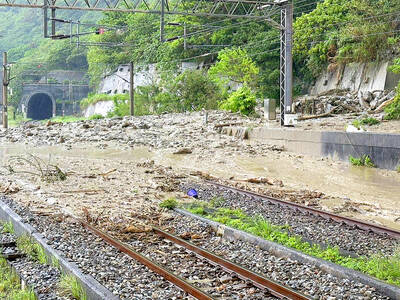
ROLLER-COASTER RIDE: More than five earthquakes ranging from magnitude 4.4 to 5.5 on the Richter scale shook eastern Taiwan in rapid succession yesterday afternoon Back-to-back weather fronts are forecast to hit Taiwan this week, resulting in rain across the nation in the coming days, the Central Weather Administration said yesterday, as it also warned residents in mountainous regions to be wary of landslides and rockfalls. As the first front approached, sporadic rainfall began in central and northern parts of Taiwan yesterday, the agency said, adding that rain is forecast to intensify in those regions today, while brief showers would also affect other parts of the nation. A second weather system is forecast to arrive on Thursday, bringing additional rain to the whole nation until Sunday, it

LANDSLIDES POSSIBLE: The agency advised the public to avoid visiting mountainous regions due to more expected aftershocks and rainfall from a series of weather fronts A series of earthquakes over the past few days were likely aftershocks of the April 3 earthquake in Hualien County, with further aftershocks to be expected for up to a year, the Central Weather Administration (CWA) said yesterday. Based on the nation’s experience after the quake on Sept. 21, 1999, more aftershocks are possible over the next six months to a year, the agency said. A total of 103 earthquakes of magnitude 4 on the local magnitude scale or higher hit Hualien County from 5:08pm on Monday to 10:27am yesterday, with 27 of them exceeding magnitude 5. They included two, of magnitude

CONDITIONAL: The PRC imposes secret requirements that the funding it provides cannot be spent in states with diplomatic relations with Taiwan, Emma Reilly said China has been bribing UN officials to obtain “special benefits” and to block funding from countries that have diplomatic ties with Taiwan, a former UN employee told the British House of Commons on Tuesday. At a House of Commons Foreign Affairs Committee hearing into “international relations within the multilateral system,” former Office of the UN High Commissioner for Human Rights (OHCHR) employee Emma Reilly said in a written statement that “Beijing paid bribes to the two successive Presidents of the [UN] General Assembly” during the two-year negotiation of the Sustainable Development Goals. Another way China exercises influence within the UN Secretariat is

Taiwan’s first drag queen to compete on the internationally acclaimed RuPaul’s Drag Race, Nymphia Wind (妮妃雅), was on Friday crowned the “Next Drag Superstar.” Dressed in a sparkling banana dress, Nymphia Wind swept onto the stage for the final, and stole the show. “Taiwan this is for you,” she said right after show host RuPaul announced her as the winner. “To those who feel like they don’t belong, just remember to live fearlessly and to live their truth,” she said on stage. One of the frontrunners for the past 15 episodes, the 28-year-old breezed through to the final after weeks of showcasing her unique


 RSS
RSS