


US logistics giant, FedEx, said yesterday it plans to build what would be the largest Asia-Pacific air transshipment hub at Guangzhou's Baiyun International Airport.
The company said it will invest US$150 million US dollars in the facility which will have a total floor space of 82,000m2 located on 63 hectares. The new hub will have 1,200 employees and will see 228 flights weekly into and out of the airport at the start-up.
The hub, expected to begin operations in December 2008, will assume and expand the current activities of the hub in Subic Bay, the Philippines, the company said in a statement.
"More than two decades ago, we envisioned China as a nexus of global supply and demand and as a result became the first express carrier to enter the market," Frederick Smith, FedEx chairman, said.
"Today, we further invest in our leadership position by creating a new gateway that expands our customers' access to the global marketplace," he said.
FedEx said it will maintain its presence in the Philippines and is expanding its airport operations in Manila in order to provide back-office functions.
Speaking at a press conference, Smith said the runway in Subic Bay would not be long enough to accommodate its A380 superjumbo jets although its greater consideration was that its future Asia's growth will be in China.
"Growth in Asia will be highly centred on China and Guangzhou, and this gives us flexibility with the A380s," Smith said.
"When the market changes, when growth pattern changes, you have to go where your customers want you to go," he said.
FedEx said the decision to develop the new hub was made following a study that forecast Asia will remain the world's fastest growing regional air freight market, with growth of 8.5 percent each year until 2023. China will be the main factor in that growth due to increasing traffic in semi-finished manufactured goods and steadily rising consumption, it said.
The study also showed air freight from China to the US will grow at an average of 9.6 percent a year over the next 20 years, while traffic to Europe is predicted to grow at 9.3 percent over the same period.
The US$2.4 billion dollar Baiyun Airport in Guangdong Province -- an area dubbed the factory of the world and which is responsible for over a third of China's exports -- has always been seen as a rival to Hong Kong.
Some 80 percent of all freight handled at Hong Kong's airport comes from Guangdong, accounting for more than a quarter of the city's external trade value.
Smith tried to allay fears that Hong Kong's airport will be affected as it will still be its major point of the cargo movement for its air express network.
He also said a landmark aviation deal between China and the US allowing the company to increase its cargo flights between the two makes this deal possible.
Under the agreement, five additional airlines from each country will be allowed to serve the US-China market by 2010, up from the existing four, with the number of weekly flights between each country rising to 249 from the current 54.
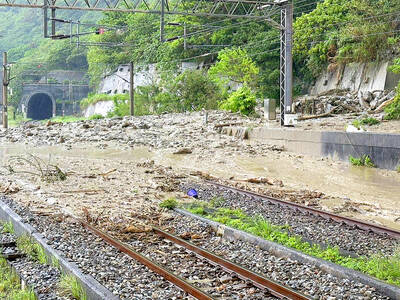
ROLLER-COASTER RIDE: More than five earthquakes ranging from magnitude 4.4 to 5.5 on the Richter scale shook eastern Taiwan in rapid succession yesterday afternoon Back-to-back weather fronts are forecast to hit Taiwan this week, resulting in rain across the nation in the coming days, the Central Weather Administration said yesterday, as it also warned residents in mountainous regions to be wary of landslides and rockfalls. As the first front approached, sporadic rainfall began in central and northern parts of Taiwan yesterday, the agency said, adding that rain is forecast to intensify in those regions today, while brief showers would also affect other parts of the nation. A second weather system is forecast to arrive on Thursday, bringing additional rain to the whole nation until Sunday, it
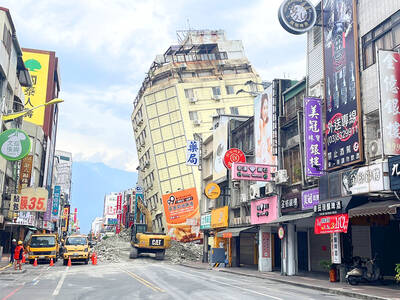
LANDSLIDES POSSIBLE: The agency advised the public to avoid visiting mountainous regions due to more expected aftershocks and rainfall from a series of weather fronts A series of earthquakes over the past few days were likely aftershocks of the April 3 earthquake in Hualien County, with further aftershocks to be expected for up to a year, the Central Weather Administration (CWA) said yesterday. Based on the nation’s experience after the quake on Sept. 21, 1999, more aftershocks are possible over the next six months to a year, the agency said. A total of 103 earthquakes of magnitude 4 on the local magnitude scale or higher hit Hualien County from 5:08pm on Monday to 10:27am yesterday, with 27 of them exceeding magnitude 5. They included two, of magnitude

CONDITIONAL: The PRC imposes secret requirements that the funding it provides cannot be spent in states with diplomatic relations with Taiwan, Emma Reilly said China has been bribing UN officials to obtain “special benefits” and to block funding from countries that have diplomatic ties with Taiwan, a former UN employee told the British House of Commons on Tuesday. At a House of Commons Foreign Affairs Committee hearing into “international relations within the multilateral system,” former Office of the UN High Commissioner for Human Rights (OHCHR) employee Emma Reilly said in a written statement that “Beijing paid bribes to the two successive Presidents of the [UN] General Assembly” during the two-year negotiation of the Sustainable Development Goals. Another way China exercises influence within the UN Secretariat is

Taiwan’s first drag queen to compete on the internationally acclaimed RuPaul’s Drag Race, Nymphia Wind (妮妃雅), was on Friday crowned the “Next Drag Superstar.” Dressed in a sparkling banana dress, Nymphia Wind swept onto the stage for the final, and stole the show. “Taiwan this is for you,” she said right after show host RuPaul announced her as the winner. “To those who feel like they don’t belong, just remember to live fearlessly and to live their truth,” she said on stage. One of the frontrunners for the past 15 episodes, the 28-year-old breezed through to the final after weeks of showcasing her unique


 RSS
RSS