


US aviation giant Boeing Co is facing possible US charges for selling commercial aircraft to China and other countries containing a gyroscopic chip with potential military applications, officials said on Wednesday.
"The [State] Department is currently in negotiations with the Boeing company regarding potential violation of the Arms Exports Control Act and International Trafficking in Arms Regulations," State Department spokeswoman Nancy Beck said.
She declined to provide specifics concerning the negotiations but said "documents relating to the charges" or a settlement would eventually be made public.
A Boeing spokeswoman, Amanda Landers, said the company has "been in discussions with the State Department for many months concerning past deliveries of aircraft and spare parts with the QRS-11 censor."
"As we continue to work with the State Department towards possible resolution of this matter, it would not be appropriate for us to comment on any possible charges or response," she said in a statement.
Boeing made the statement in response to a report in the Seattle Times newspaper that the State Department was poised to sue it for selling aircraft equipped with the QRS-11 chip.
The aviation giant, whose production base is in Seattle, could be hit with up to US$47 million in fines if found guilty of 94 violations of the Arms Control Act, according to the Seattle Times.
Aside from the fines, Boeing faces a "potential but unlikely three-year suspension from government contracts," the newspaper said.
Boeing failed to get export licenses for some microchips used in 96 jets it sold to China and other countries between 2000 and 2003, government officials maintained in civil charges cited by the paper.
The charges relate to the export of jets that contain the QRS-11 chip, used as a backup system in determining a plane's orientation in the air.
The Times cited a Boeing document that refers to the chip as "relatively unsophisticated" technology, but notes that the gyrochip also has been used to help stabilize and steer guided missiles.
The State Department's Directorate of Defense Trade Controls claims the company sold the technology to China "deliberately and repeatedly" even after it had been warned to stop, the Seattle Times said.
Boeing "was aware that a Department export license was required but chose to export without authorization by using false statements on documents," it quoted the charges as saying.
Boeing eventually acknowledged to the State Department it had exported 96 aircraft and 27 spare gyrochip-equipped flight boxes without export licenses, according to the report.
The QRS-11 chip, made by a unit of BEI Technologies in Concord, California, sells for between US$1,000 and US$2,000 and reportedly works in tandem with one made by the French firm Thales.
The newspaper reported that the State Department's charging letter contends that Thales told Boeing in 2000 that an export license was needed for the gyroscope system.
Such systems require a license every time they are moved to another country.
The new charges come in the wake of a series of scandals involving the aircraft maker.
The US Air Force in March lifted a ban on business with three Boeing units, clearing the way for them to compete for satellite launches worth billions of dollars.
The ban was slapped on the Boeing units in July 2003 after they were discovered with proprietary information belonging to Lockheed Martin that helped them win a 1998 rocket contract.

‘NO SECURITY RISK’: The Railway Bureau reassured the public that the technicians’ activities were limited to technical guidance and did not involve sensitive systems The Railway Bureau yesterday said it had invited eight Chinese technicians to assist with an airport MRT construction project. The bureau issued the confirmation after an Internet user said Chinese nationals had entered the construction zone of Taiwan Taoyuan International Airport’s Terminal 3 project. They asked why “individuals from an enemy state” were allowed access to such a major national infrastructure project, which raised serious concerns over Taiwan’s industrial safety, sensitive systems and information security. The bureau’s Northern Region Engineering Branch Office said subcontractor Taiwan Handle Industrial Co (台灣手把工業) of the Taoyuan airport MRT’s “Contract No. CU05 Project A14 Station Civil, MEP &

A US uncrewed surface vessel (USV) encountered multiple Chinese warships during an autonomous transit of the Taiwan Strait, US defense company Seasats said in a statement on Wednesday. Seasats announced that a Lightfish USV had completed the first autonomous transit of the Taiwan Strait. Over five days, the USV traversed the entire length of the Strait while constantly monitoring surface vessel traffic, the company said. The Lightfish encountered multiple Chinese warships, one of which was a Chinese People’s Liberation Army Navy (PLAN) Type 056 corvette, it said. The Chinese vessels were operating “well within Taiwan’s exclusive economic zone without transmitting their identity via the
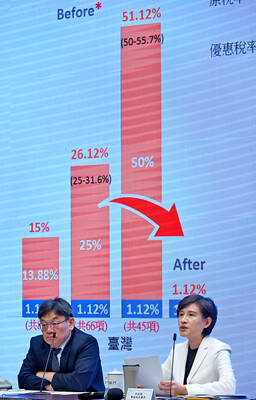
GREATER REACH? Auto parts and wood products would face tariffs of up to 15%, matching those targeting the EU, Japan and South Korea, Vice Premier said The US has announced that preferential tariff treatment for Taiwan’s non-semiconductor Section 232 goods would take effect retroactively from May 1, the Executive Yuan said yesterday. The US government yesterday posted a notice on the Federal Register’s public inspection Web site previewing tariff concessions for Taiwan under a memorandum of understanding (MOU) on Taiwan-US investment after two months of negotiations. The MOU signed on Jan. 15 stipulated three major preferential tariff arrangements: a 15 percent “reciprocal” tariff rate for Taiwan without stacking most-favored nation (MFN) rates; preferential Section 232 treatment for semiconductors and related products; and preferential Section 232 treatment for non-semiconductor

The National Chungshan Institute of Science and Technology yesterday showcased its locally developed variants of the Vision 60 robotic patrol dog, which it plans to deploy on the nation’s outlying territories in the South China Sea. The variants were produced under the Joint Lab project — created by the institute and domestic companies — and assembled with domestically produced motors, lenses and artificial intelligence (AI) systems alongside licensed tech from the US, Missile and Rocket Systems Research Division deputy director Jen Kuo-kang (任國光) told the media event at a military base in Taipei’s Dazhi (大直) area. Taiwan has built up its strengths


 RSS
RSS