


Willowy South Korean models skipped down the catwalk in the garment factory in North Korea as western funk and techno-pop blared from the loudspeakers.
They were showing off summer season clothes made a floor below by more than 200 North Korean women in light blue uniforms toiling over sewing machines to the thump of loud North Korean marching music.
The workers were spared the decadent capitalist display because none of them were invited.

PHOTO: AFP
It was a promotion by South Korean fashion maker Shinhan which runs the factory in a North Korean industrial park about 5km north of the heavily fortified border with South Korea.
The performance was watched by seven North Korean officials and 400 South Korean guests, including journalists bussed in for the day on Thursday.
"I am happy to make clothes here in cooperation with our southern brothers," said Lee Eun-hee, a 23-year-old North Korean woman.
The factory, run by seven South Korean managers, was free of political slogans and pictures of the country's leader Kim Jong-il, ubiquitous in North Korea homes, offices and public buildings.
Only a dozen workers who were designated as guides to South Korean visitors wore lapel pins with pictures of him or his father, Kim Il-sung, who founded the communist country and died in 1994.
Shinwon is one of the 15 South Korean firms, which started operations seven months ago in a demonstration complex of the 66 million square meter industrial zone, which is still under construction.
"I am fully satisfied with my business here," Shinwon chairman Park Sung-chul said.
He described the Kaesong factory as "most successful" of Shinwon's five overseas operations as it reached the break-even point last month, eight months earlier than he thought.
"At the beginning, many people voiced negative views. However, they were wrong ... as productivity here has improved quickly, partly thanks to easy communication," Park said.
He praised the factory's 281 North Koreans for showing "fraternal love and eagerness" to acquire skills.
Shinwon pays US$57 for each worker to a state manpower agency, roughly one-twentieth of the average wage in South Korea. It was unclear how much of the money went to the North Korean workers, who refused to disclose their take-home pay.
"I am satisfied with my wages," said Lee, who said she has worked in textile factories after vocational training for two years.
The minimum monthly wage for North Korean workers provided by a state agency has been set at US$50 on the basis of a 48-hour week.
Work on the Kaesong industrial park, which is expected to cost about US$4 billion, has suffered delays due to fluctuations in inter-Korean ties.
But Hyun Jeong-eun, 51, the chairwoman of Hyundai Group, rebuffed skepticism over the zone, a direct result of a watershed inter-Korean summit in 2000.
"Shinwon's success proved South and North Korea can do anything if they work together," she said, touting the Kaesong project as the backbone of inter-Korean cooperation.
Hyundai has spearheaded inter-Korean exchanges highlighted by work on relinking roads and railways across the demilitarized zone, which has separated the Korean Peninsula since the 1950-1953 Korean War.
South and North Korean checkpoints are only 4km apart but the cross-border trip took half an hour due to a strict inspection by North Korean border guards and customs officials.

NO-LIMITS PARTNERSHIP: ‘The bottom line’ is that if the US were to have a conflict with China or Russia it would likely open up a second front with the other, a US senator said Beijing and Moscow could cooperate in a conflict over Taiwan, the top US intelligence chief told the US Senate this week. “We see China and Russia, for the first time, exercising together in relation to Taiwan and recognizing that this is a place where China definitely wants Russia to be working with them, and we see no reason why they wouldn’t,” US Director of National Intelligence Avril Haines told a US Senate Committee on Armed Services hearing on Thursday. US Senator Mike Rounds asked Haines about such a potential scenario. He also asked US Defense Intelligence Agency Director Lieutenant General Jeffrey Kruse
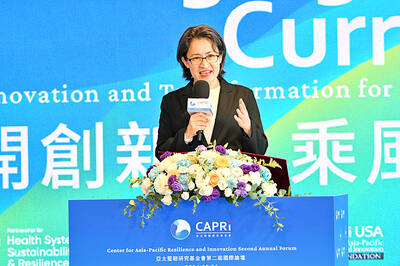
INSPIRING: Taiwan has been a model in the Asia-Pacific region with its democratic transition, free and fair elections and open society, the vice president-elect said Taiwan can play a leadership role in the Asia-Pacific region, vice president-elect Hsiao Bi-khim (蕭美琴) told a forum in Taipei yesterday, highlighting the nation’s resilience in the face of geopolitical challenges. “Not only can Taiwan help, but Taiwan can lead ... not only can Taiwan play a leadership role, but Taiwan’s leadership is important to the world,” Hsiao told the annual forum hosted by the Center for Asia-Pacific Resilience and Innovation think tank. Hsiao thanked Taiwan’s international friends for their long-term support, citing the example of US President Joe Biden last month signing into law a bill to provide aid to Taiwan,
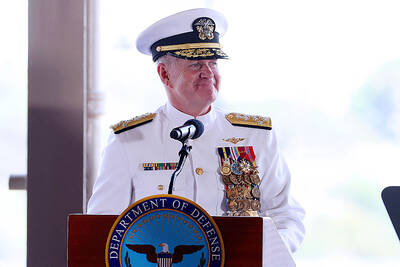
China’s intrusive and territorial claims in the Indo-Pacific region are “illegal, coercive, aggressive and deceptive,” new US Indo-Pacific Commander Admiral Samuel Paparo said on Friday, adding that he would continue working with allies and partners to keep the area free and open. Paparo made the remarks at a change-of-command ceremony at Joint Base Pearl Harbor-Hickam in Hawaii, where he took over the command from Admiral John Aquilino. “Our world faces a complex problem set in the troubling actions of the People’s Republic of China [PRC] and its rapid buildup of forces. We must be ready to answer the PRC’s increasingly intrusive and
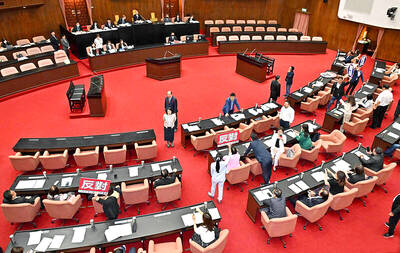
STATE OF THE NATION: The legislature should invite the president to deliver an address every year, the TPP said, adding that Lai should also have to answer legislators’ questions The Chinese Nationalist Party (KMT) yesterday proposed inviting president-elect William Lai (賴清德) to make a historic first state of the nation address at the legislature following his inauguration on May 20. Lai is expected to face many domestic and international challenges, and should clarify his intended policies with the public’s representatives, KMT caucus secretary-general Hung Meng-kai (洪孟楷) said when making the proposal at a meeting of the legislature’s Procedure Committee. The committee voted to add the item to the agenda for Friday, along with another similar proposal put forward by the Taiwan People’s Party (TPP). The invitation is in line with Article 15-2


 RSS
RSS