


As the sewing machines whirred at British clothing maker Season Link's busy factory floor, joint owner Sarjan Singh bemoaned the country's struggling manufacturing sector, ahead of a general election.
"Nobody's mentioned anything about what they are going to do for UK manufacturing at the moment," Singh said in reference to the three main parties slugging it out to win office on May 5.
British manufacturing -- in stark decline for the past 20 years -- has lost more than 1 million jobs since Prime Minister Tony Blair's Labour government swept to power eight years ago, many of which have been outsourced to Asia and Eastern Europe.
"We need support from the government but it would be too little too late," said Richard Marshall, whose leather goods factory employing 30 people is based in Birmingham along with Singh's workshop.
"They've never helped this industry. All they have done is just let it go down the pan," he said.
A recent survey showed that England's West Midlands region -- a traditional industrial heartland and home to Britain's second city Birmingham -- currently employs 469,000 manufacturing workers, equivalent to 12.58 percent of Britain's 3.726 million total workforce.
Blair's government, hoping to win an unprecedented third term on an economic ticket, has been keen to paint itself as the savior of British manufacturing, despite the recent collapse of bankrupt car maker MG Rover, also situated in Birmingham.
Faced with thousands of job losses at MG Rover's Longbridge car factory and its suppliers across marginal constituencies in the area, Blair has sought to reassure voters by stressing the "absolutely vital" importance of manufacturing to the country's economic success.
"But it's a case of what kind of manufacturing," Singh countered.
"Industry is changing here. There is still manufacturing done, but it's just not the original engineering-based manufacturing," he said as he watched over his machinists making piles of colorful women's tops.
"Globalization has made a big effect. Generally what we're finding is that any big orders tend to go off-shore now. They're not made in the UK."
British companies are under increasing pressure to relocate parts of their business overseas to remain competitive. A survey for the Confederation of British Industry last November revealed that 30 percent of 150 business leaders questioned had switched activities abroad.
Of those who had begun to outsource, 51 percent moved manufacturing to India, while 49 percent had staff working in China, 24 percent in Poland and 20 percent in the Czech Republic.
Singh said his workforce had shrunk from 20 to eight in the past two years, as sales orders dropped off owing to competition from cheaper foreign-produced goods.
Britain's clothing and textiles industry employs about 16,000 people across the West Midlands region, producing annual turnover in excess of ?300 million (US$575.7 million), according to Kim Knowles, chief executive of local industry body Midlands Fashion Showcase.
"But a lot of that money will have been sent overseas to source the manufacturing," he added.
Questioned about outsourcing, he replied simply: "It's business, it's called globalization. Some of them are finding it very tough to change with the times."
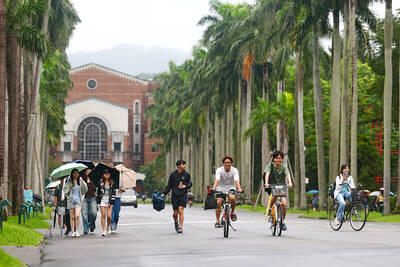
National Taiwan University (NTU) yesterday said it disqualified a person from an entrance examination for using AI smart glasses to cheat, along with two others for making untruthful statements in their curriculum vitae. The three applicants were given null scores, Taiwan’s highest-ranked university said, calling on prospective students to be honest in the admissions process. NTU registrar Lee Hung-sen (李宏森) said that the cheating applicant wore a hat and thick-rimmed glasses to the second written exam for medical school, claiming that they felt cold. Suspicions were aroused when the applicant stared oddly at the test for long stretches while steadily bringing the paper
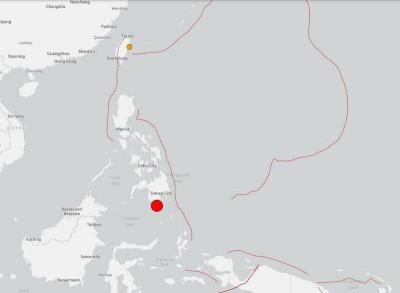
A magnitude 7.8 earthquake struck off the southern coast of Mindanao in the Philippines at 7:38am today, prompting the US Tsunami Warning System to issue an alert for neighboring countries, including Taiwan. The system issued a purple alert indicating a "tsunami threat." The potential threat zone includes Taiwan, the Philippines, Papua New Guinea, Yap and Palau. Philippine authorities were assessing the damage from the quake, with the office of civil defense seeking to verifying initial reports that 15 people had been killed and 129 injured in the region, mostly from falling debris. Arlene Hollero, disaster chief of Maasim town in the Philippines' Sarangani Province,

‘GRAY ZONE’ PRESSURE: Beijing’s activities are intended to create the deceitful impression that China has jurisdiction over the area around Taiwan, the CGA said Taiwan’s rights over its territorial waters and exclusive economic zone must not be violated by any country, the Mainland Affairs Council said yesterday, adding that it will not accept any unprovoked actions. The council issued the remarks in response to the China Coast Guard conducting maritime enforcement drills near eastern Taiwan and claiming to fully exercise China’s maritime administrative law enforcement authority. The Coast Guard Administration (CGA) has been closely monitoring the situation and is taking concrete steps to defend the nation’s sovereignty and secure its waters, the council said. China has no sovereign rights over the waters off eastern
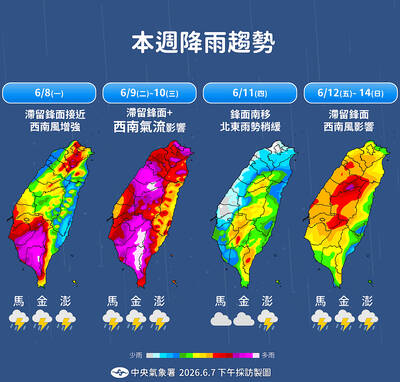
Heavy rain is expected to affect parts of Taiwan this week, the Central Weather Administration (CWA) said yesterday as a meteorologist said the active part of the annual plum rain season has started. A stationary plum rain front and southwesterly winds would bring unstable weather and abundant moisture to Taiwan from today for about a week, with the heaviest rainfall forecast for tomorrow and Wednesday, the CWA said. The agency said western and northeastern Taiwan, and mountainous areas in the east and southeast, could expect showers or thunderstorms on those two days, with localized heavy rain possible. Other parts of


 RSS
RSS