


The Bush administration has completed a national security review of the planned sale of IBM's personal computer business to Lenovo (聯想), clearing the way for the deal, IBM announced on Wednesday.
The unusual scrutiny given to the IBM-Lenovo deal mainly reflects the ambivalence in Washington toward China, and its rising economic and military power.
Other Chinese companies, with their increasing wealth and global ambitions, are expected to follow Lenovo's example by shopping for acquisitions in the US.
"The lesson from the IBM experience is that the government is going to be difficult on them all," said William Reinsch, president of the National Foreign Trade Council and a former trade official in the Clinton administration.
The Committee on Foreign Investments in the US, a multiagency group, reviews purchases by overseas corporations of American businesses for any impact on national security. The IBM inquiry was a full investigation, which occurs in far less than 1 percent of cross-border deals, according to former members of the committee.
The investment committee's proceedings are secret, and IBM would not say what steps it took to address the concerns of the group, which includes representatives from the departments of homeland security, defense, justice, treasury and commerce. Two people who have been told of the investment committee's inquiry said IBM made more in the way of commitments and assurances than concessions, which might restrain its sales or product development.
The steps, they said, included agreeing to separate Lenovo's US employees, mainly in Research Triangle Park in North Carolina, from IBM workers in that industrial park who work on the development of other products, like larger server computers and software. Lenovo will absorb the 1,900 American workers in IBM's personal computer business.
The people close to the government inquiry said IBM also agreed to ensure that the computer chips and other parts in desktop PCs and notebooks were stamped with the name of their manufacturer and country of origin. Such labeling is fairly common practice for PC makers.
Steven Ward Jr., an IBM senior vice president who will become chief executive of Lenovo, said he met with more than a dozen senior officials of government agencies to explain the US$1.75 billion sale, in cash, stock and debt, which was announced last December. He said the steps IBM took to gain the approval of the investment committee would not hobble the business.
"I'm delighted with getting this approval," Ward said. "And we expect to sell Lenovo PCs and ThinkPads to businesses, governments and individuals around the globe."
Some members of the investment committee were concerned that the sale to Lenovo, which is partly state-owned, could result in technology with important military uses being passed on to the Chinese, but the people close to the inquiry said IBM addressed that concern during briefings and product demonstrations in Washington in the middle of last month.
IBM engineers and executives, they said, dismantled a desktop PC and a ThinkPad notebook for the investment committee, part by part, identifying where the components are produced and how the machines are assembled. Most IBM PCs are already manufactured in China. They contain Intel microprocessors and are assembled from chips and parts made around the world, mostly in East Asia.
The IBM-Lenovo episode should prompt Congress to review the authority of the foreign investment committee, which dates from the Cold War, said Michael Wessel, a member of the US-China Economic and Security Review Commission, a group established by Congress. Wessel believes there should be more scrutiny of such deals with Chinese companies.
Representative Donald Manzullo, a Republican, said on Wednesday that he planned to push for hearings to see if the role of the foreign investment committee should be expanded to "take more account of economic security as well as military security."
Manzullo was one of three congressmen who wrote in January to Secretary of the Treasury John Snow, who heads the foreign investment committee, urging him to conduct a full investigation of the IBM-Lenovo deal.
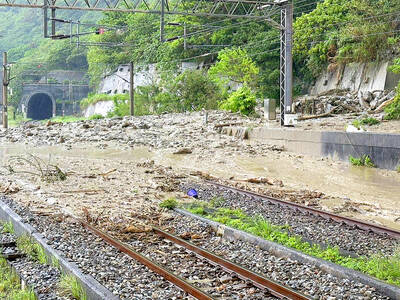
ROLLER-COASTER RIDE: More than five earthquakes ranging from magnitude 4.4 to 5.5 on the Richter scale shook eastern Taiwan in rapid succession yesterday afternoon Back-to-back weather fronts are forecast to hit Taiwan this week, resulting in rain across the nation in the coming days, the Central Weather Administration said yesterday, as it also warned residents in mountainous regions to be wary of landslides and rockfalls. As the first front approached, sporadic rainfall began in central and northern parts of Taiwan yesterday, the agency said, adding that rain is forecast to intensify in those regions today, while brief showers would also affect other parts of the nation. A second weather system is forecast to arrive on Thursday, bringing additional rain to the whole nation until Sunday, it
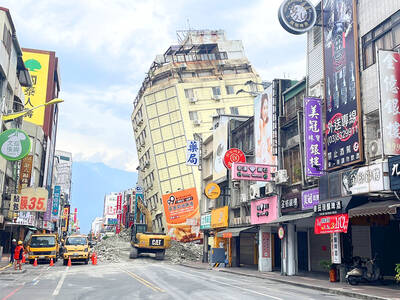
LANDSLIDES POSSIBLE: The agency advised the public to avoid visiting mountainous regions due to more expected aftershocks and rainfall from a series of weather fronts A series of earthquakes over the past few days were likely aftershocks of the April 3 earthquake in Hualien County, with further aftershocks to be expected for up to a year, the Central Weather Administration (CWA) said yesterday. Based on the nation’s experience after the quake on Sept. 21, 1999, more aftershocks are possible over the next six months to a year, the agency said. A total of 103 earthquakes of magnitude 4 on the local magnitude scale or higher hit Hualien County from 5:08pm on Monday to 10:27am yesterday, with 27 of them exceeding magnitude 5. They included two, of magnitude
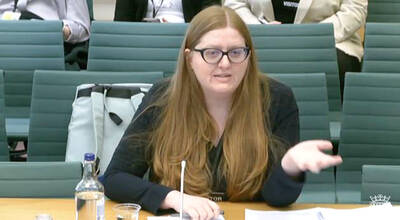
CONDITIONAL: The PRC imposes secret requirements that the funding it provides cannot be spent in states with diplomatic relations with Taiwan, Emma Reilly said China has been bribing UN officials to obtain “special benefits” and to block funding from countries that have diplomatic ties with Taiwan, a former UN employee told the British House of Commons on Tuesday. At a House of Commons Foreign Affairs Committee hearing into “international relations within the multilateral system,” former Office of the UN High Commissioner for Human Rights (OHCHR) employee Emma Reilly said in a written statement that “Beijing paid bribes to the two successive Presidents of the [UN] General Assembly” during the two-year negotiation of the Sustainable Development Goals. Another way China exercises influence within the UN Secretariat is

Taiwan’s first drag queen to compete on the internationally acclaimed RuPaul’s Drag Race, Nymphia Wind (妮妃雅), was on Friday crowned the “Next Drag Superstar.” Dressed in a sparkling banana dress, Nymphia Wind swept onto the stage for the final, and stole the show. “Taiwan this is for you,” she said right after show host RuPaul announced her as the winner. “To those who feel like they don’t belong, just remember to live fearlessly and to live their truth,” she said on stage. One of the frontrunners for the past 15 episodes, the 28-year-old breezed through to the final after weeks of showcasing her unique


 RSS
RSS