

The US suffered a final defeat on Thursday in its dispute with Brazil over cotton subsidies at the WTO.
The organization's appellate body upheld a ruling last year by trade judges who said US subsidies to cotton farmers broke international trade rules by depressing world prices and harming cotton farmers in Brazil and elsewhere.
The decision could force the US to lower the subsidies it pays farmers to grow cotton and, eventually, other crops.
Republican Representative Clay Shaw, who heads the trade subcommittee of the House Ways and Means Committee, said: "If we want to keep exporting American cotton, we're going to have to abide by the WTO ruling. It certainly gives you cover to make some of the corrections needed."
The administration was more cautious. Richard Mills, the spokesman for the US trade representative, said that "we will study the report carefully and work closely with Congress and our farm community on our next steps."
Brazil declared victory for itself and poor African nations that have complained about the subsidies.
Roberto Azevedo, the official who heads trade disputes at Brazil's Foreign Ministry, said on Thursday that "this decision ratifies what is just and what is legal."
As the first successful challenge of a wealthy nation's domestic agricultural subsidies, the cotton case could propel Europe and other industrialized nations to offer new compromises at global trade talks that are centered on this agriculture issue.
Brazilian officials used information from the US Department of Agriculture to argue that the US broke trade rules that limit to US$1.6 billion the subsidies it can pay cotton growers every year. The US defended the additional financing as domestic subsidies that do no harm to global markets.
But Brazil said the subsidies increased US cotton production, which, in turn, helped destroy Brazil's export markets and undermined the livelihood of its farmers. Argentina, Australia, Benin, Canada, Chad, China, the EU, India, New Zealand, Pakistan, Paraguay, Taiwan and Venezuela joined Brazil in the case.
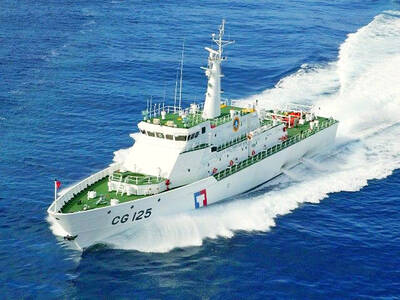
GEOPOLITICAL SIGNIFICANCE: The CGA’s nonmilitary role makes it a tool to avert diplomatic issues, an official said, while confirming the donation of a ship to Manila Coast Guard Administration (CGA) ships are scheduled to sail to the Philippines bearing the words “Taiwan Coast Guard” in a high-profile visit in October next year, the first such visit by a Taiwanese maritime law enforcement vessel to the Southeast Asian nation, the agency said yesterday. The CGA also confirmed that it had donated one of its decommissioned patrol vessels to the Philippines in a rare transfer of a retired ship to a nondiplomatic ally. The Republic of China (ROC) Navy last made such a visit in 1974, shortly before the Philippines switched diplomatic recognition to the People’s Republic of China in

SOFT TENNIS: Yu Kai-wen and Huang Shih-yuan narrowly defeated their Japanese rivals to capture Taiwan’s first gold at the Asian Games in Nagoya Yu Kai-wen (余凱文) and Huang Shih-yuan (黃詩媛) won Taiwan’s first gold of this year’s Asian Games, defeating a Japanese duo in a nail-biter in the soft tennis mixed doubles final in Nagoya, Japan, while Johnny Sun (孫家閎) won silver in wushu and Shih Cheng-chung (石政中) won bronze in men’s kumite. Yu and Huang narrowly defeated Japan’s Toshiki Uematsu and Rena Temma 5-4 (2-4, 5-3, 4-2, 1-4, 1-4, 4-0, 1-4, 4-1, 7-5) to give Taiwan its first gold in soft tennis mixed doubles at an Asian Games since 2018. Sun secured Taiwan’s first wushu medal at this year’s game, with a combined score
CALL FOR CHANGE: They urged the UN to facilitate Taiwan’s involvement in the body, recognize its peace efforts and to work with members in preventing military conflict Representatives to the UN from five of Taiwan’s diplomatic allies sent a joint letter to UN Secretary-General Antonio Guterres on Friday, calling for the country’s inclusion in the body. Allies in the letter sent ahead of the 81st session of the UN General Assembly General Debate made three demands in support of Taiwan: inclusion, recognition and camaraderie. They implored the UN to seek an appropriate way to facilitate Taiwan’s meaningful involvement in the world governing body, saying that UN Resolution 2758, which accepted the People’s Republic of China (PRC) as a member of the UN, does not exclude Taiwan. Beijing claims that the

‘GLOBAL WARNING’: The infiltration is not just a local problem, as Beijing has been deploying the same tactics worldwide against Western democracies, a report said Between 50,000 and 100,000 Chinese spies are operating in Taiwan, far more than the National Security Bureau’s previous estimate of 5,000, German journalist and author Jurgen Kremb said on Monday. Kremb presented his research, titled “The War of Spies: How China’s Intelligence Services Are Infiltrating Taiwan — and What Europe Must Learn from It,” at a joint event held by the Taiwan offices of the Friedrich Naumann Foundation and the European Values Center for Security Policy. The report was published in June in the Ministry of Justice Investigation Bureau’s Prospect & Exploration Monthly (展望與探索月刊). By spies, he said he was referring to informants,


 RSS
RSS