


The damper on this week's holiday shopping launch, Wal-Mart Stores Inc, was at risk of seeing its shares pummeled yesterday amid signs that its decision not to discount as heavily this year curbed sales growth. But don't expect to see the sell-off spreading to the rest of the retail industry stocks, an analyst said.
That's because Wal-Mart has its "own unique set of circumstances," Richard Hastings, retail analyst at Bernard Sands LLC, said on Sunday.

PHOTO: AP
reduced discounts
In an effort to defend its profits, the world's largest retailer did not discount as deeply on a wide array of products as it has in the past. That hurt sales the day after Thanksgiving, the official start of the holiday shopping season, as other competitors like Sears, Roebuck and Co lured shoppers with deeper price cuts.
Customers tend to be price-sensitive and go to Wal-Mart to take advantage of the blitz of deals.
The company said Saturday that November sales at stores opened at least a year would be up only 0.7 percent, instead of the previously projected 2 percent to 4 percent, based on disappointing sales for the seven days ended Friday.
Wal-Mart, based in Bentonville, Arkansas, and other retailers are expected to report sales for this month on Thursday.
focus on profits
"Wal-Mart is getting serious about profits, and they're not as obsessed about market share, which means they are getting careful about sales promotions and inventories -- things that impact expenses and cash flow," Hastings said.
But with disappointing sales, investors face concerns that fourth-quarter profits at the world's largest retailer might be "a little challenged," he added.
Analysts polled by Thomson First Call expect US$0.75 per share for the retailer's fourth quarter.
On Friday, shares of Wal-Mart closed at US$55.32, down US$0.18, which is at the lower end of its 52-week range of US$50.50 to US$61.31.

NO-LIMITS PARTNERSHIP: ‘The bottom line’ is that if the US were to have a conflict with China or Russia it would likely open up a second front with the other, a US senator said Beijing and Moscow could cooperate in a conflict over Taiwan, the top US intelligence chief told the US Senate this week. “We see China and Russia, for the first time, exercising together in relation to Taiwan and recognizing that this is a place where China definitely wants Russia to be working with them, and we see no reason why they wouldn’t,” US Director of National Intelligence Avril Haines told a US Senate Committee on Armed Services hearing on Thursday. US Senator Mike Rounds asked Haines about such a potential scenario. He also asked US Defense Intelligence Agency Director Lieutenant General Jeffrey Kruse

INSPIRING: Taiwan has been a model in the Asia-Pacific region with its democratic transition, free and fair elections and open society, the vice president-elect said Taiwan can play a leadership role in the Asia-Pacific region, vice president-elect Hsiao Bi-khim (蕭美琴) told a forum in Taipei yesterday, highlighting the nation’s resilience in the face of geopolitical challenges. “Not only can Taiwan help, but Taiwan can lead ... not only can Taiwan play a leadership role, but Taiwan’s leadership is important to the world,” Hsiao told the annual forum hosted by the Center for Asia-Pacific Resilience and Innovation think tank. Hsiao thanked Taiwan’s international friends for their long-term support, citing the example of US President Joe Biden last month signing into law a bill to provide aid to Taiwan,
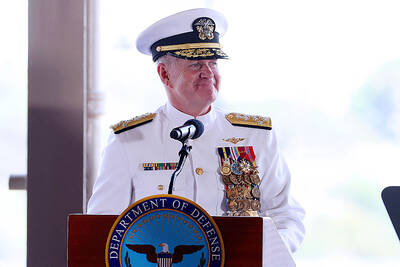
China’s intrusive and territorial claims in the Indo-Pacific region are “illegal, coercive, aggressive and deceptive,” new US Indo-Pacific Commander Admiral Samuel Paparo said on Friday, adding that he would continue working with allies and partners to keep the area free and open. Paparo made the remarks at a change-of-command ceremony at Joint Base Pearl Harbor-Hickam in Hawaii, where he took over the command from Admiral John Aquilino. “Our world faces a complex problem set in the troubling actions of the People’s Republic of China [PRC] and its rapid buildup of forces. We must be ready to answer the PRC’s increasingly intrusive and
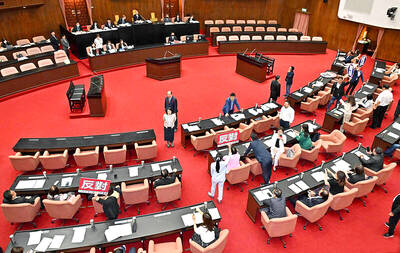
STATE OF THE NATION: The legislature should invite the president to deliver an address every year, the TPP said, adding that Lai should also have to answer legislators’ questions The Chinese Nationalist Party (KMT) yesterday proposed inviting president-elect William Lai (賴清德) to make a historic first state of the nation address at the legislature following his inauguration on May 20. Lai is expected to face many domestic and international challenges, and should clarify his intended policies with the public’s representatives, KMT caucus secretary-general Hung Meng-kai (洪孟楷) said when making the proposal at a meeting of the legislature’s Procedure Committee. The committee voted to add the item to the agenda for Friday, along with another similar proposal put forward by the Taiwan People’s Party (TPP). The invitation is in line with Article 15-2


 RSS
RSS