


Crude oil prices, which rose to a record US$55 a barrel in New York on Friday, may increase further and peak at US$75 a barrel, said Ber-nard Dan, president of the Chicago Board of Trade, the second-biggest US futures market.
"Given that some production is going on around the world, I can't see it much higher than US$75 unless there are disruptions in supply lines," Dan said on Nine Network's Business Sunday show in Sydney. "I think that the US economy is strong enough to absorb that."
Crude oil for delivery next month closed on Friday at US$54.93 a barrel on the New York Mercantile Exchange after reaching US$55 during the day, the highest since futures began in 1983.
Futures were boosted by comments from Federal Reserve Chairman Alan Greenspan, who said oil isn't high enough to slow expansion as much as in prior oil shocks. High oil prices helped push the US economy into recession in the 1970s and 1980s, and caused demand to plunge by 19 percent between 1978 and 1983, according to the US Energy Department.
While a rise to US$75 sounded significant, the majority of oil traders and consumers had "priced in that sort of range and while it may do some damage in terms of the economy and may be reflected in our equity market, I don't think it's going to be at a level where it's catastrophic," Dan said.
It's clear though that rising energy prices are creating concern in US equity markets, he said.

LEVERAGE: China did not ‘need to fire a shot’ to deny Taiwan airspace over Africa when it owns ‘half the continent’s debt,’ a US official said, calling it economic warfare The EU has raised concerns about overflight rights following the delay of President William Lai’s (賴清德) planned state visit to the Kingdom of Eswatini after three African nations denied overflight clearance for his charter at the last minute. Taiwanese allies Paraguay and Saint Kitts and Nevis, as well as several US lawmakers and the Inter-Parliamentary Alliance on China (IPAC) condemned China for allegedly pressuring the countries. Lai was scheduled to fly directly to Taiwan’s only African ally from yesterday to Sunday to celebrate the 40th anniversary of King Mswati III’s accession and his 58th birthday, but Seychelles, Mauritius and Madagascar suddenly revoked
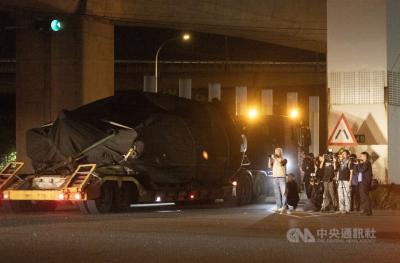
The final batch of 28 M1A2T Abrams tanks purchased from the US arrived at Taipei Port last night and were transported to the Armor Training Command in Hsinchu County’s Hukou Township (湖口), completing the military’s multi-year procurement of 108 of the tanks. Starting at 12:10am today, reporters observed more than a dozen civilian flatbed trailers departing from Taipei Port, each carrying an M1A2T tank covered with black waterproof tarps. Escorted by military vehicles, the convoy traveled via the West Coast Expressway to the Armor Training Command, with police implementing traffic control. The army operates about 1,000 tanks, including CM-11 Brave Tiger
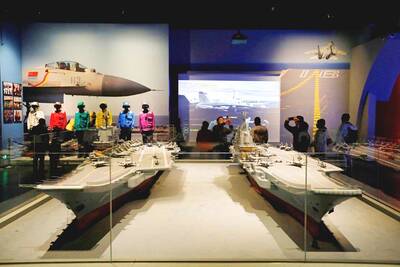
China on Wednesday teased in a video an aircraft carrier that could be its fourth, and the first using nuclear power, while making an allusion to Taiwan and vowing to further build up its islands, as it looks to boost maritime power, secure resources and bolster territorial claims. The video, issued on the eve of the 77th founding anniversary of the Chinese People’s Liberation Army Navy, featured fictional officers with names that are homophones of three commissioned aircraft carriers, the Liaoning (遼寧), Shandong (山東) and Fujian (福建). Titled Into the Deep, it showed a 19-year-old named “Hejian” (何劍) joining the group, sparking
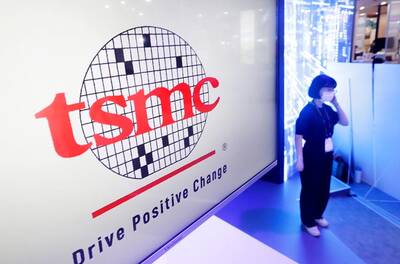
BIG YEAR: The company said it would also release its A12 chip the same year to keep a ‘reliable stream of new silicon technologies’ flowing to its customers Taiwan Semiconductor Manufacturing Co (TSMC, 台積電) yesterday said its newest A13 chip is to enter volume production in 2029 as the chipmaker seeks to hold onto its tech leadership and demand for next-generation chips used in artificial intelligence (AI), high-performance-computing (HPC) and mobile applications. TSMC, the world’s biggest contract chipmaker, also unveiled its A12 chip at its annual technology symposium in Santa Clara, California. The A12 chip, which features TSMC’s super-power-rail technology to provide backside power delivery for AI and HPC applications, is also to enter volume production in 2029, a year after the scheduled release of the A14 chip. The technology moves


 RSS
RSS