


Chinese wholesalers have set up shop in the Moroccan port of Casablanca, causing a wave of panic among local traders fearful of competition.
"Chinese wholesale centre," reads a sign in Arabic, French and Chinese at one Chinese trader's shop.
"I don't speak English and French very well, and Arabic is difficult," said Lin Xue-yun, 32, who manages a shop selling mirrors, sandals, shoes, chessboards and electronic toys.
Language is the main obstacle for her and her compatriots who arrive unable to converse in Morocco's main languages, Arabic and French. Moroccan nationals are employed in an intermediary role in their shops.
"I've only been here for four months," Lin said. "I have an 11-year-old son I left in Fujian," the province most wholesalers originate from.
"Watch out, the Chinese are landing!" headlined the daily newspaper Aujourd'hui Le Maroc last week, saying "an army of Chinese businessmen (estimated at 1,200) has decamped in the kingdom's main towns and villages."
"Business in Casa is good," said Yen Tieh, 39, in halting English, a sxi-months resident in Morocco.
Ghita, 21, a Moroccan employed in a Chinese shop in Derb Omar, the bustling trading area of Casablanca, said she was happy working where she was. "We sell sandals, photo and picture frames, and small gifts," she said, adding that her wages were "very satisfying."
But Nadia, writing out a bill on the counter of her neighboring shop, railed against the Chinese influx, claiming the new traders had "destroyed the economy and job market" in Casablanca.
"The product for which I pay 25 dirhams in duty, they sell at 10 dirhams. They could sell sandals for only 18 dirhams (US$1.95)."
"Their products are of a very bad quality," Nadia said, adding that some Chinese traders were going "door-to-door, suitcase in hand."
Salah, a fellow Moroccan worker in Derb Omar, added: "I've seen them unload their own container at Casablanca port."
The Moroccan association for game importers says Chinese traders are engaged in "unfair and anti-competitive practices."
In a recent statement, the association said it wanted to "sound the alarm bell."
Shop manager Fatima Lmoussi, however, disagrees: "Trade is open to all. The arrival of the Chinese is even positive, because it creates a business dynamic."
According to one taxi driver, the Chinese came across as "nice, extremely polite, and they pay the Moroccans they employ very well."

National Taiwan University (NTU) yesterday said it disqualified a person from an entrance examination for using AI smart glasses to cheat, along with two others for making untruthful statements in their curriculum vitae. The three applicants were given null scores, Taiwan’s highest-ranked university said, calling on prospective students to be honest in the admissions process. NTU registrar Lee Hung-sen (李宏森) said that the cheating applicant wore a hat and thick-rimmed glasses to the second written exam for medical school, claiming that they felt cold. Suspicions were aroused when the applicant stared oddly at the test for long stretches while steadily bringing the paper
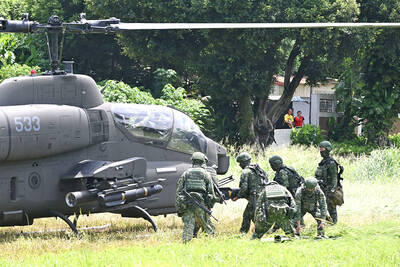
MILITARY ISSUES: A partisan divide between the Cabinet and the legislature ‘raised questions about Taiwan’s ability to adequately fund its defense,’ the report said Taiwan’s defense budget, military personnel numbers and resilience are challenges to its ability to meet national defense goals, the US Naval Institute said in a report published on Tuesday. In response to the perception of a growing military threat posed by China, Taiwan has embarked on an effort to enhance the capabilities needed to deter an attempt by Beijing to annex the nation by force, the institute said in the US Congressional Research Service report, titled Taiwan: Defense and Military Issues, which was filed on Thursday last week. Taiwan’s defense budget increased by about 7.5 percent from 2024 to last year, it
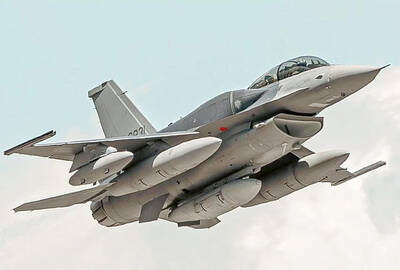
66 FIGHTER JETS: The aircraft is likely undergoing preparations for its transfer to Taiwan — a significant step forward in the nation’s modernization program, a lawmaker said The first of Taiwan’s order of F-16V Block 70 aircraft has been sighted in Texas ahead of delivery, Democratic Progressive Party (DPP) Legislator Wang Ting-yu (王定宇) said. Taiwan’s first F-16V Block 70 two-seat aircraft, tail number 6831, was seen flying from Lockheed Martin’s production facility in Greenville, South Carolina, to Naval Air Station Joint Reserve Base Fort Worth in Texas, Wang wrote on Facebook yesterday. The plane is likely undergoing preparations for its transfer to Taiwan, marking a significant step forward in the Republic of China Air Force’s modernization program, Wang said, citing military analysts. The F-16V Block 70 is a new-build version

NOT JUST NUMBERS: What matters to intelligence work is crucial, reliable information, so even a few credible leads can be highly valuable to national security, a legislator said The National Security Bureau (NSB) yesterday said it has finished the establishment of an information-reporting channel for Chinese nationals, the aim of which is to broaden intelligence gathering on China’s political, military, economic and social developments. Chinese nationals can submit information on the Web page, https://report.nsb.gov.tw, the NSB said in a statement. The move aims to expand the bureau’s diverse intelligence sources and is pursuant to the National Intelligence Services Act (國家情報工作法), it said, adding that it referenced practices adopted by intelligence agencies in the US, the UK and Israel. An increasing number of people are approaching Taiwanese agencies to provide information, as


 RSS
RSS