


Toyota Motor Corp, Asia's largest carmaker, will invest 3.8 billion yuan (US$461 million) with its partner Guangzhou Automobile Group to expand in China and catch up with rivals that started making cars in the country earlier.
Toyota and Guangzhou Auto will build Camry models in a factory located in Guangzhou, the two companies said. The factory will start production in 2006 and have the annual capacity of at least 100,000 units.
Toyota is adding production and introducing new models to increase its share of China's car market to 10 percent by 2010 from its current 3 percent. It lags Honda Motor Co, which has 5 percent of the market, Volkswagen AG, the market leader with about 30 percent and General Motors Corp with about 12 percent.
"The China project will help Toyota become a real global automaker and keep it on course to become the biggest automaker in the world," said Atsushi Osa, who helps manage the equivalent of US$110 billion at Sumitomo Mitsui Asset Management Co in Tokyo. "Toyota's plan in China is finally coming through."
Toyota and Guangzhou Auto may boost capacity at the new factory to 250,000 units annually if there is demand, Toyota Executive Vice President Kosuke Shiramizu said at a press conference in Guangzhou, southern China's largest city. Factories typically expand capacity by adding on more machines and work shifts on to an existing production line.
He did not give a time frame for the plan to expand. After the factory is built, Toyota will stop importing Camrys into China from Japan.
Toyota expects sales in China will climb 50 percent this year to 150,000 units. The Corolla, which Toyota began building locally in February, should account for a third of this year's sales.
Toyota's sales are growing faster than market leaders Volkswagen AG, General Motors Corp and Honda, all of which set up manufacturing facilities in China before the carmaker. Toyota invested 80 billion yen (US$725 million) since 1964 in China setting up dealerships, marketing and maintenance centers before the joint venture with Guangzhou Auto, according to company data.
Slower growth has prompted carmakers to cut prices to lure customers. Volkswagen,reduced its prices by as much as 12 percent in June.
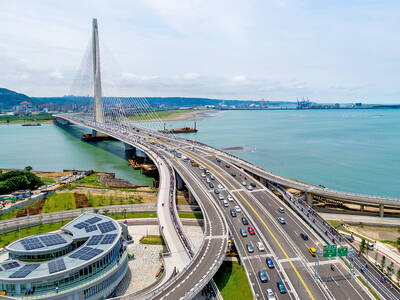
The Ministry of Transportation and Communications yesterday inaugurated the Danjiang Bridge across the Tamsui River in New Taipei City, saying that the structure would be an architectural icon and traffic artery for Taiwan. Feted as a major engineering achievement, the Danjiang Bridge is 920m long, 211m tall at the top of its pylon, and is the longest single-pylon asymmetric cable-stayed bridge in the world, the government’s Web site for the structure said. It was designed by late Iraqi-British architect Zaha Hadid. The structure, with a maximum deck of 70m, accommodates road and light rail traffic, and affords a 200m navigation channel for boats,
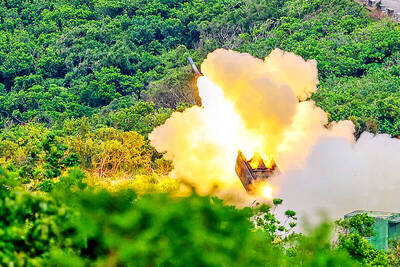
PRECISION STRIKES: The most significant reason to deploy HIMARS to outlying islands is to establish a ‘dead zone’ that the PLA would not dare enter, a source said A High Mobility Artillery Rocket System (HIMARS) would be deployed to Penghu County and Dongyin Island (東引) in Lienchiang County (Matsu) to force the Chinese military to retreat at least 100km from the coastline, a military source said yesterday. Taiwan has been procuring HIMARS and Army Tactical Missile Systems (ATACMS) from the US in batches. Once all batches have been delivered, Taiwan would possess 111 HIMARS units and 504 ATACMS, which have a range of 300km. Considering that “offense is the best defense,” the military plans to forward-deploy the systems to outlying islands such as Penghu and Dongyin so that
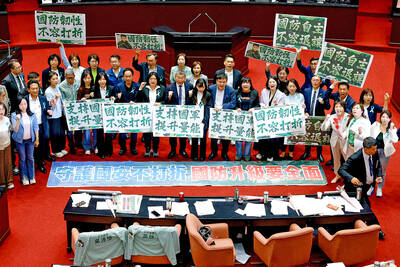
WHAT WAS ALL THAT FOR? Jaw Shaw-kong said that Cheng Li-wen had pushed for more drastic cuts and attacked him, just for the outcome to be nearly identical to his bill The legislature yesterday passed a supplementary budget bill to fund the purchase of separate packages of US military equipment, with the combined amount of spending capped at NT$780 billion (US$24.8 billion). The Chinese Nationalist Party (KMT) and Taiwan People’s Party (TPP) used their legislative majority to pass the bill, which runs until 2033 and has two main funding provisions. One was for NT$300 billion of arms sales already approved by the US for Taiwan on Dec. 17 last year, the other was for NT$480 billion for another arms package expected to be announced by Washington. The bill, which fell short of the NT$1.25
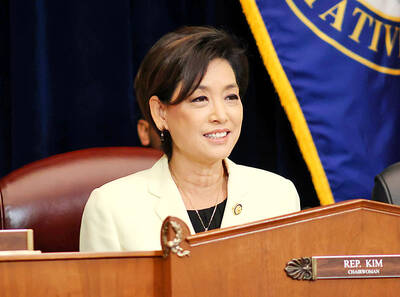
‘CLEAR MESSAGE’: The bill would set up an interagency ‘tiger team’ to review sanctions tools and other economic options to help deter any Chinese aggression toward Taiwan US Representative Young Kim has introduced a bill to deter Chinese aggression against Taiwan, calling for an interagency “tiger team” to preplan coordinated sanctions and economic measures in response to possible Chinese military or political action against Taiwan. “[Chinese President] Xi Jinping [習近平] has directed the People’s Liberation Army to be ready to invade Taiwan by 2027. China has a plan. America should have one too,” Kim said in a news release on Thursday last week. She introduced the “Deter PRC [People’s Republic of China] aggression against Taiwan act” to “ensure the US has a coordinated sanctions strategy ready should


 RSS
RSS