


Asia's economies have been able to withstand this year's surge in oil prices but the relentless climb is starting to take its toll and high growth rates are now in jeopardy, analysts said.
Crude futures prices reached historic highs at nearly US$45 a barrel last week, causing a slump in regional stock markets and prompting economists to draw up scenarios based on prices breaching US$50 a barrel.
"If energy prices come back down to what we think supply and demand should have them right now, probably around US$30 a barrel, it's not a big deal," David Wyss, chief global economist at US credit rating firm Standard & Poor's, told reporters in Singapore on Friday.
"If they stay where they are now, it's a minor problem. But if they go up to US$70 to US$80 a barrel then you have got some real problems in Asia and everywhere else too."
Joseph Tan, an economist with Standard Chartered Bank in Singapore, said the "big question" was how long oil prices would stay between US$42 to US$50 a barrel.
If prices stayed between these levels for most of the year, then this would impact on Asian growth, Tan said, adding however he thinks prices will ease in the next few months.
He also pointed out any impact "will not be homogeneous given that some countries are more dependent on oil than others," with South Korea, India and Thailand among the most vulnerable.
Ifzal Ali, chief economist of the Manila-based Asian Development Bank (ADB), said the bank's economists recently went back to the drawing board to plot a scenario where prices reach US$50 a barrel.
A bank study in June on the impact of high oil prices on Asia had assumed levels of up to US$40 a barrel.
High oil prices are now a "serious threat not only to Asia but globally as well," Ali told reporters by telephone on Friday.
"The thing is if this increase in oil prices is combined with an increase in interest rates, that would be even more damaging," he said, referring to moves by the US Federal Reserve to raise key interest rates.
Oil prices at US$50 a barrel could shave off 1.1 percentage points from Asia's projected GDP growth next year, compared with 0.8 percent if prices remained at US$40 a barrel, Ali said.
China's GDP would be trimmed by 1.1 percentage points and India's 1.2 percentage points, compared with 0.8 percent for both countries if prices were at US$40 a barrel.
At US$50 a barrel, Asia's trade balance by the end next year would deteriorate 0.9 percentage points and inflation would rise by 1.9 percentage points.
Oil-importing Southeast Asian nations would also be in the line of fire.
For example, the Philippines' GDP would shed 2.6 percentage points if oil prices reached US$50 a barrel, inflation would rise 2.7 percentage points and the trade balance would worsen by 2.1 percentage points.
Thailand's GDP would lose 3.1 percentage points, inflation would increase 2.8 points and trade would worsen by 2.6 points, according to the ADB.
But Standard Chartered's Tan said he believed current high oil prices would not be sustained because this was being caused chiefly by the financial problems of Russian oil giant Yukos, which produces more oil than Libya, a member of the Organization of Petroleum Exporting Countries.
Fears Yukos will shut down its 1.7 million barrels a day production due to a tax dispute with the Russian government sent oil prices soaring its highs last week.
Julian Jessop, chief international economist of London-based research house Capital Economics, said he believed Yukos and Moscow were playing a game of "brinkmanship" and Russian authorities were unlikely to stop production.
But the ADB's Ali said oil prices should stay above US$40 a barrel until the end of this year because, apart from the Yukos factor, the problem of supply disruptions in oil-producers Iraq, Venezuela and Nigeria remained.
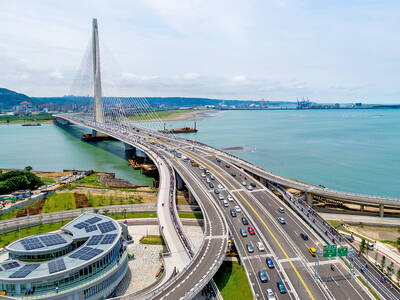
The Ministry of Transportation and Communications yesterday inaugurated the Danjiang Bridge across the Tamsui River in New Taipei City, saying that the structure would be an architectural icon and traffic artery for Taiwan. Feted as a major engineering achievement, the Danjiang Bridge is 920m long, 211m tall at the top of its pylon, and is the longest single-pylon asymmetric cable-stayed bridge in the world, the government’s Web site for the structure said. It was designed by late Iraqi-British architect Zaha Hadid. The structure, with a maximum deck of 70m, accommodates road and light rail traffic, and affords a 200m navigation channel for boats,
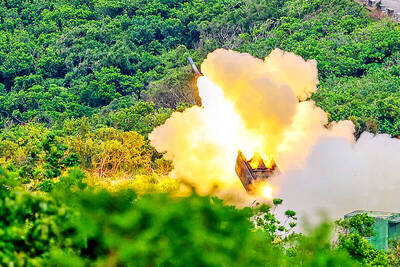
PRECISION STRIKES: The most significant reason to deploy HIMARS to outlying islands is to establish a ‘dead zone’ that the PLA would not dare enter, a source said A High Mobility Artillery Rocket System (HIMARS) would be deployed to Penghu County and Dongyin Island (東引) in Lienchiang County (Matsu) to force the Chinese military to retreat at least 100km from the coastline, a military source said yesterday. Taiwan has been procuring HIMARS and Army Tactical Missile Systems (ATACMS) from the US in batches. Once all batches have been delivered, Taiwan would possess 111 HIMARS units and 504 ATACMS, which have a range of 300km. Considering that “offense is the best defense,” the military plans to forward-deploy the systems to outlying islands such as Penghu and Dongyin so that

‘CLEAR MESSAGE’: The bill would set up an interagency ‘tiger team’ to review sanctions tools and other economic options to help deter any Chinese aggression toward Taiwan US Representative Young Kim has introduced a bill to deter Chinese aggression against Taiwan, calling for an interagency “tiger team” to preplan coordinated sanctions and economic measures in response to possible Chinese military or political action against Taiwan. “[Chinese President] Xi Jinping [習近平] has directed the People’s Liberation Army to be ready to invade Taiwan by 2027. China has a plan. America should have one too,” Kim said in a news release on Thursday last week. She introduced the “Deter PRC [People’s Republic of China] aggression against Taiwan act” to “ensure the US has a coordinated sanctions strategy ready should

TAIWAN ISSUE: US treasury secretary Scott Bessent said on the first day of meetings that ‘it wouldn’t be a US-China summit without the Taiwan issue coming up’ There were no surprises on the first day of the summit between US President Donald Trump and Chinese President Xi Jinping (習近平), the Mainland Affairs Council (MAC) said yesterday, as the government reiterated that cross-strait stability is crucial to the Asia-Pacific region, as well as the world. As the two presidents met for a highly anticipated summit yesterday, Chinese state media reported that Xi warned Trump that missteps regarding Taiwan could push their two countries into “conflict.” Trump arrived in China with accolades for his host, calling Xi a “great leader” and “friend,” and extending an invitation to visit the White House


 RSS
RSS