


Nearly five years ago, IBM embarked on an ambitious project to build a supercomputer, Blue Gene, to study protein-folding, a fundamental biological process. IBM regarded it as a custom research program, useful for testing computing concepts but not a potential product.
Later this week, IBM intends to announce its plans for a commercial version of the machine, Blue Gene/L. The company hopes to sell the machines, which would typically cost millions of dollars, to corporations that want vast amounts of computing power.
Potential customers include oil companies that use geologic simulations to hunt for oil and gas fields, investment banks doing financial market and risk calculations and pharmaceutical manufacturers simulating how new drugs might work.
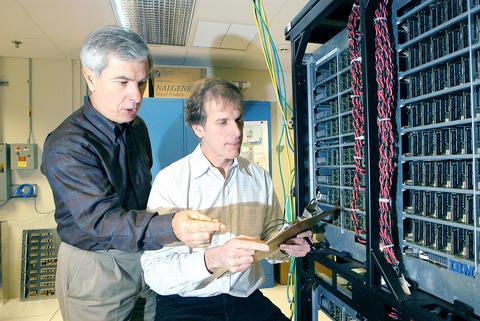
PHOTO: NY TIMES NEWS SERVICE
The power of the technology IBM is bringing to the marketplace was expected to be underlined yesterday when the latest twice-a-year ranking of the world's 500 fastest computers was due to be published.
Two new Blue Gene/L prototype supercomputers are ranked in the top 10, as the fourth fastest and the eighth fastest.
More significant, the prototype machines represent a modest sampling of what the Blue Gene/L technology can do. The fastest supercomputers are usually vast racks of machinery, routinely described as requiring as much space as several tennis courts. The Blue Gene/L prototype machines are four refrigerator-sized consoles each.
A big Blue Gene/L machine that IBM is building for the Lawrence Livermore National Laboratory should be up and running next year.
According to IBM and Livermore scientists, that machine should be as much as nine times as fast and one-tenth the size of the fastest machine today, the NEC Earth Simulator, used for weather and earthquake simulations in a Japanese government laboratory.
The performance of the Blue Gene/L prototypes is "very impressive," said Jack Dongarra, a computer scientist at the University of Tennessee, who for years has maintained the authoritative list of 500 fastest computers.
The Blue Gene/L uses one-tenth or less of the power as most other supercomputer designs. Power consumption is an increasingly important issue in high-performance computing, because overheating adds to the cost of operation and degrades performance. Other major issues in supercomputing are floor space, peak performance, price and how to allot complex scientific applications across many thousands of microprocessors.
"With Blue Gene/L, IBM has addressed all these issues," said Michel McCoy, leader of the advanced simulation and computing program at the Livermore lab.

ROLLER-COASTER RIDE: More than five earthquakes ranging from magnitude 4.4 to 5.5 on the Richter scale shook eastern Taiwan in rapid succession yesterday afternoon Back-to-back weather fronts are forecast to hit Taiwan this week, resulting in rain across the nation in the coming days, the Central Weather Administration said yesterday, as it also warned residents in mountainous regions to be wary of landslides and rockfalls. As the first front approached, sporadic rainfall began in central and northern parts of Taiwan yesterday, the agency said, adding that rain is forecast to intensify in those regions today, while brief showers would also affect other parts of the nation. A second weather system is forecast to arrive on Thursday, bringing additional rain to the whole nation until Sunday, it

LANDSLIDES POSSIBLE: The agency advised the public to avoid visiting mountainous regions due to more expected aftershocks and rainfall from a series of weather fronts A series of earthquakes over the past few days were likely aftershocks of the April 3 earthquake in Hualien County, with further aftershocks to be expected for up to a year, the Central Weather Administration (CWA) said yesterday. Based on the nation’s experience after the quake on Sept. 21, 1999, more aftershocks are possible over the next six months to a year, the agency said. A total of 103 earthquakes of magnitude 4 on the local magnitude scale or higher hit Hualien County from 5:08pm on Monday to 10:27am yesterday, with 27 of them exceeding magnitude 5. They included two, of magnitude

CONDITIONAL: The PRC imposes secret requirements that the funding it provides cannot be spent in states with diplomatic relations with Taiwan, Emma Reilly said China has been bribing UN officials to obtain “special benefits” and to block funding from countries that have diplomatic ties with Taiwan, a former UN employee told the British House of Commons on Tuesday. At a House of Commons Foreign Affairs Committee hearing into “international relations within the multilateral system,” former Office of the UN High Commissioner for Human Rights (OHCHR) employee Emma Reilly said in a written statement that “Beijing paid bribes to the two successive Presidents of the [UN] General Assembly” during the two-year negotiation of the Sustainable Development Goals. Another way China exercises influence within the UN Secretariat is

Taiwan’s first drag queen to compete on the internationally acclaimed RuPaul’s Drag Race, Nymphia Wind (妮妃雅), was on Friday crowned the “Next Drag Superstar.” Dressed in a sparkling banana dress, Nymphia Wind swept onto the stage for the final, and stole the show. “Taiwan this is for you,” she said right after show host RuPaul announced her as the winner. “To those who feel like they don’t belong, just remember to live fearlessly and to live their truth,” she said on stage. One of the frontrunners for the past 15 episodes, the 28-year-old breezed through to the final after weeks of showcasing her unique


 RSS
RSS