


US Federal Reserve Chairman Alan Greenspan said on Tuesday the US central bank is standing ready to deal with potential threats to the economy including the "fortunately low but still deeply disturbing possibility" of a new terrorist attack.
The comments, which came at Greenspan's confirmation hearing for a fifth term as Fed chairman, followed a recent warning by Attorney General John Ashcroft that the terrorist network al-Qaeda was "90 percent" ready to attack the US.
Greenspan told the Senate Banking Committee that the US economy was able to able to emerge relatively unscathed from the Sept. 11, 2001, attacks, which forced Wall Street to close temporarily and led the central bank to flood the banking system with massive amounts of money to make sure that all US financial institutions had the resources to meet withdrawal demands.

PHOTO: AP
"We at the Federal Reserve learned a good deal from that tragic episode," Greenspan said.
He said that the Fed was continuing its efforts to bolster its operational capabilities and the banking system's payments systems to withstand another attack.
Private economists widely believe Fed officials will begin raising interest rates at their next meeting on June 29 and 30, pushing the federal funds rate from a 46-year low of 1 percent up by the first of what are expected to be a series of quarter-point increases.
Despite the impending rate hikes, something that politicians often rail against, members of the Banking Committee widely predicted a quick confirmation for Greenspan, who was first nominated as Fed chairman in 1987 by president Ronald Reagan and has gone on to serve under four presidents.
While the nomination for a fifth term as Fed chairman would cover four years until 2008, Greenspan's 14-year term as a Fed board member will end Jan. 31, 2006, and friends of Greenspan, 78, say he has told them he does not plan to serve beyond that date.
The 2006 retirement date was acknowledged during Greenspan's confirmation hearing by Democratic Senator Paul Sarbanes, who said that would allow whoever is elected president next November the chance to name a new Fed chairman early in his term.
Greenspan told the committee he did not want to enumerate other potential threats that might keep him awake at night.
"I don't want to go list them because they sound -- one sounds scarier than the next ... even though the probabilities are very low," he said.
Senator Evan Bayh, a Democrat, pressed Greenspan to say whether he believed the country's record trade deficits and the need to finance those deficits by borrowing from foreigners represented a threat, especially if foreigners suddenly decided to cash out their dollar-denominated assets, triggering a sharp drop in the stock and bond markets and a plunge in the value of the dollar.
Greenspan said the bulging trade deficit was "obviously one of the issues which we are focused on," but he said he continued to believe that international financial markets were sufficiently flexible to allow for a gradual adjustment of the US trade deficit in a way that will not harm the US economy.
He rejected the idea that the country could be facing a "housing bubble" with the rapid rise in home prices in recent years that could suddenly collapse, saying he believed price increases would moderate as sales slow in coming months.
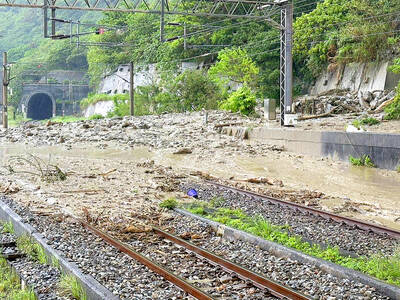
ROLLER-COASTER RIDE: More than five earthquakes ranging from magnitude 4.4 to 5.5 on the Richter scale shook eastern Taiwan in rapid succession yesterday afternoon Back-to-back weather fronts are forecast to hit Taiwan this week, resulting in rain across the nation in the coming days, the Central Weather Administration said yesterday, as it also warned residents in mountainous regions to be wary of landslides and rockfalls. As the first front approached, sporadic rainfall began in central and northern parts of Taiwan yesterday, the agency said, adding that rain is forecast to intensify in those regions today, while brief showers would also affect other parts of the nation. A second weather system is forecast to arrive on Thursday, bringing additional rain to the whole nation until Sunday, it
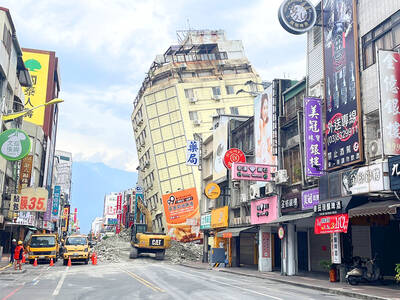
LANDSLIDES POSSIBLE: The agency advised the public to avoid visiting mountainous regions due to more expected aftershocks and rainfall from a series of weather fronts A series of earthquakes over the past few days were likely aftershocks of the April 3 earthquake in Hualien County, with further aftershocks to be expected for up to a year, the Central Weather Administration (CWA) said yesterday. Based on the nation’s experience after the quake on Sept. 21, 1999, more aftershocks are possible over the next six months to a year, the agency said. A total of 103 earthquakes of magnitude 4 on the local magnitude scale or higher hit Hualien County from 5:08pm on Monday to 10:27am yesterday, with 27 of them exceeding magnitude 5. They included two, of magnitude
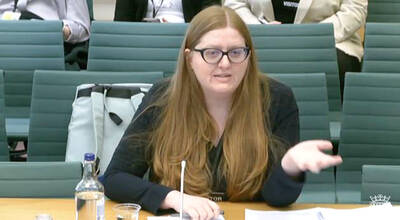
CONDITIONAL: The PRC imposes secret requirements that the funding it provides cannot be spent in states with diplomatic relations with Taiwan, Emma Reilly said China has been bribing UN officials to obtain “special benefits” and to block funding from countries that have diplomatic ties with Taiwan, a former UN employee told the British House of Commons on Tuesday. At a House of Commons Foreign Affairs Committee hearing into “international relations within the multilateral system,” former Office of the UN High Commissioner for Human Rights (OHCHR) employee Emma Reilly said in a written statement that “Beijing paid bribes to the two successive Presidents of the [UN] General Assembly” during the two-year negotiation of the Sustainable Development Goals. Another way China exercises influence within the UN Secretariat is

Taiwan’s first drag queen to compete on the internationally acclaimed RuPaul’s Drag Race, Nymphia Wind (妮妃雅), was on Friday crowned the “Next Drag Superstar.” Dressed in a sparkling banana dress, Nymphia Wind swept onto the stage for the final, and stole the show. “Taiwan this is for you,” she said right after show host RuPaul announced her as the winner. “To those who feel like they don’t belong, just remember to live fearlessly and to live their truth,” she said on stage. One of the frontrunners for the past 15 episodes, the 28-year-old breezed through to the final after weeks of showcasing her unique


 RSS
RSS