


Factories in the Pearl River Delta, the heart of China's export engine, are considering shutting up shop and relocating in pursuit of cheaper labor and lower running costs.
But the shift is not going to silence global critics who have blasted China for poaching jobs from the US and elsewhere, because many of the factories aren't leaving the country, just the province.
"Relocation could happen within two or three years if we can't contain the cost. It's primarily labor but also utilities," said Willie Fung, chairman of world-leading bra maker Top Form International, referring to his factory in Shenzhen, where wages have doubled in a decade.
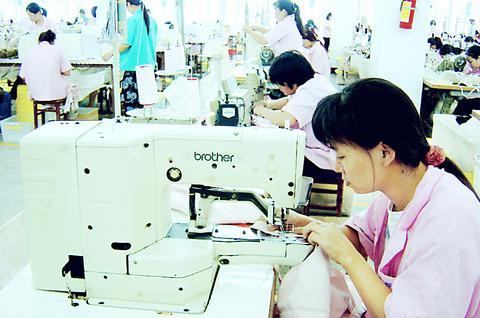
PHOTO: REUTERS
Top Form makes bras for US brands such as Maidenform. It has already started production in Jiangxi, a largely rural and mountainous province where labor and electricity cost half what they do in Shenzhen, a delta boomtown near Hong Kong.
Hong Kong-listed Yue Yuen Industrial Holdings Ltd, the world's largest shoe maker, is also moving production inland and global brands such as Nike and Reebok have even switched some manufacturing contracts away from China to places like Vietnam in pursuit of ever lower costs.
"We do face rising costs. They are rising slowly but surely," said Paul Yin, vice president of Hong Kong's Chinese Manufacturers' Association.
"Many of our members are talking about moving, although I don't know any who have made the move," Yin said.
Southern Chinese factories, mainly located in Guangdong's Pearl River Delta region near Hong Kong, exported US$150 billion worth of toys, textiles, electronics and other goods last year -- about a third of the country's total.
To many observers, the Delta's grip on global manufacturing is reminiscent of Manchester's dominance in the 19th century, but that could be on the verge of changing.
Manufacturing is the region's lifeblood. Glitzy hotels serving visiting executives dot a landscape dominated by factories.
Residential housing is scarce. The area's 23 million migrant workers often share dormitories distinguishable from the factories only by the factory uniforms hanging outside windows.
Shenzhen, which has China's highest minimum wage, raised its minimum monthly pay last month by 10 yuan to 610 yuan (US$73.71) in the inner zone nearest to Hong Kong and by 15 yuan to 480 yuan a month in outer areas.
By contrast, Top Form said the minimum wage at its plant in Jiangxi is 230 yuan and electricity costs 0.5 yuan a kilowatt, compared with around 1.2 yuan per kilowatt in Shenzhen.
The firm hopes a move inland will help it retain skilled staff. Turnover among migrant workers at its Pearl River Delta plants is high and new staff take five months to train.
Yue Yuen, which makes shoes for Nike, Reebok and Hush Puppies, also plans a production base in Jiangxi.
Labor and utility costs there are 30 percent cheaper than in the Pearl River Delta and new roads have halved transport times to southern China's Yantian Port to around six hours, said Terry Ip, the firm's head of investor relations.
Tight energy supply and rising wages are prompting some cost-conscious corporations to look further afield.
Half of China was plagued by brownouts -- managed electricity cuts -- last year as power firms failed to meet demand and manufacturers are bracing for more severe shortages.
US sportwear giant Nike produced 43 percent of its goods in China in 2000 but only 38 percent last year, according to data compiled by Merrill Lynch. China's share of Reebok's production stood at 51 percent last year, down from 53 percent in 2002.
But the Pearl River Delta, within a few hours' reach of two of the world's largest container ports and four international airports, is likely to remain the world's workshop for the foreseeable future.
"China has grabbed a huge share and it will keep that -- the changes are at the margin," said Jeanine Angell, analyst at Merrill Lynch.

NATIONAL SECURITY THREAT: An official said that Guan Guan’s comments had gone beyond the threshold of free speech, as she advocated for the destruction of the ROC China-born media influencer Guan Guan’s (關關) residency permit has been revoked for repeatedly posting pro-China content that threatens national security, the National Immigration Agency said yesterday. Guan Guan has said many controversial things in her videos posted to Douyin (抖音), including “the red flag will soon be painted all over Taiwan” and “Taiwan is an inseparable part of China,” while expressing hope for expedited “reunification.” The agency received multiple reports alleging that Guan Guan had advocated for armed reunification last year. After investigating, the agency last month issued a notice requiring her to appear and account for her actions. Guan Guan appeared as required,
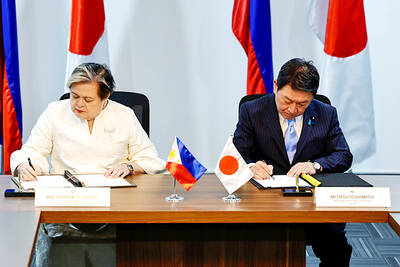
Japan and the Philippines yesterday signed a defense pact that would allow the tax-free provision of ammunition, fuel, food and other necessities when their forces stage joint training to boost deterrence against China’s growing aggression in the region and to bolster their preparation for natural disasters. Japan has faced increasing political, trade and security tensions with China, which was angered by Japanese Prime Minister Sanae Takaichi’s remark that a Chinese attack on Taiwan would be a survival-threatening situation for Japan, triggering a military response. Japan and the Philippines have also had separate territorial conflicts with Beijing in the East and South China
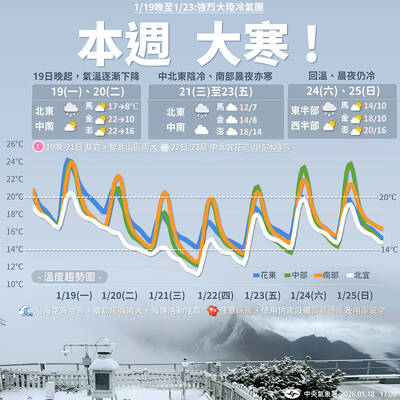
A strong cold air mass is expected to arrive tonight, bringing a change in weather and a drop in temperature, the Central Weather Administration (CWA) said. The coldest time would be early on Thursday morning, with temperatures in some areas dipping as low as 8°C, it said. Daytime highs yesterday were 22°C to 24°C in northern and eastern Taiwan, and about 25°C to 28°C in the central and southern regions, it said. However, nighttime lows would dip to about 15°C to 16°C in central and northern Taiwan as well as the northeast, and 17°C to 19°C elsewhere, it said. Tropical Storm Nokaen, currently
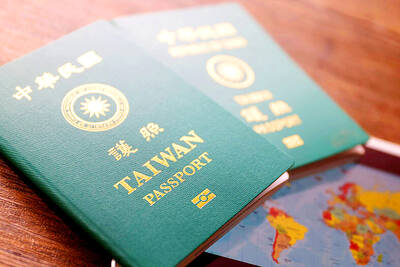
PAPERS, PLEASE: The gang exploited the high value of the passports, selling them at inflated prices to Chinese buyers, who would treat them as ‘invisibility cloaks’ The Yilan District Court has handed four members of a syndicate prison terms ranging from one year and two months to two years and two months for their involvement in a scheme to purchase Taiwanese passports and resell them abroad at a massive markup. A Chinese human smuggling syndicate purchased Taiwanese passports through local criminal networks, exploiting the passports’ visa-free travel privileges to turn a profit of more than 20 times the original price, the court said. Such criminal organizations enable people to impersonate Taiwanese when entering and exiting Taiwan and other countries, undermining social order and the credibility of the nation’s


 RSS
RSS