


First they turned the music industry on its head. Now the men behind the revolutionary file-sharing program Kazaa are setting their sights on an even greater target: the telecom industry.
If Niklas Zennstrom and Janus Friis succeed they would instantly star in one of the most disruptive chapters in modern economic history. Two plain guys with a great idea and plenty of guts who would bring down some of the world's most powerful companies.
The funny thing is that with the backing of over US420 million in venture capital funds (and plenty more to come), this pair of unlikely business revolutionaries may well succeed.
They have a pioneering technology that could make big savings for everyone who makes phone calls, and it has been downloaded over 12 million times since they quietly launched a preliminary service nine months ago.
The tool is Skype, which currently allows users to talk over the Internet with anyone else who subscribes to the service. No big deal, you may think, since people have been chatting over data networks since the early days of the net, despite often appalling sound quality.
But in the same way that Kazaa took the initial idea of Napster and improved it beyond compare, Skype has taken the voice-over-Internet protocol (VOIP) concept to a new level in terms of quality, functionality and ease of use. The implications of this will change the telecom industry for ever.
"I knew it was over when I downloaded Skype," Michael Powell, chairman of the US Federal Communications Commission, told Fortune magazine recently.
"When the inventors of Kazaa are distributing for free a little program that you can use to talk to anybody else, and the quality is fantastic, and it's free -- it's over. The world will change now inevitably," Powell said.
For many of of Skype's users in over 170 countries, it already has.
The downloadable program allows you to use a directory to search for other people who have registered with Skype. Click on a user, and his computer starts ringing and you can speak with crystal-clear clarity.
Of course both computers must be linked to the Net, and have a microphone and speaker or headset.
In the not too distant future such restrictions will be meaningless. Wireless Internet networks (Wi-Fi ) will cover every modern city and Net access will be nearly ubiquitous in laptops, personal digital assistants and cellphones.
Even now, users rave about the Skype experience. Argentinian-American Maria Ardiles used to speak only rarely to her family in Buenos Aires. Now she sits and chats with them for hours from her San Francisco apartment.
"It's amazing, like having my family live next door. Skype is free so I talk with them whenever I want," she said.
Like Kazaa before it, Skype's advantage lies in its ability to take complex technology and make it easy to use. Kazaa is still used by 10s of millions of music fans, but it's caused major waves in the music industry and both the company and users of Kazaa are being sued by recording industry.
Skype copies Kazaa's peer-to-peer network model that essentially delegates all the heavy lifting like routing the calls and indexing the subscriber lists to the users' computers. As the MIT Technology Review noted, "By clever use of software, Skype can outsource the entire business of running a telephone network to its own users".
But since no one ever got rich giving away all their products, Zennstrom and Friis have plans to begin charging. Not for the calls themselves -- Zennstrom says the idea of charging for calls belongs to the last century -- but for added services like voicemail and making calls to the conventional phone network.
"Skype is not about cheap, discounted prices," Zennstrom told attendees at a VOIP conference on in San Francisco Tuesday. "It's about enhanced features, superior voice quality and putting power in the hands of consumers."
But Skype still has a lot of hard work to do. Numerous companies already offer VOIP services, such as AT&T Corp, Time Warner and Net2Phone. The field is also being eyed by IBM Corp and Cisco Systems announced this week that they were teaming up to promote Internet telephony.

ROLLER-COASTER RIDE: More than five earthquakes ranging from magnitude 4.4 to 5.5 on the Richter scale shook eastern Taiwan in rapid succession yesterday afternoon Back-to-back weather fronts are forecast to hit Taiwan this week, resulting in rain across the nation in the coming days, the Central Weather Administration said yesterday, as it also warned residents in mountainous regions to be wary of landslides and rockfalls. As the first front approached, sporadic rainfall began in central and northern parts of Taiwan yesterday, the agency said, adding that rain is forecast to intensify in those regions today, while brief showers would also affect other parts of the nation. A second weather system is forecast to arrive on Thursday, bringing additional rain to the whole nation until Sunday, it

LANDSLIDES POSSIBLE: The agency advised the public to avoid visiting mountainous regions due to more expected aftershocks and rainfall from a series of weather fronts A series of earthquakes over the past few days were likely aftershocks of the April 3 earthquake in Hualien County, with further aftershocks to be expected for up to a year, the Central Weather Administration (CWA) said yesterday. Based on the nation’s experience after the quake on Sept. 21, 1999, more aftershocks are possible over the next six months to a year, the agency said. A total of 103 earthquakes of magnitude 4 on the local magnitude scale or higher hit Hualien County from 5:08pm on Monday to 10:27am yesterday, with 27 of them exceeding magnitude 5. They included two, of magnitude
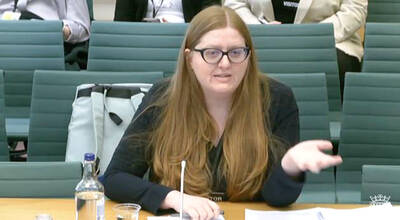
CONDITIONAL: The PRC imposes secret requirements that the funding it provides cannot be spent in states with diplomatic relations with Taiwan, Emma Reilly said China has been bribing UN officials to obtain “special benefits” and to block funding from countries that have diplomatic ties with Taiwan, a former UN employee told the British House of Commons on Tuesday. At a House of Commons Foreign Affairs Committee hearing into “international relations within the multilateral system,” former Office of the UN High Commissioner for Human Rights (OHCHR) employee Emma Reilly said in a written statement that “Beijing paid bribes to the two successive Presidents of the [UN] General Assembly” during the two-year negotiation of the Sustainable Development Goals. Another way China exercises influence within the UN Secretariat is

Taiwan’s first drag queen to compete on the internationally acclaimed RuPaul’s Drag Race, Nymphia Wind (妮妃雅), was on Friday crowned the “Next Drag Superstar.” Dressed in a sparkling banana dress, Nymphia Wind swept onto the stage for the final, and stole the show. “Taiwan this is for you,” she said right after show host RuPaul announced her as the winner. “To those who feel like they don’t belong, just remember to live fearlessly and to live their truth,” she said on stage. One of the frontrunners for the past 15 episodes, the 28-year-old breezed through to the final after weeks of showcasing her unique


 RSS
RSS