


Voters in a California city cast their ballots Tuesday in a bitter referendum to decide if retail behemoth Wal-Mart can override local opposition and planning laws to open a new super-store.
Plans by the world's biggest retailer to build a new commercial center that will be equivalent to the size of 17 football fields have pitted it against organized labor and has sharply divided the community.
Wal-Mart, frequently the focus of rows over its intensely low-cost discount stores that are accused of destroying local business and exploiting workers, has employed a disputed strategy in the battle over Inglewood.
The chain has taken its plans directly to voters in a referendum that could sideline local officials and allow the huge complex to be built without the usual traffic studies, environmental reviews and public hearings.
"There is in Inglewood today a legitimate fear -- a fear of being wiped out by a Confederate economic Trojan horse," said US politician and labor activist Reverend Jesse Jackson, who is campaigning against Wal-Mart.
The ballot measure, on which Wal-Mart has reportedly spent a million dollars, came after it successfully fought efforts to keep its super-centers -- that combine low-cost department store items with groceries -- out of other towns in California where the chain plans to open 40 new giant stores.
Last year, the Inglewood City Council effectively blocked it from moving into town, prompting the chain to navigate a course around officials by gathering about of 10,000 signatures to put the plans to a vote.
The measure needs a simple majority of its estimated 50,000 registered voters to pass.
"They will under-sell [their competitors] and when they are all gone, then they will raise the prices again," said Democratic Congresswoman Maxine Waters.
But supporters of the plan insist the development will prove an economic boon to the depressed area of Los Angeles, creating about 1,200 jobs.
"It's important that Inglewood consumers have the same shopping that many of the neighboring communities have had for years," Wal-Mart spokesman Peter Kanelos told the Los Angeles Times.
"Wal-Mart and our customers are tired of being bullied by the unions. If the unions and the local politicians they put in office want to attack Wal-Mart, they can rest assured that we'll fight back."
Inglewood Mayor Roosevelt Dorn said the Wal-Mart, which would be part of a 24-hectare retail complex, would generate US$3 million to US$5 million a year in sales tax revenues in the city of 112,000 people.
Residents were divided over the plans.
"We do need something in Inglewood, but what they are putting in here is poor quality," said Joan Curtis, who voted no to the Wal-Mart plan.
Some, however, said the vast empty lot where Wal-Mart wants to build should be used to the city's advantage.
"We've got to build something here," said Richard Bell. "It's just a vacant lot that's not doing anything but sitting there, so I feel that we should vote for Wal-Mart to come into this community."
Wal-Mart's expansion in California has drawn fire from labor unions, some politicians and business owners worried about what effect the stores will have on local economies and workers' rights.
Labor groups accuse the non-unionized company of paying employees as little as half the hourly wages of union stores in order to maintain its low-cost sales. Smaller businesses have a tough time competing with Wal-Mart.

NO-LIMITS PARTNERSHIP: ‘The bottom line’ is that if the US were to have a conflict with China or Russia it would likely open up a second front with the other, a US senator said Beijing and Moscow could cooperate in a conflict over Taiwan, the top US intelligence chief told the US Senate this week. “We see China and Russia, for the first time, exercising together in relation to Taiwan and recognizing that this is a place where China definitely wants Russia to be working with them, and we see no reason why they wouldn’t,” US Director of National Intelligence Avril Haines told a US Senate Committee on Armed Services hearing on Thursday. US Senator Mike Rounds asked Haines about such a potential scenario. He also asked US Defense Intelligence Agency Director Lieutenant General Jeffrey Kruse

INSPIRING: Taiwan has been a model in the Asia-Pacific region with its democratic transition, free and fair elections and open society, the vice president-elect said Taiwan can play a leadership role in the Asia-Pacific region, vice president-elect Hsiao Bi-khim (蕭美琴) told a forum in Taipei yesterday, highlighting the nation’s resilience in the face of geopolitical challenges. “Not only can Taiwan help, but Taiwan can lead ... not only can Taiwan play a leadership role, but Taiwan’s leadership is important to the world,” Hsiao told the annual forum hosted by the Center for Asia-Pacific Resilience and Innovation think tank. Hsiao thanked Taiwan’s international friends for their long-term support, citing the example of US President Joe Biden last month signing into law a bill to provide aid to Taiwan,

China’s intrusive and territorial claims in the Indo-Pacific region are “illegal, coercive, aggressive and deceptive,” new US Indo-Pacific Commander Admiral Samuel Paparo said on Friday, adding that he would continue working with allies and partners to keep the area free and open. Paparo made the remarks at a change-of-command ceremony at Joint Base Pearl Harbor-Hickam in Hawaii, where he took over the command from Admiral John Aquilino. “Our world faces a complex problem set in the troubling actions of the People’s Republic of China [PRC] and its rapid buildup of forces. We must be ready to answer the PRC’s increasingly intrusive and
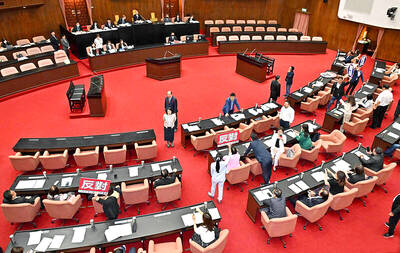
STATE OF THE NATION: The legislature should invite the president to deliver an address every year, the TPP said, adding that Lai should also have to answer legislators’ questions The Chinese Nationalist Party (KMT) yesterday proposed inviting president-elect William Lai (賴清德) to make a historic first state of the nation address at the legislature following his inauguration on May 20. Lai is expected to face many domestic and international challenges, and should clarify his intended policies with the public’s representatives, KMT caucus secretary-general Hung Meng-kai (洪孟楷) said when making the proposal at a meeting of the legislature’s Procedure Committee. The committee voted to add the item to the agenda for Friday, along with another similar proposal put forward by the Taiwan People’s Party (TPP). The invitation is in line with Article 15-2


 RSS
RSS