


OPEC on Wednesday forged ahead with tighter oil supply curbs, deaf to consumer country complaints about crude prices near 13-year highs.
Delegates from the 11 members of the organization cited robust demand for crude oil and ample supply as the main reasons for their decision, which comes at a delicate time in energy markets. Pump prices for gasoline are setting record highs in the US, and crude oil is more expensive than it has been at nearly any time since the first war with Iraq in 1991.
Still, skepticism persists that OPEC's decision, ratifying a plan first announced last month in Algiers, would result in actual production cuts; the cartel has announced cuts at other recent meetings that have never been implemented.
The cartel agreed to turn down the taps despite calls from the US for cheaper fuel. The Bush administration, in an election year, had pressed OPEC to lift export restrictions to help control prices at the pump and prevent energy inflation slowing economic growth.
Delegates said cartel powerhouse Saudi Arabia led the push for implementing cuts of 1 million barrels a day or 4 percent from yesterday.
"The Saudis have gone from being a reliable OPEC price dove to OPEC's arch price hawk," said independent energy consultant Mehdi Varzi.
"That's because of the demands of the Saudi budget. They need higher and higher oil prices every year to meet current expenditure for a larger and larger population," he said.
The White House said President George W. Bush was "disappointed" in OPEC's decision.
"Producers should not take steps that harm American consumers and our economy," said a spokesman for the White House.
Oil prices eased after the deal. A big weekly build in US crude inventories led the slide but expectations among traders that OPEC will be slow to enforce lower quota limits also undermined prices.
Benchmark U.S. crude ended off US$0.49 at US$35.76 a barrel, down from a recent peak of over US$38 on the New York Mercantile Exchange.
OPEC blames speculative investment funds, now commanding record positions on energy contracts, for this year's oil price spike.
Gary Ross of leading US energy consultancy PIRA Energy said: "We estimate speculative funds have already invested US$15 billion in oil futures contracts in New York and London.
This decision is only going to encourage the speculators to stay long on oil markets."
Saudi Arabia's regional Gulf allies Kuwait and the United Arab Emirates (UAE) had recommended OPEC consider delaying tighter output restrictions to allow oil prices to cool.
The unusual division among OPEC's core Gulf members raised speculation that the US is now targeting Kuwait and the UAE, instead of Saudi, for diplomatic efforts aimed at getting lower prices.
Despite a ritual call from ministers for full adherence to quotas, the behind-the-scenes sop to Kuwait and the UAE appears to be a less than rigorous requirement to immediately meet new limits.
Delegates said that to cater to Kuwaiti and UAE concerns it was privately acknowledged by Saudi that actual supplies would not be cut much more in this month, unless oil prices fall.
Kuwaiti Oil Minister Sheikh Ahmad al-Fahd al-Sabah admitted that it would be next month before cartel compliance improved.
"This idea of a compromise to get the Kuwaitis on board, meaning not much of a cut will get implemented, is going to cap prices," said Nauman Barakat of brokers Refco in New York.
If OPEC production is actually reduced, most of the cuts will have to come at Saudi fields, analysts said. Saudi Arabia accounts for about one-third of OPEC's official production of 24.5 million barrels a day.
Analysts believe that most OPEC members are flaunting their official production targets, and that the group is actually producing closer to 26 million barrels a day.
Saudi and a few other OPEC countries have already ordered slightly lower April volumes, moving down towards the new combined limit of 23.5 million barrels daily.
But Reuters estimates from a survey of OPEC customers are that actual supplies are likely to drop by only about a third of the planned million barrel a day cut.
ROLLER-COASTER RIDE: More than five earthquakes ranging from magnitude 4.4 to 5.5 on the Richter scale shook eastern Taiwan in rapid succession yesterday afternoon Back-to-back weather fronts are forecast to hit Taiwan this week, resulting in rain across the nation in the coming days, the Central Weather Administration said yesterday, as it also warned residents in mountainous regions to be wary of landslides and rockfalls. As the first front approached, sporadic rainfall began in central and northern parts of Taiwan yesterday, the agency said, adding that rain is forecast to intensify in those regions today, while brief showers would also affect other parts of the nation. A second weather system is forecast to arrive on Thursday, bringing additional rain to the whole nation until Sunday, it

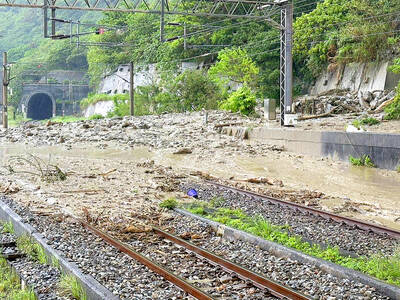
LANDSLIDES POSSIBLE: The agency advised the public to avoid visiting mountainous regions due to more expected aftershocks and rainfall from a series of weather fronts A series of earthquakes over the past few days were likely aftershocks of the April 3 earthquake in Hualien County, with further aftershocks to be expected for up to a year, the Central Weather Administration (CWA) said yesterday. Based on the nation’s experience after the quake on Sept. 21, 1999, more aftershocks are possible over the next six months to a year, the agency said. A total of 103 earthquakes of magnitude 4 on the local magnitude scale or higher hit Hualien County from 5:08pm on Monday to 10:27am yesterday, with 27 of them exceeding magnitude 5. They included two, of magnitude

CONDITIONAL: The PRC imposes secret requirements that the funding it provides cannot be spent in states with diplomatic relations with Taiwan, Emma Reilly said China has been bribing UN officials to obtain “special benefits” and to block funding from countries that have diplomatic ties with Taiwan, a former UN employee told the British House of Commons on Tuesday. At a House of Commons Foreign Affairs Committee hearing into “international relations within the multilateral system,” former Office of the UN High Commissioner for Human Rights (OHCHR) employee Emma Reilly said in a written statement that “Beijing paid bribes to the two successive Presidents of the [UN] General Assembly” during the two-year negotiation of the Sustainable Development Goals. Another way China exercises influence within the UN Secretariat is

Taiwan’s first drag queen to compete on the internationally acclaimed RuPaul’s Drag Race, Nymphia Wind (妮妃雅), was on Friday crowned the “Next Drag Superstar.” Dressed in a sparkling banana dress, Nymphia Wind swept onto the stage for the final, and stole the show. “Taiwan this is for you,” she said right after show host RuPaul announced her as the winner. “To those who feel like they don’t belong, just remember to live fearlessly and to live their truth,” she said on stage. One of the frontrunners for the past 15 episodes, the 28-year-old breezed through to the final after weeks of showcasing her unique


 RSS
RSS