


The WTO, in its first decision on an Internet-related dispute, has ignited a political, cultural and legal tinderbox by ruling that the US policy prohibiting online gambling violates its obligations under international trade law.
The ruling, issued by a WTO panel on Wednesday, is being hailed by operators of online casinos based overseas as a major victory that could force America to liberalize laws outlawing their business.
But the George W. Bush administration vowed to appeal the decision, and several members of Congress said they would rather have an international trade war or withdraw from future rounds of the WTO than have American social policy dictated from abroad.
"It's appalling," said Republican Representative Bob Goodlatte. "It cannot be allowed to stand that another nation can impose its values on the US and make it a trade issue."
The decision stems from a case brought to the WTO in June last year by the tiny island nation of Antigua and Barbuda, which licenses 19 companies that offer sports betting and casino games like blackjack over the Internet.
Antigua and Barbuda argued that US trade policy does not prohibit cross-border gambling operations, and that the US would be hypocritical to do otherwise because it wants to allow American casino operations to operate land-based and Internet-based subsidiaries overseas.
It is not clear precisely why the WTO ruled in favor of Antigua and Barbuda, since the specifics of its decision remain confidential. The ruling covers only online casinos based on the islands, near Puerto Rico, but other nations could seek similar rulings, legal experts said.
Ronald Sanders, the islands' chief foreign affairs representative, said he believes it is clear from the decision that the US must liberalize its online gambling regulations or risk being hypocritical about its stance on free trade.
"The US says it wants open competition," he said. "But it only wants free trade when it suits the US."
Millions of Americans gamble over the Internet, using credit cards or online payment services to wager on sports contests or at games like poker, blackjack and roulette.
Under federal law, it is illegal to offer sports bets over the Internet or to operate other gambling operations not otherwise allowed by individual states. State laws vary widely, with some allowing specific forms of gambling within their borders. Some states criminalize the placing of a bet, but others, like New York, do not make it a crime to place a bet on the Internet.
Online casinos are typically based in Costa Rica or the Caribbean, but also in Britain. Their business continues to grow, but not nearly as fast as industry experts once projected; the slower growth has come in part because many banks do not allow their credit cards to be used to place bets.
Also, the Justice Department has begun to crack down on American broadcasters and publishers that advertise on behalf of Internet casinos. The crackdown, based on an untested legal theory that American companies are aiding and abetting an illegal enterprise, has limited the ability of online casinos to reach Americans.
Sebastian Sinclair, a research analyst who studies the Internet gambling industry, said he doubted the WTO decision would affect America's internal policies and instead could actually strengthen the resolve of policy-makers who want to see the activity prohibited. At the same time, he said the decision shows the gulf in policy on the issue between America and much of the world.
"We're going down one path, and the rest of the world is going down a completely different path," said Sinclair, an analyst with Christiansen Capital Advisors.
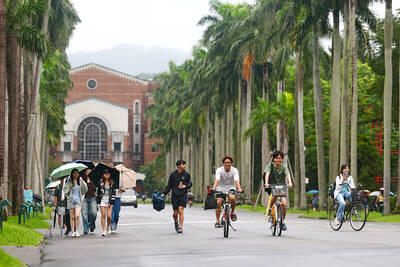
National Taiwan University (NTU) yesterday said it disqualified a person from an entrance examination for using AI smart glasses to cheat, along with two others for making untruthful statements in their curriculum vitae. The three applicants were given null scores, Taiwan’s highest-ranked university said, calling on prospective students to be honest in the admissions process. NTU registrar Lee Hung-sen (李宏森) said that the cheating applicant wore a hat and thick-rimmed glasses to the second written exam for medical school, claiming that they felt cold. Suspicions were aroused when the applicant stared oddly at the test for long stretches while steadily bringing the paper
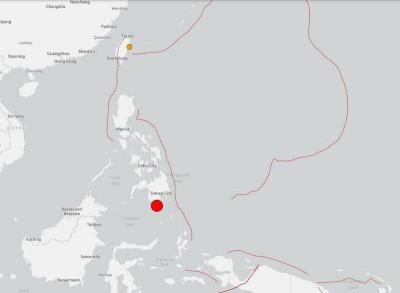
A magnitude 7.8 earthquake struck off the southern coast of Mindanao in the Philippines at 7:38am today, prompting the US Tsunami Warning System to issue an alert for neighboring countries, including Taiwan. The system issued a purple alert indicating a "tsunami threat." The potential threat zone includes Taiwan, the Philippines, Papua New Guinea, Yap and Palau. Philippine authorities were assessing the damage from the quake, with the office of civil defense seeking to verifying initial reports that 15 people had been killed and 129 injured in the region, mostly from falling debris. Arlene Hollero, disaster chief of Maasim town in the Philippines' Sarangani Province,
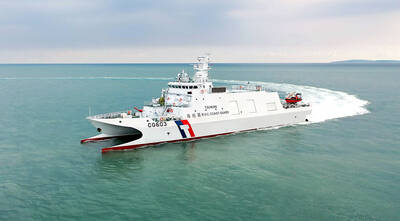
‘GRAY ZONE’ PRESSURE: Beijing’s activities are intended to create the deceitful impression that China has jurisdiction over the area around Taiwan, the CGA said Taiwan’s rights over its territorial waters and exclusive economic zone must not be violated by any country, the Mainland Affairs Council said yesterday, adding that it will not accept any unprovoked actions. The council issued the remarks in response to the China Coast Guard conducting maritime enforcement drills near eastern Taiwan and claiming to fully exercise China’s maritime administrative law enforcement authority. The Coast Guard Administration (CGA) has been closely monitoring the situation and is taking concrete steps to defend the nation’s sovereignty and secure its waters, the council said. China has no sovereign rights over the waters off eastern
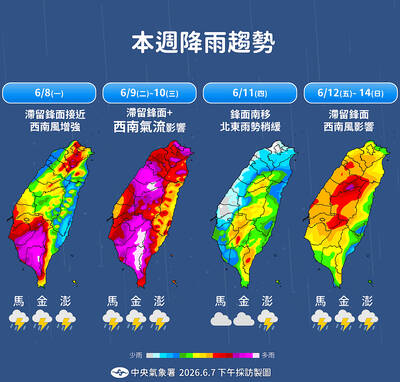
Heavy rain is expected to affect parts of Taiwan this week, the Central Weather Administration (CWA) said yesterday as a meteorologist said the active part of the annual plum rain season has started. A stationary plum rain front and southwesterly winds would bring unstable weather and abundant moisture to Taiwan from today for about a week, with the heaviest rainfall forecast for tomorrow and Wednesday, the CWA said. The agency said western and northeastern Taiwan, and mountainous areas in the east and southeast, could expect showers or thunderstorms on those two days, with localized heavy rain possible. Other parts of


 RSS
RSS