


Online search engine leader Google has banned the ads of an environmental group protesting a major cruise line's sewage treatment methods, casting a spotlight on the policies -- and power -- of the popular Web site's lucrative marketing program.
Oceana, a two-and-a-half-year-old nonprofit group, said Google dropped the text-based ads displayed in shaded boxes along the right side of its Web page because they were critical of Royal Caribbean Cruise Lines.
Washington DC-based Oceana believes Royal Caribbean pollutes the oceans by improperly treating the sewage on its ships. It hoped to publicize its complaints by paying to have its ads appear when terms like "cruise vacation" and "cruise ship" were entered into Google's search engine.
The ad, which said "Help us protect the world's oceans," appeared for two days last week before Google pulled it from its page.
When Oceana challenged the ban, Mountain View, California-based Google responded with an e-mail advising the group that it doesn't accept ads with "language that advocates against Royal Caribbean."
Oceana's ad didn't mention Royal Caribbean directly, but the link directed Google visitors to a Web page critical of the Miami-based cruise line.
The decision stunned Oceana because it reeked of censorship and favoritism, said Andrew Sharpless, the group's chief executive.
"We were surprised because the answer they gave certainly raises the question whether they got a phone call from Royal Caribbean," Sharpless said Thursday.
"We can't prove that, but it certainly smells that way."
Both Google and Royal Caribbean denied there was any pressure applied to remove the Oceana ad.
Google's policy prohibits ads criticizing other groups or companies, said spokeswoman Cindy McCaffrey.
"We do reserve the right to exercise editorial discretion when it comes to the advertising we accept on our site," she said.
Google's ad policies don't affect the noncommercial results that the search engine delivers using a closely guarded formula.
Oceana's ad probably would be accepted by Yahoo, which operates a similar online marketing program through its Overture subsidiary. Overture accepts critical ads, as long as they aren't obscene or libelous, said company spokeswoman Jennifer Stephens.
"We see it as a freedom of speech issue," she said.
The ads have become a big moneymaker for Google, providing the company with hundreds of millions of dollars to expand its operations and technology.
As a privately held company, Google doesn't disclose its financial results, but its revenue last year is believed to have ranged between US$700 million and US$1 billion.
The company is expected to go public later this year.
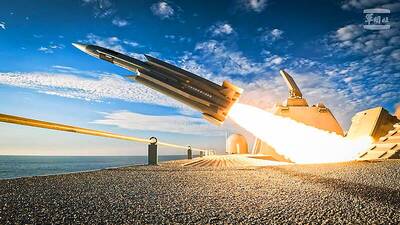
DETERRENCE: With 1,000 indigenous Hsiung Feng II and III missiles and 400 Harpoon missiles, the nation would boast the highest anti-ship missile density in the world With Taiwan wrapping up mass production of Hsiung Feng II and III missiles by December and an influx of Harpoon missiles from the US, Taiwan would have the highest density of anti-ship missiles in the world, a source said yesterday. Taiwan is to wrap up mass production of the indigenous anti-ship missiles by the end of year, as the Chungshan Institute of Science and Technology has been meeting production targets ahead of schedule, a defense official with knowledge of the matter said. Combined with the 400 Harpoon anti-ship missiles Taiwan expects to receive from the US by 2028, the nation would have

North Korea yesterday fired about 10 ballistic missiles to the sea toward Japan, the South Korean Joint Chiefs of Staff (JCS) said, days after Pyongyang warned of “terrible consequences” over ongoing South Korea-US military drills. Pyongyang recently dashed hopes of a diplomatic thaw with Seoul, Washington’s security ally, describing its latest peace efforts as a “clumsy, deceptive farce.” Seoul’s military detected “around 10 ballistic missiles launched from the Sunan area in North Korea toward the East Sea [Sea of Japan] at around 1:20pm,” JCS said in a statement, referring to South Korea’s name for the body of water. The missiles

‘UNWAVERING FRIENDSHIP’: A representative of a Japanese group that co-organized a memorial, said he hopes Japanese never forget Taiwan’s kindness President William Lai (賴清德) yesterday marked the 15th anniversary of the Tohoku earthquake and tsunami, urging continued cooperation between Taiwan and Japan on disaster prevention and humanitarian assistance. Lai wrote on social media that Taiwan and Japan have always helped each other in the aftermath of major disasters. The magnitude 9 earthquake struck northeastern Japan on March 11, 2011, triggering a massive tsunami that claimed more than 19,000 lives, according to data from Japanese authorities. Following the disaster, Taiwan donated more than US$240 million in aid, making it one of the largest contributors of financial assistance to Japan. In addition to cash donations and
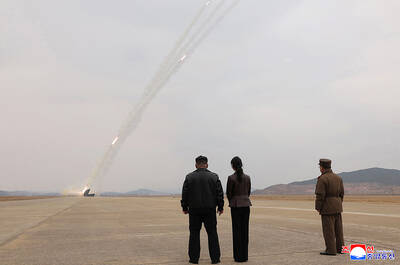
North Korea tested nuclear-capable rocket launchers, state media reported yesterday, a day after Seoul detected the launch of about 10 ballistic missiles. The test comes after South Korean and US forces launched their springtime military drills, due to run until Thursday. North Korean leader Kim Jong-un on Saturday oversaw the testing of the multiple rocket launcher system (MRLS), the Korean Central News Agency (KCNA) said. The test involved 12 600mm-caliber ultra-precision multiple rocket launchers and two artillery companies, it said. Kim said the drill gave Pyongyang’s enemies, within the 420km striking range, a sense of “uneasiness” and “a deep understanding


 RSS
RSS