


There are no chestnuts roasting by open fires in Japan at Christmas and chimneys to hang stockings by are few and far between.
It isn't even a holiday in this non-Christian nation and schoolchildren, at least in Tokyo, will be trudging off to get their report cards.
But Christmas lights and decorations on private homes are going strong -- perhaps an effort to chase away the shadows of economic gloom that have hovered over the nation for a decade.
Twinkling lights on trees, lights in the shape of reindeer and blinking lights nestled in artificial pine boughs are gracing ordinary Japanese homes in growing numbers.
"Back during the economic boom years, people would go out to a hotel to celebrate and spend lots of money on Christmas," said Tomoki Sakaino, a manager at Internet research firm infoPLANT.
"But people celebrate at home now, and lights and decorations are cheap. It's a good way to have fun."
According to a survey conducted by infoPLANT last year, 47 percent of people planned to put up lights for Christmas, up from 43 percent the year before. Other informal surveys suggest the practice has become much more common in recent years.
"Our sales have really shot up," said Wataru Matsuyama, who runs a home centre specializing in Christmas lights in Yamanashi, some 109km west of Tokyo. "At least 20 percent higher than last year."
Unlike venerable Japanese traditions such as the tea ceremony, there is no prescribed way to put up Christmas lights, which is a big part of their appeal.
Businesses are also finding that elaborate Christmas displays bring seasonal cheer, as people flock to admire -- and spend.
"A lot of chambers of commerce are getting into this, using lights to decorate their local shopping areas," said Matsuyama.
"It brings people in and makes things more lively."
Japan also has a few home-grown Christmas traditions.
It has long been seen as an occasion for couples rather than families, with romantic dinners for two -- preferably at a Western restaurant -- the celebration of choice, along with an exchange of gifts.
Like most of Japan's other Christmas rituals, this takes place on Christmas Eve rather than the day itself.
Since turkey is hard to come by and won't fit into the tiny oven in most Japanese homes, Christmas Eve dinner often features chicken, roasted or fried.
Kentucky Fried Chicken does a booming business and many stores have sales four or five times higher than usual.
"Around 1971, managers noticed that foreigners who couldn't find turkey were coming in to buy chicken for their Christmas meal and they suggested we promote this," said a spokeswoman at Kentucky Fried Chicken Japan. "It's now the best season for us."
Meals end with Christmas cake, traditionally a concoction of white sponge cake, strawberries and sweet whipped cream.
It's useless after the 25th, which gave rise at one point to the saying that women "were like Christmas cake" -- they ought to be married by 25.
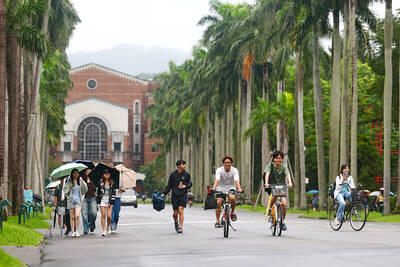
National Taiwan University (NTU) yesterday said it disqualified a person from an entrance examination for using AI smart glasses to cheat, along with two others for making untruthful statements in their curriculum vitae. The three applicants were given null scores, Taiwan’s highest-ranked university said, calling on prospective students to be honest in the admissions process. NTU registrar Lee Hung-sen (李宏森) said that the cheating applicant wore a hat and thick-rimmed glasses to the second written exam for medical school, claiming that they felt cold. Suspicions were aroused when the applicant stared oddly at the test for long stretches while steadily bringing the paper
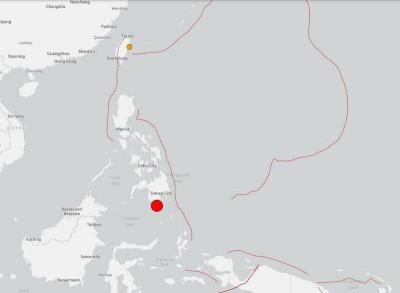
A magnitude 7.8 earthquake struck off the southern coast of Mindanao in the Philippines at 7:38am today, prompting the US Tsunami Warning System to issue an alert for neighboring countries, including Taiwan. The system issued a purple alert indicating a "tsunami threat." The potential threat zone includes Taiwan, the Philippines, Papua New Guinea, Yap and Palau. Philippine authorities were assessing the damage from the quake, with the office of civil defense seeking to verifying initial reports that 15 people had been killed and 129 injured in the region, mostly from falling debris. Arlene Hollero, disaster chief of Maasim town in the Philippines' Sarangani Province,

‘GRAY ZONE’ PRESSURE: Beijing’s activities are intended to create the deceitful impression that China has jurisdiction over the area around Taiwan, the CGA said Taiwan’s rights over its territorial waters and exclusive economic zone must not be violated by any country, the Mainland Affairs Council said yesterday, adding that it will not accept any unprovoked actions. The council issued the remarks in response to the China Coast Guard conducting maritime enforcement drills near eastern Taiwan and claiming to fully exercise China’s maritime administrative law enforcement authority. The Coast Guard Administration (CGA) has been closely monitoring the situation and is taking concrete steps to defend the nation’s sovereignty and secure its waters, the council said. China has no sovereign rights over the waters off eastern
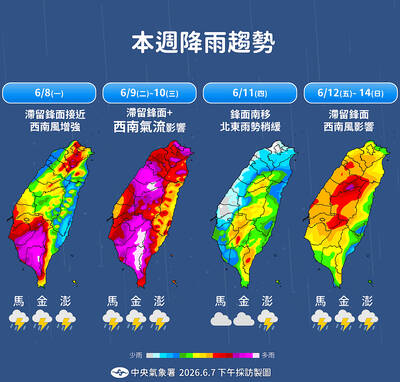
Heavy rain is expected to affect parts of Taiwan this week, the Central Weather Administration (CWA) said yesterday as a meteorologist said the active part of the annual plum rain season has started. A stationary plum rain front and southwesterly winds would bring unstable weather and abundant moisture to Taiwan from today for about a week, with the heaviest rainfall forecast for tomorrow and Wednesday, the CWA said. The agency said western and northeastern Taiwan, and mountainous areas in the east and southeast, could expect showers or thunderstorms on those two days, with localized heavy rain possible. Other parts of


 RSS
RSS