


New laws allowing Singapore to launch pre-emptive strikes against computer hackers have raised fears that Internet controls are being tightened and privacy compromised in the name of fighting terrorism.
The city-state's parliament has approved tough new legislation aimed at stopping "cyberterrorism," referring to computer crimes that are endanger national security, foreign relations, banking and essential public services.
Security agencies can now patrol the Internet and swoop down on hackers suspected of plotting to use computer keyboards as weapons of mass disruption.
Violators of the Computer Misuse Act such as Web site hackers can be jailed up to three years or fined up to S$10,000 (US$5,800 US).
But a vocal opposition fear the law will be abused.
"It could be misused to invade into the privacy of citizens to gather information," said Sinapan Samydorai, president of Think Center, a civil liberties group.
He said the new laws could be used as an "instrument of oppression" by the government.
An online poll by popular Internet portal Yahoo Singapore showed that 70 percent of respondents felt the new laws gave the authorities too much power, and they were afraid they were being watched.
The new measures have been likened by critics to the Internal Security Act, which has been used to detain political dissidents and radicals without trial.
Kit Yau, a Hong Kong-based analyst with technology research group IDC, said Singapore should spell out how the new laws are to be implemented in order to allay public fears.
"This is part of the government's job of providing security, but you have to make people know what is going on, what are the limitations," she said.
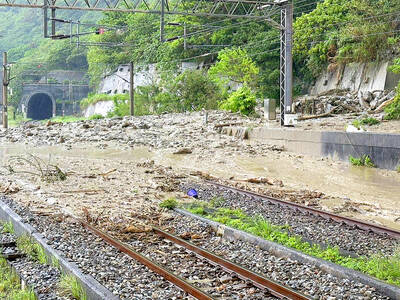
ROLLER-COASTER RIDE: More than five earthquakes ranging from magnitude 4.4 to 5.5 on the Richter scale shook eastern Taiwan in rapid succession yesterday afternoon Back-to-back weather fronts are forecast to hit Taiwan this week, resulting in rain across the nation in the coming days, the Central Weather Administration said yesterday, as it also warned residents in mountainous regions to be wary of landslides and rockfalls. As the first front approached, sporadic rainfall began in central and northern parts of Taiwan yesterday, the agency said, adding that rain is forecast to intensify in those regions today, while brief showers would also affect other parts of the nation. A second weather system is forecast to arrive on Thursday, bringing additional rain to the whole nation until Sunday, it
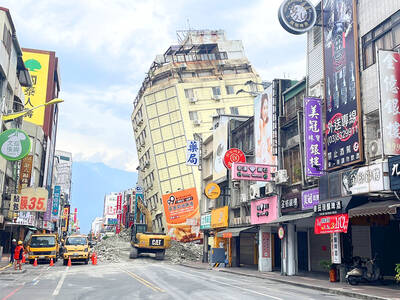
LANDSLIDES POSSIBLE: The agency advised the public to avoid visiting mountainous regions due to more expected aftershocks and rainfall from a series of weather fronts A series of earthquakes over the past few days were likely aftershocks of the April 3 earthquake in Hualien County, with further aftershocks to be expected for up to a year, the Central Weather Administration (CWA) said yesterday. Based on the nation’s experience after the quake on Sept. 21, 1999, more aftershocks are possible over the next six months to a year, the agency said. A total of 103 earthquakes of magnitude 4 on the local magnitude scale or higher hit Hualien County from 5:08pm on Monday to 10:27am yesterday, with 27 of them exceeding magnitude 5. They included two, of magnitude

CONDITIONAL: The PRC imposes secret requirements that the funding it provides cannot be spent in states with diplomatic relations with Taiwan, Emma Reilly said China has been bribing UN officials to obtain “special benefits” and to block funding from countries that have diplomatic ties with Taiwan, a former UN employee told the British House of Commons on Tuesday. At a House of Commons Foreign Affairs Committee hearing into “international relations within the multilateral system,” former Office of the UN High Commissioner for Human Rights (OHCHR) employee Emma Reilly said in a written statement that “Beijing paid bribes to the two successive Presidents of the [UN] General Assembly” during the two-year negotiation of the Sustainable Development Goals. Another way China exercises influence within the UN Secretariat is

Taiwan’s first drag queen to compete on the internationally acclaimed RuPaul’s Drag Race, Nymphia Wind (妮妃雅), was on Friday crowned the “Next Drag Superstar.” Dressed in a sparkling banana dress, Nymphia Wind swept onto the stage for the final, and stole the show. “Taiwan this is for you,” she said right after show host RuPaul announced her as the winner. “To those who feel like they don’t belong, just remember to live fearlessly and to live their truth,” she said on stage. One of the frontrunners for the past 15 episodes, the 28-year-old breezed through to the final after weeks of showcasing her unique


 RSS
RSS