


US officials, frustrated with the prospect of a watered-down hemispheric trade agreement, said Tuesday they would focus on bilateral agreements with several compliant nations in the Andes, Central America and the Caribbean as a way to get past differences with South America's largest economy, Brazil.
In announcing the decision to seek less-ambitious trade agreements with a group of relatively small economies, Robert Zoellick, the US trade representative, tacitly confirmed the glacial pace of wider talks here this week aimed at creating a Free Trade Area of the Americas among 34 countries in the Western Hemisphere.
The US and Brazil, which are jointly leading the negotiations, reached an understanding that would remove sensitive issues like agricultural subsidies and intellectual property protection from the talks in an effort to avert the type of collapse that took place two months ago at a WTO meeting in Cancun, Mexico.
This strategy could ultimately allow talks to advance on creating a hemispheric trade agreement by early 2005. But because the US and Brazil remain far apart in several crucial areas, the approach has also generated concern that the talks could result in a watered-down agreement described by some negotiators as an a la carte approach.
While a group of about a dozen countries, led by Canada and Chile, have reacted coolly to the joint proposal by the US and Brazil, effectively stalling resolution of the matter until top-level negotiators convene here later this week, several nations have seized on the opportunity to negotiate parallel agreements with the US.
Zoellick said he had notified Congress on Tuesday of the Bush administration's intent to begin trade talks with several countries in the Andean region: Colombia, Peru, Ecuador and Bolivia.
Zoellick said there would be a two-pronged approach to the talks, with an early emphasis on negotiations with Colombia and Peru and later efforts to bring Ecuador and Bolivia into the talks.
Zoellick said he was also planning to start talks to bring the Dominican Republic into the Central American Free Trade Agreement and a separate effort to reach an agreement with Panama.
Despite concern that the Central American agreement could encounter resistance in Congress, especially with regard to efforts to reduce subsidies for sugar producers, negotiators here said it was important to move forward in some areas.
Brazilian negotiators reacted calmly to Zoellick's announcement of talks with several countries, describing the strategy as a normal negotiating tactic. Antonio Simoes, an adviser to Brazil's foreign minister, Celso Amorim, said Brazil was also hoping to negotiate bilateral trade agreements with nations including Peru and Venezuela through the Mercosur trade group.
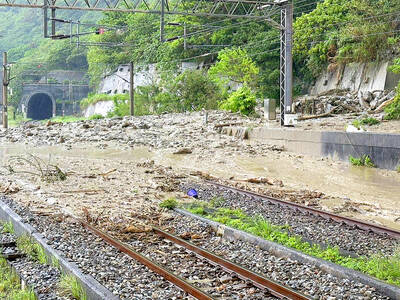
ROLLER-COASTER RIDE: More than five earthquakes ranging from magnitude 4.4 to 5.5 on the Richter scale shook eastern Taiwan in rapid succession yesterday afternoon Back-to-back weather fronts are forecast to hit Taiwan this week, resulting in rain across the nation in the coming days, the Central Weather Administration said yesterday, as it also warned residents in mountainous regions to be wary of landslides and rockfalls. As the first front approached, sporadic rainfall began in central and northern parts of Taiwan yesterday, the agency said, adding that rain is forecast to intensify in those regions today, while brief showers would also affect other parts of the nation. A second weather system is forecast to arrive on Thursday, bringing additional rain to the whole nation until Sunday, it

LANDSLIDES POSSIBLE: The agency advised the public to avoid visiting mountainous regions due to more expected aftershocks and rainfall from a series of weather fronts A series of earthquakes over the past few days were likely aftershocks of the April 3 earthquake in Hualien County, with further aftershocks to be expected for up to a year, the Central Weather Administration (CWA) said yesterday. Based on the nation’s experience after the quake on Sept. 21, 1999, more aftershocks are possible over the next six months to a year, the agency said. A total of 103 earthquakes of magnitude 4 on the local magnitude scale or higher hit Hualien County from 5:08pm on Monday to 10:27am yesterday, with 27 of them exceeding magnitude 5. They included two, of magnitude
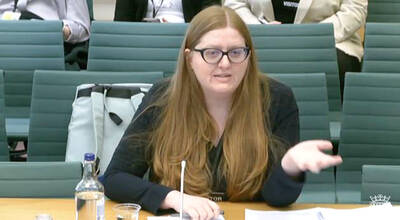
CONDITIONAL: The PRC imposes secret requirements that the funding it provides cannot be spent in states with diplomatic relations with Taiwan, Emma Reilly said China has been bribing UN officials to obtain “special benefits” and to block funding from countries that have diplomatic ties with Taiwan, a former UN employee told the British House of Commons on Tuesday. At a House of Commons Foreign Affairs Committee hearing into “international relations within the multilateral system,” former Office of the UN High Commissioner for Human Rights (OHCHR) employee Emma Reilly said in a written statement that “Beijing paid bribes to the two successive Presidents of the [UN] General Assembly” during the two-year negotiation of the Sustainable Development Goals. Another way China exercises influence within the UN Secretariat is

Taiwan’s first drag queen to compete on the internationally acclaimed RuPaul’s Drag Race, Nymphia Wind (妮妃雅), was on Friday crowned the “Next Drag Superstar.” Dressed in a sparkling banana dress, Nymphia Wind swept onto the stage for the final, and stole the show. “Taiwan this is for you,” she said right after show host RuPaul announced her as the winner. “To those who feel like they don’t belong, just remember to live fearlessly and to live their truth,” she said on stage. One of the frontrunners for the past 15 episodes, the 28-year-old breezed through to the final after weeks of showcasing her unique


 RSS
RSS