


There is marketing muscle and then there is Microsoft. After all, what other company would spend five times as much to promote a product upgrade as it did on an earlier upgrade just two years before? Microsoft, of course.
Could it be that Microsoft is finally hearing footsteps from competitors in the office suite software market?
Analysts say maybe so; Microsoft says of course not.
At hand is the introduction scheduled for yesterday of a US$150 million ad campaign to promote the latest version of Microsoft Office.
The company is hoping to transform the suite's image from that of a set of taken-for-granted desktop equipment to a system that can make everyone a winner.
The system, this time around, is shown less as a key to personal productivity than as a way to enhance collaboration and team success.
One goal, naturally, is to solidify the company's already intimidating market position, analysts said, by fending off challenges from competitors like Sun Microsystems, which has introduced its own StarOffice suite of business programs, and IBM, which is aggressively pursuing small and medium-sized businesses with software and hardware offerings.
"They have an awesome presence in the small and medium-size business market," said Richard Sherlund, a software industry analyst at Goldman Sachs in New York, speaking of Microsoft.
"Having said that, everyone wants to get into that market. IBM, Sun, Oracle and others want to compete against them in that space," he said.
But a Microsoft executive said it was also crucial to persuade existing Office users to upgrade from older versions.
"This is more robust and broader than everything we've done in the past," said Michael Dix, director for Office branding at Microsoft. "Our primary competitor is ourselves from our past," he said.
For Microsoft to battle the biggest marketing behemoth out there -- itself -- takes money, said Robert Lerner, senior analyst at Current Analysis in Sterling, Virgina.
"Microsoft is not a stupid company," Lerner said. "They're very aggressive."
To that end, the advertising budget for the next six months, expected to total US$150 million to US$200 million, far eclipses the US$30 million spent to advertise the introduction of Office XP two years ago.
The challenge for the Microsoft agency, the San Francisco office of McCann-Erickson Worldwide Advertising, was to communicate computer power and human excitement at the same time.
Michael McLaren, executive vice president, director for client services and worldwide account director for Microsoft, said Office needed a big branding campaign to make people focus on it.
"Office in some respects is probably the most underestimated brand in the technology space," McLaren said.
"People know it's there but take it for granted," he said.
Some analysts were skeptical that the sports analogy would translate into sales.
"That's not how people think about their jobs," said Ted Schadler, principal analyst at Forrester Research in Cambridge, Massachusetts. "No computer ever turned their employee into a sports star," he said.

NO-LIMITS PARTNERSHIP: ‘The bottom line’ is that if the US were to have a conflict with China or Russia it would likely open up a second front with the other, a US senator said Beijing and Moscow could cooperate in a conflict over Taiwan, the top US intelligence chief told the US Senate this week. “We see China and Russia, for the first time, exercising together in relation to Taiwan and recognizing that this is a place where China definitely wants Russia to be working with them, and we see no reason why they wouldn’t,” US Director of National Intelligence Avril Haines told a US Senate Committee on Armed Services hearing on Thursday. US Senator Mike Rounds asked Haines about such a potential scenario. He also asked US Defense Intelligence Agency Director Lieutenant General Jeffrey Kruse
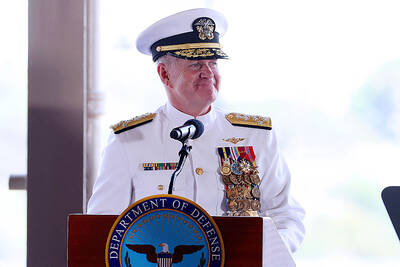
China’s intrusive and territorial claims in the Indo-Pacific region are “illegal, coercive, aggressive and deceptive,” new US Indo-Pacific Commander Admiral Samuel Paparo said on Friday, adding that he would continue working with allies and partners to keep the area free and open. Paparo made the remarks at a change-of-command ceremony at Joint Base Pearl Harbor-Hickam in Hawaii, where he took over the command from Admiral John Aquilino. “Our world faces a complex problem set in the troubling actions of the People’s Republic of China [PRC] and its rapid buildup of forces. We must be ready to answer the PRC’s increasingly intrusive and

INSPIRING: Taiwan has been a model in the Asia-Pacific region with its democratic transition, free and fair elections and open society, the vice president-elect said Taiwan can play a leadership role in the Asia-Pacific region, vice president-elect Hsiao Bi-khim (蕭美琴) told a forum in Taipei yesterday, highlighting the nation’s resilience in the face of geopolitical challenges. “Not only can Taiwan help, but Taiwan can lead ... not only can Taiwan play a leadership role, but Taiwan’s leadership is important to the world,” Hsiao told the annual forum hosted by the Center for Asia-Pacific Resilience and Innovation think tank. Hsiao thanked Taiwan’s international friends for their long-term support, citing the example of US President Joe Biden last month signing into law a bill to provide aid to Taiwan,
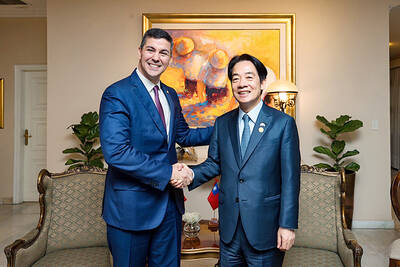
UNWAVERING: Paraguay remains steadfast in its support of Taiwan, but is facing growing pressure at home and abroad to switch recognition to Beijing, Pena said Paraguayan President Santiago Pena has pledged to continue enhancing cooperation with Taiwan, as he and Japanese Prime Minister Fumio Kishida expressed opposition to any unilateral change to the “status quo” in the Taiwan Strait using force, Japanese media reported on Saturday. Kishida yesterday completed a trip to France, Brazil and Paraguay, his first visit to South America since taking office in 2021. After the Japanese leader and Pena spoke for more than an hour on Friday, exchanging views on the situation in East Asia in the face of China’s increasing military pressure on Taiwan, they affirmed that “unilateral attempts to change the


 RSS
RSS