


Sony Corp, the world's second-largest maker of consumer electronics, plans to cut as many as 20,000 jobs, or about 10 percent of its workforce, by March 2006 as it stops making televisions in Japan and reduces administration costs, the Nihon Keizai Shimbun said.
"It is true Sony is planning layoffs," spokesman Koichi Izukura said in Tokyo where the company is based, adding he was unable to provide details.
Sony, whose profit plunged 98 percent in the three months ended June 30, will include the cuts in a plan to be announced on Oct. 28, the newspaper reported.
Sony, which had 161,000 workers at the end of March, until now has resisted cuts that have claimed as many as 70,000 jobs at electronics companies such as NEC Corp, Fujitsu Ltd and Toshiba Corp the past three years.
The cuts would follow a vow by chief executive officer Nobuyuki Idei to increase profit margins to 10 percent from 4 percent after costs for the overhaul are subtracted.
"Consumer-electronics makers need to cut costs because it's becoming much more difficult to continue to grow sales," said Makoto Suzuki, who manages the equivalent of US$137 million at Chuo Mitsui Asset Management Co, including Sony.
Led by Idei, Sony is relying on new products such as a hand-held game player and the PSX, a type of game console with a hard disk drive and television tuner, to stimulate sales.
Idei will attend next week's meeting when Sony unveils its reorganization as will Sony president Kunitake Ando.
The reorganization comes after Sony shocked investors and analysts in April by reporting a wider-than-expected fourth-quarter loss after sales at its game business fell by 25 percent and demand for stereos and TVs slumped.
The maker of the PlayStation 2 video-game console, second behind only Matsushita Electric Industrial Co in sales of consumer electronics, has been late in introducing the kinds of job cuts taken by some of its competitors.
Still, an overhaul at some of the Sony's most unprofitable businesses is already underway. Sony Music Entertainment Inc, the company's New York-based music unit, predicted in March it will save about US$100 million a year by cutting 1,000 workers or about 10 percent of its workforce.
Sony in May said it will spend ?140 billion (US$1.29 billion) by March 31 to shed jobs and close factories.
The plant closings, in part, are intended to boost profit at Sony's electronics unit, which reported a 74 percent decline in fiscal first-quarter operating profit.
The company may cut 1,500 to 2,000 domestic jobs, most of them administrative workers at the parent company, the Nihon Keizai said, without saying where it got the information.
Sony also intends to pull out of "unprofitable and non-strategic" operations to pare costs, it said.
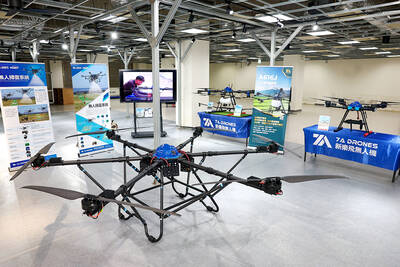
DRONE CENTRAL: Taiwan aims to become Asia’s democratic hub for drones, with most exports focused on high-quality military-grade models, an official said Taiwan’s drone industry is expected to expand significantly by 2030, producing 100,000 units per month and exporting half of them, the Ministry of Economic Affairs said yesterday. Current drone production capacity is about 15,000 units per month, but the industry can quickly scale up as demand increases, Industrial Development Administration Director-General Chiou Chyou-huey (邱求慧) told a news conference in Taipei. Taiwan’s drone output grew 2.5-fold last year to NT$12.9 billion (US$408.3 million) under a government program to develop the uncrewed vehicle sector, he said. The Executive Yuan in October last year approved plans to invest NT$44.2 billion into domestic production of uncrewed aerial
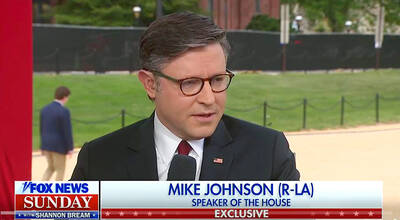
RESOLUTE BACKING: Two Republican senators are planning to introduce legislation that would impose immediate sanctions on China if it attempts to invade Taiwan US House of Representatives Speaker Mike Johnson on Sunday reaffirmed US congressional support for Taiwan, saying the US and “all freedom-loving people” have a stake in preventing China from seizing Taiwan by force. Johnson made the remarks in an interview with Fox News Sunday on US President Donald Trump’s summit with Chinese President Xi Jinping (習近平) last week. In an interview that aired on Friday on Fox News, just as Trump wrapped up a high-stakes visit to China, he said he has yet to green-light a new US$14 billion arms package to Taiwan and that it “depends on China.” “It’s a very good
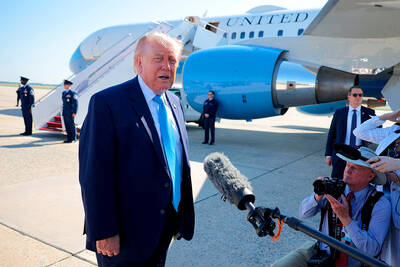
US President Donald Trump yesterday said he would speak to President William Lai (賴清德) as his administration considers whether to move ahead with a US$14 billion weapons sale to Taiwan — a potential arms deal that has drawn criticism from China. “Well, I’ll speak to him. I speak to everybody,” Trump told reporters yesterday when asked if he had any plans to call his counterpart, although he did not offer a time frame for when such a conversation could take place. Trump previously said he would speak to the person “that’s running Taiwan,” without specifying who he meant. “We have that situation very
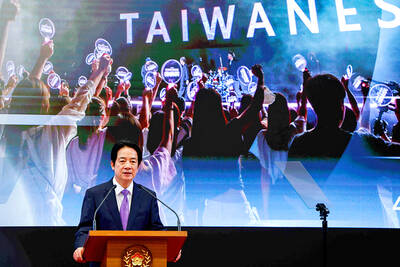
SPEAKING UP: If he had the opportunity to talk with Trump, Lai said he would tell the US president that China was undermining peace in the region The future of Taiwan must not be decided by external forces nor can it be held hostage by fear, division or short-term gain, President William Lai (賴清德) said yesterday in an address marking the second anniversary of his inauguration. Speaking at the Presidential Office, Lai said democracy is the most important part of Taiwan’s identity, and it is not a gift from heaven. Taiwan’s democracy is rooted in the sacrifices and devotion of many generations, and while differences are inevitable, he urged the ruling and opposition parties to demonstrate unity in confronting external threats and upholding national interests. “Taiwan’s future cannot be decided


 RSS
RSS