


On the outskirts of Shenzhen, the headquarters of Huawei Technol-ogies (
With dozens of sleek stone and glass buildings that would not look out of place in Silicon Valley, the expanding campus houses many of the 10,000 engineers working to establish Huawei as China's first international player in the communications-equipment business.
Among the makers of the equipment that knit the Internet, telephone systems and computer databases together, Huawei still stands deep in the shadows of industry heavyweights like Cisco Systems Inc and the Nortel Networks Corp.
But in a tough market, its domestic sales grew by a third in the first half of the year, and analysts expect international sales to grow from US$550 million last year to US$1 billion this year and US$1.4 billion next year.
Huawei's rapid expansion has brought it plaudits from China's top leaders, who are eager for the country to establish itself as a high-technology power and not just a factory floor for the world.
Outside China, Huawei's rise has been a source of anxiety and accusations. Most conspicuously, Cisco filed a lawsuit early this year in Texas charging that Huawei stole its computer coding for data routing equipment. On Oct. 1, the two companies agreed to suspend the lawsuit and seek private adjudication.
In the past, Huawei faced accusations of deals with former Iraqi president Saddam Hussein's government. Some critics say the company continues to have close ties to China's military. Industry analysts, though, say that such accusations are unlikely to derail Huawei.
And they see the Cisco lawsuit as a sideshow that will not seriously hinder Huawei's plans. They said the company's research and strong inroads into markets abroad would make it a formidable player.
"Huawei is one of China's most promising businesses," said Allen Chen, an analyst with Norsom Consulting in Beijing.
"We feel they're working hard to globalize, and may have the strength to succeed," he said.
Along the way, the company must make some tough transitions that will test its resilience. Apart from moving from secure domestic markets into volatile international ones, Huawei also faces uncertainty over how long its present leadership will continue in place and the challenges of floating its first stock offering. How Huawei fares may act as a litmus test for other Chinese high-tech companies hoping to grow into international powerhouses.
Cisco's accusations brought into the limelight a company long used to the low-key ways of its founder and president, Ren Zhengfei (
Ren, 59, started the company 15 years ago after a career as an army engineer and then brief stints at an oil company and as a failed electronics salesman. He generally refuses interviews and declined to talk for this article.
Started on an investment of US$1,000, Huawei began by selling imported telephone call switchers before turning to making them itself. Huawei grew rapidly by first focusing on the poor, rural regions ignored by larger companies and then, taking advantage of China's rapid upgrading of its communications infrastructure, entered more lucrative cities like Shanghai and Beijing.
"Because the development here has been so rapid, there have been many opportunities for us to develop new products," said Xu Wenwei, the executive vice president for international marketing.
"That's how we were able to move from the margins to the center," Xu said.
Its product line expanded from telephone exchange equipment to fiber-optic networks, mobile telephone technology and data routing systems. Critics claim, however, that its growth was also fueled by a fast and loose attitude toward the intellectual property of rivals.
In January, Cisco filed a suit against Huawei's US subsidiary, claiming that Huawei stole computer code used to run its computer data routing and switching equipment. Initially, Huawei denied the charges; then it admitted that some coding found in Cisco's machines was present in its own. As part of its agreement with Cisco, Huawei agreed to stop selling its routers that carried the disputed code.
"The Cisco case hasn't had a big impact on the overseas market," Chen said. "It's attracted a lot of public interest, but I don't think industry people take it as seriously."
Ren's background has prompted claims that the company is closely tied to the government and military.
There is little doubt that China's leaders want Huawei to succeed.
But several industry analysts and government officials said reports of Huawei's close links to the People's Liberation Army were exaggerated.
"I don't see the evidence that they're more than a well-placed private company," a Western investment analyst said. "I'd be scared of them as a business, not an arm of government."
Huawei now dominates many domestic markets; it has a 40 percent share, for example, in fixed-line switchers and sells 55 percent of transmission equipment.
But as China's market filled with smaller, cheaper rivals, Huawei has turned to new sources of growth abroad.
"The international market is very important to the company's future, and we've devoted a lot of energy to succeeding in it," Xu said.
Last year, foreign markets accounted for 20 percent of sales, he said, but within two years that figure should be as high as 40 percent.
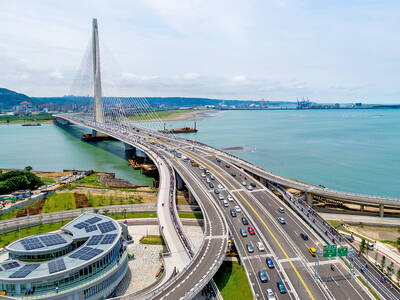
The Ministry of Transportation and Communications yesterday inaugurated the Danjiang Bridge across the Tamsui River in New Taipei City, saying that the structure would be an architectural icon and traffic artery for Taiwan. Feted as a major engineering achievement, the Danjiang Bridge is 920m long, 211m tall at the top of its pylon, and is the longest single-pylon asymmetric cable-stayed bridge in the world, the government’s Web site for the structure said. It was designed by late Iraqi-British architect Zaha Hadid. The structure, with a maximum deck of 70m, accommodates road and light rail traffic, and affords a 200m navigation channel for boats,
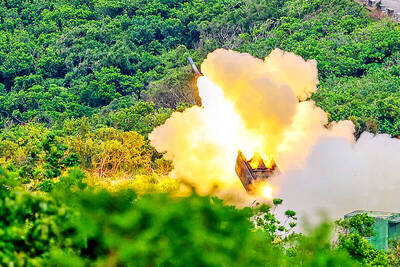
PRECISION STRIKES: The most significant reason to deploy HIMARS to outlying islands is to establish a ‘dead zone’ that the PLA would not dare enter, a source said A High Mobility Artillery Rocket System (HIMARS) would be deployed to Penghu County and Dongyin Island (東引) in Lienchiang County (Matsu) to force the Chinese military to retreat at least 100km from the coastline, a military source said yesterday. Taiwan has been procuring HIMARS and Army Tactical Missile Systems (ATACMS) from the US in batches. Once all batches have been delivered, Taiwan would possess 111 HIMARS units and 504 ATACMS, which have a range of 300km. Considering that “offense is the best defense,” the military plans to forward-deploy the systems to outlying islands such as Penghu and Dongyin so that
Taiwan Semiconductor Manufacturing Co (TSMC, 台積電), the world’s largest foundry service provider, yesterday said that global semiconductor revenue is projected to hit US$1.5 trillion in 2030, after the figure exceeds US$1 trillion this year, as artificial intelligence (AI) demand boosts consumption of token and compute power. “We are still at the beginning of the AI revolution, but we already see a significant impact across the whole semiconductor ecosystem,” TSMC deputy cochief operating officer Kevin Zhang (張曉強) said at the company’s annual technology symposium in Hsinchu City. “It is fair to say that in the past decade, smartphones and other mobile devices were
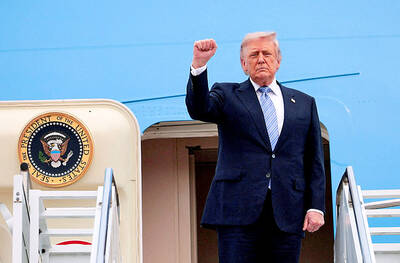
US-CHINA SUMMIT: MOFA welcomed US reassurance of no change in its Taiwan policy; Trump said he did not comment when Xi talked of opposing independence US President Donald Trump yesterday said he has not made a decision on whether to move forward with a major arms package for Taiwan after hearing concerns about it from Chinese President Xi Jinping (習近平). Trump’s comments on Taiwan came as he flew back to Washington after wrapping up critical talks in which both leaders said important progress was made in stabilizing US-China relations even as deep differences persist between the world’s two biggest powers on Iran and Taiwan. “I will make a determination,” Trump said, adding: “I’ll be making decisions. But, you know, I think the last thing we need right


 RSS
RSS